





















Sophia Dasser explains that publishing the names of the seven men accused in Jane Doe’s lawsuit was a way to make the allegations concrete for Cornell students. These were people they might have shared classes with. Her colleague Cereese Qusba describes the Cornell Daily Sun’s reporting as an attempt to provide the transparency she believed the university had withheld. Their interviews give Instadocs: Jane Doe v. Cornell an identifiable decision to examine: student journalists took information about an alleged campus assault into public view, with consequences they had not anticipated.
The editors are useful guides because they can explain that decision from inside the newsroom. Their contribution has a clear purpose and a clear limit. They establish how the case attracted attention and why they considered publication necessary. Their reporting cannot independently settle the allegations. The documentary’s reliance on them works best as an account of information becoming public, particularly when their concern for classmates gives the institutional story an immediate human scale.
Jane Doe alleges that seven men sexually assaulted her at Cornell’s Chi Phi fraternity house in 2024. She reported the incident to campus police, participated in university proceedings, and later filed a civil lawsuit against Cornell, the fraternity, and the accused men. The district attorney declined to bring criminal charges; university proceedings produced disciplinary outcomes including expulsions, suspensions, and a campus ban. The film’s most useful work is to explain how those outcomes can coexist. Police reporting, campus discipline, and civil litigation occupy different tracks, a distinction easily lost when the case circulates as a succession of alarming headlines.
Amanda Walsh, a former university Title IX coordinator who works with sexual-assault survivors, supplies the complication that gives this 35-minute documentary some analytical weight. Her assessment is that Cornell appears to have complied with the applicable Title IX regulations.
That does not resolve the dissatisfaction described by Jane Doe and other students. It changes the question. The film has to consider both the university’s handling of a complaint and the adequacy of the process available to it. Walsh’s contribution interrupts the easier narrative in which every unsatisfactory outcome can be explained by an institution ignoring its own rules.
Former student Kacey Lee gives that distinction a concrete consequence. She describes a separate case in which a finding against her assailant led to sanctions including a written reprimand, disciplinary probation, a no-contact order, and a reflection paper. Her testimony makes the distance between obtaining a finding and receiving a satisfactory response understandable without requiring an abstract lecture.
It also gives the documentary a reason to widen its attention beyond Jane Doe. Lee contributes a specific experience against which the language of institutional accountability can be tested. The weakness is that the film introduces this difficult question about the purpose of sanctions without giving it much room to develop.
Elsewhere, the interviews identify concerns more effectively than they trace decisions. Jane Doe’s attorney, Thomas Giuffra, questions the independence of campus police because they work for the university. He also says Doe believed the investigation remained active and did not know it had been closed.
These are substantial matters, especially the reported failure of communication. Yet the employment relationship establishes a potential conflict; it does not establish how that conflict affected a particular investigative choice. Governor Kathy Hochul adds political weight to concerns about accountability, but the accumulation of authoritative speakers leaves some of the causal work unfinished.
That limitation matters because the documentary’s interview range leans heavily toward those criticizing Cornell’s response. The accused men’s denials are acknowledged, though they do not appear in on-camera interviews. Their absence does not automatically invalidate the account, and equal interview time would offer no guarantee of rigor.
The more useful test is how clearly the film separates allegation, testimony, disciplinary finding, and interpretation. It explains the available processes with welcome economy. Its account of institutional motives needs closer examination of the decisions being challenged. Sympathy for a complainant and scrutiny of the evidence can occupy the same documentary.
The anonymous former fraternity president contributes a sharper argument when discussing Cornell’s restriction of fraternity social events. He acknowledges problems within Greek life, including drinking and weak accountability, then argues that prohibiting events will simply move parties elsewhere.
The objection identifies a mechanism the response may leave untouched. His testimony also complicates the temptation to treat fraternity culture as a complete explanation for failures in reporting or investigation. The film finds a productive connection here between the environment in which harm can occur and the institutions expected to respond. Those remain separate responsibilities.
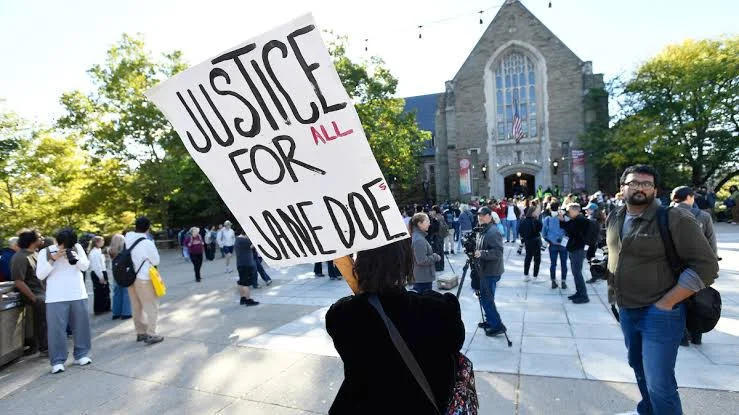
The reported threats, doxxing, and swatting directed at Jane Doe give public attention another consequence. Earlier, the editors describe publication as a means of making information available to their community. The harassment demonstrates the danger that can accompany a complainant’s increased visibility. This is disturbing material, handled without a need to reconstruct the alleged assault graphically.
It also exposes the pressure on the short format: newsroom decisions, disciplinary procedures, fraternity reform, and retaliation each open a substantial line of inquiry. The film keeps them intelligible, but several receive an explanation of their importance before attention moves elsewhere. The independent review of Cornell’s handling of sexual misconduct, reported here as part of the developing response, leaves a specific task outstanding: tracing who made those decisions, what information they used, and what changes would alter the experience of the next student who reports an assault.
Instadocs: Jane Doe v. Cornell premiered globally on Netflix on October 29, 2026. Part of Netflix’s quick-turn documentary series, the film examines a high-profile campus sexual assault lawsuit at Cornell University primarily through the lens of student journalists.
Where to Watch (2026) Online


Full Credits
Title: Instadocs: Jane Doe v. Cornell
Distributor: Netflix
Release date: October 29, 2026
Rating: TV-MA
Running time: 35 minutes
Producers and Executive Producers: Max Gershberg, Amel Guettatfi, Rakhee Jethwa
Cast: Sophia Dasser, Cereese Qusba, Kathy Hochul, Amanda Walsh, Thomas Giuffra, Steve Yaccino
The Review
Instadocs Jane Doe v. Cornell
Instadocs: Jane Doe v. Cornell organizes a difficult case with useful clarity, particularly when Amanda Walsh distinguishes procedural compliance from satisfactory accountability. The student journalists explain how the allegations became public, while Kacey Lee gives the discussion of sanctions a concrete human consequence. Its investigation is less developed: concerns about institutional motives need closer examination, and several substantial questions compete for limited attention. An accessible introduction whose strongest distinctions deserve further development.
PROS
- Clearly distinguishes criminal proceedings from campus discipline.
- Walsh complicates easy assumptions about institutional failure.
- Student journalists explain consequential reporting decisions.
- Lee’s testimony grounds the discussion of sanctions.
CONS
- Institutional motives receive insufficient scrutiny.
- The purpose of disciplinary sanctions remains underexplored.
- Expanding coverage leaves several inquiries thinly developed.