



























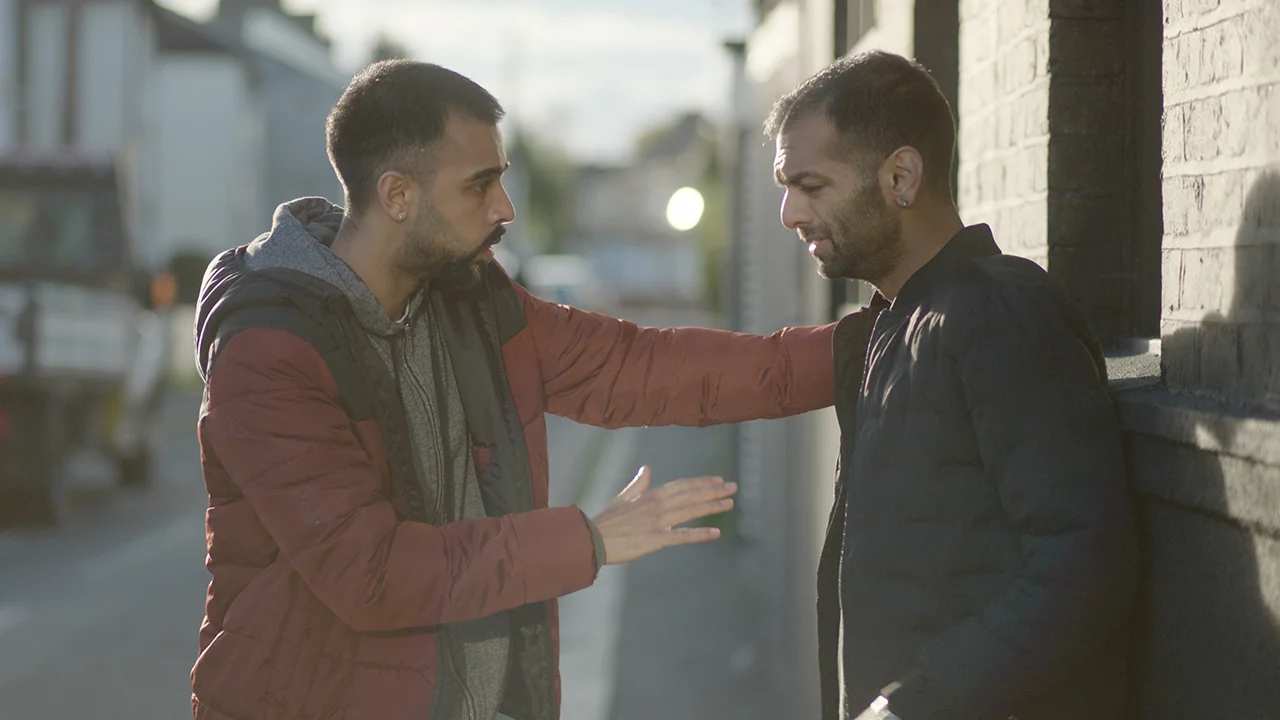

Ravi tells Jay that what he wants most is family. The two friends are smoking and watching planes, briefly allowing their conversation to acquire some emotional weight before joking it away. Neither seems equipped to leave the admission alone long enough to discuss it. Yet the admission has happened. Ravi can retreat into the familiar routine of taking the piss, but he has given his friend information that ought to change how they treat each other.
A job soon gives that desire a practical shape. Working for a building-supplies business means Ravi must wake early and reconsider the usefulness of a hangover. In Jazz Bhalla’s Hounslow-set crime drama Never Had a Chance, the prospect of a different life arrives with an ordinary demand on his time. The morning belongs to someone else now. His evenings with Jay will have to accommodate that, and the adjustment asks something of their friendship that their easy conversation never does.
Amar Chaggar gives Ravi enough warmth to make his attachments understandable without making his judgment look sound. He has a drug conviction, lives in a bedsit, and has become estranged from his mother following his father’s death and her remarriage. His older sister wants him back within the family. The wish expressed beside Jay carries a contradiction: Ravi longs for belonging while keeping his distance from people who might provide it. Grief makes that contradiction legible. It does not conveniently resolve it.
Jay initially looks like evidence that the right household can make life easier. Played by Jayant Singh, he lives with supportive, middle-class parents and possesses the sociability Ravi needs. Their rapport gives the drinking and idle talk an affectionate pull. Then Jay’s gambling and involvement with a dealer’s cocaine expose how little domestic security guarantees. He starts consuming stock entrusted to him for sale. The problem entering Ravi’s life comes attached to someone who already has a place in it.
I initially read Jay as the family Ravi had chosen. I’m less certain that description helps. It grants the friendship a moral authority its conduct has not earned, as though being there for someone automatically made you good for them. Ravi’s new job asks him to change his habits; loyalty to Jay preserves the habits they share. The film makes that friction persuasive because the companionship itself remains pleasurable. Refusing Jay would mean losing something Ravi values, even when staying beside him threatens things he wants.
Bhalla understands the attractions of this male social world. Pool games, social-club conversations, and affectionate insults give the men a way to spend time together without specifying what the time is for. Chaggar and Singh make the movement between intimacy and evasion feel familiar. A serious conversation is possible, provided everyone agrees to pretend it was an accident.

The British-Punjabi setting gains substance through these everyday interactions. People work, flirt, disappoint their relatives, and make stupid decisions without having to explain their cultural existence to an outsider. Punjabi hip-hop, grime, and dub place the film within a shared contemporary musical environment. The community contains differences that matter to the drama: Ravi’s isolation, Jay’s comfortable home, and the restrictions facing Sukhi cannot be folded into one account of disadvantage. Their proximity makes those differences harder to ignore.
Sukhi, played by Tina Sharma, is particularly important because she has her own reasons to want a different life. Working at a fast-food outlet, she is ambitious and wants distance from an alcoholic father and a brother involved in drug dealing. In her confrontation with her father, Sharma gives fear and anger room to coexist. Seeking freedom means challenging someone whose authority still has force over her. Her indignation does not dissolve the difficulty of doing it.
Ravi’s interest in her brings hope, but the relationship also exposes a selfish possibility within his wish for family. He can imagine Sukhi as part of a safer future while allowing Jay’s trouble to approach her present. She already lives with the consequences of another man’s involvement in drugs. That fact changes the moral weight of Ravi’s loyalty: the risks he accepts cannot remain his private business once he asks someone else to build a life with him.
The screenplay becomes less convincing as it gathers these pressures into its later escalation. Jay’s gambling, the cocaine he cannot responsibly manage, Ravi’s fragile family repair, and the developing romance all begin serving the same tightening plot. The increased urgency works. There is enough affection invested in these people for danger to hurt. But the concentration also makes the construction conspicuous. Each possible source of stability becomes another relationship available for the criminal storyline to threaten.
Predictability alone would be a minor objection. We hardly need surprising news about the wisdom of mishandling a dealer’s stock. The deeper limitation is that the plot starts deciding how much possibility the characters are allowed to possess. Ravi’s work has already established that change can take the form of an inconvenient daily commitment. His improving family contact suggests that estrangement can be altered. Those openings deserve dramatic weight beyond increasing what he stands to lose.
The title’s fatalism sits awkwardly beside such evidence. It risks granting the men an excuse that their circumstances only partly support. Sukhi’s position makes that especially difficult to accept. Her conversation with her father establishes how much effort it takes to claim a little control over her life. As Ravi’s obligations to Jay reach into their relationship, she faces another restriction she has had no part in choosing. Her hope of independence now depends partly on a friendship whose members can barely discuss what they need from each other.
Never Had a Chance released in UK cinemas on August 14, 2026, following its debut at the UK Asian Film Festival. Directed by Jazz Bhalla, the gritty British Asian drama follows a young man in West London attempting to rebuild his life while the shadows of his criminal past threaten his future.
Full Credits
Title: Never Had a Chance
Distributor: Independent Cinema Release / UK Distribution
Release date: August 14, 2026 (UK Cinemas)
Rating: 18
Running time: 1 hour 42 minutes (102 minutes)
Director: Jazz Bhalla
Writers: Jazz Bhalla, Darren Rapier
Producers and Executive Producers: Jazz Bhalla
Cast: Jayant Singh, Amar Chaggar, Tina Sharma, Bhasker Patel, Raj Singh
The Review
Never Had a Chance
Never Had a Chance understands why Ravi keeps a friendship that threatens the life he wants. Its warmth, British-Punjabi social detail, and Sukhi’s struggle for independence give the crime story genuine human stakes. I’m less persuaded by its fatalism: Ravi finds work and begins repairing family ties, yet the plot treats these possibilities chiefly as things to endanger. Bhalla makes loyalty emotionally credible, then arranges its consequences a little too neatly.
PROS
- Affectionate, credible rapport between Ravi and Jay.
- British-Punjabi setting grounded in everyday relationships.
- Sukhi’s independence gives the romance moral weight.
- Later escalation retains emotional urgency.
CONS
- Criminal pressures converge too conspicuously.
- Fatalistic framing understates the alternatives Ravi has.