






















Celeste’s guardian applauds her graduation loudly enough to annoy the people around it. Metal hands are poorly suited to polite celebration, and the disapproving looks make a small public embarrassment out of its pride. Celeste laughs. In that exchange, Space Cadet lets us recognize a relationship before explaining its history. She knows this noisy, awkward robot. Its enthusiasm belongs at her graduation, and her amusement gives us permission to enjoy the clatter without treating the guardian itself as the joke.
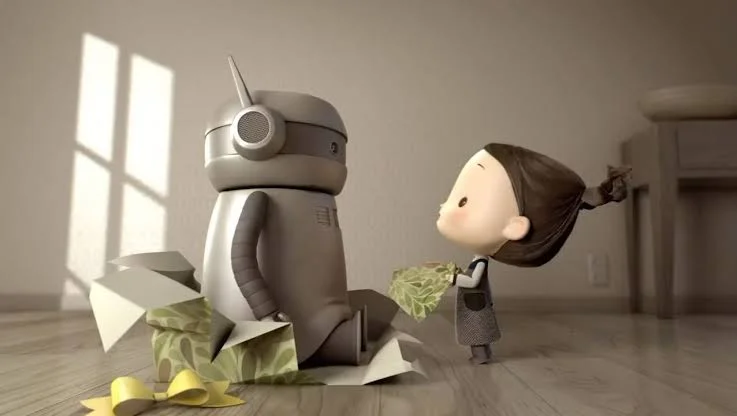
Their origami games extend that familiarity into something pleasantly ordinary. At a diner, making folded creatures together gives Celeste and the Guardianbot a way to enjoy each other’s company without a conversation. Kid Koala’s animated feature has no spoken dialogue, so these activities carry the work an affectionate exchange might do elsewhere. Celeste’s attention also reaches beyond their established rituals: when the robot takes an interest in painting supplies, she notices and arranges a gift. We get to watch someone who has been cared for recognize what her caregiver might want for itself.
That matters because Celeste is preparing to leave. Raised by this first-generation Guardianbot after her astronaut mother, Stella, disappeared during a space mission, she has followed the same profession into a six-month assignment to the Luminel System. Her excitement carries a history the robot cannot comfortably ignore. Earlier, she leaves a flower at the monument bearing Stella’s name.
The guardian has already helped a child live with someone’s absence; now it must support that child’s decision to go somewhere it cannot follow. Celeste’s achievement gives their separation an awkward emotional honesty. Staying together would mean giving up something the robot helped her reach.
Adapted from Koala’s 2011 graphic novel, the film builds much of its intimacy through recollection. Photographs and the guardian’s stored memories bring Celeste’s childhood into the present, including the telescope it gave her for her tenth birthday. That gift makes its support for her curiosity concrete. The space explorer was once a child being encouraged to look up. As the robot revisits these experiences in a home emptied of its daily responsibilities, the memories also become activities in themselves, something to do with hours previously organized around another person.
The threat of a memory wipe changes our relationship to those scenes. A repair could keep the aging machine functioning while erasing the experiences through which we have come to know it. Suddenly, the remembered birthday has a precarious existence inside the story. We have already felt the guardian’s attachment, so the prospect of deletion needs little explanation. Its reluctance to accept the fix follows naturally from the pleasure of remembering. The difficult part is that the machine’s need for maintenance remains real, however much we want it to keep everything.
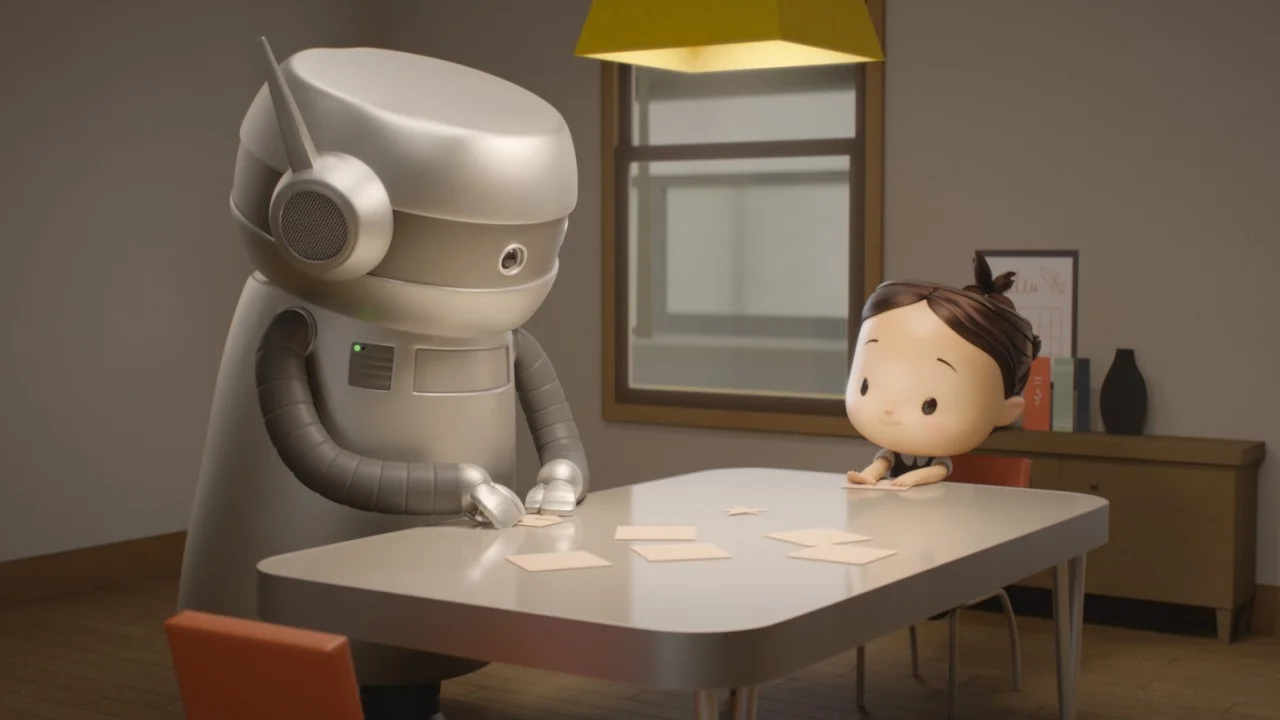
Painting gives that anxiety a physical activity. Celeste’s present initially seems like a thoughtful answer to boredom, but the robot’s attempts to put its world on canvas acquire urgency beside its failing storage. It can make something outside itself.
The frustration of an unsatisfying painting keeps this from feeling like an easy solution, too. Having the supplies does not immediately give it a new purpose or an adequate expression of what it remembers. The film allows a hobby to be awkward and necessary at once, which makes the guardian’s efforts easy to care about.
Celeste has her own encounters with the need for company. Collecting samples on an alien planet, she finds a plant that mirrors her movements. The pleasure comes from getting a response: an unfamiliar living thing briefly makes her solitary exploration feel shared. The film’s rounded, toy-like appearance suits these readable physical exchanges. Just as the graduation applause needs no explanatory speech, the plant’s imitation can establish a little connection through movement alone. Celeste remains curious in a place where she has nobody familiar to turn toward, and that responsiveness gives her experience some welcome playfulness.
Her expedition is less consistently absorbing than the guardian’s time at home. Jellyfish-like creatures threatening the ship’s power supply introduce a recognizable survival problem, but its immediate danger feels less personal than the machine’s possible loss of memory. Stella’s disappearance gives Celeste’s predicament emotional weight, yet the creatures’ interference is less revealing about her than the robot’s resistance to repair is about it.
Sound helps connect these separate experiences. “Fly Me to the Moon” returns through memories associated with Stella and the guardian, letting recognition carry affection across different periods of Celeste’s life. The familiar song has the accumulated associations of something heard together. Alongside her mother’s notebook, which preserves observations from space, it gives remembered experience a place in her present curiosity. Looking back can involve listening for something useful in an unfamiliar situation.
Back on Earth, a persistent neighborhood cat keeps interrupting the guardian’s solitude. These encounters allow the robot’s personality to surface outside its devotion to Celeste, particularly in the friction between keeping to itself and dealing with an animal that continues to appear. The cat cannot restore its memories or take over the life Celeste has left behind. It does, however, require a response in the present. After so much time spent with the guardian replaying the care it once gave, there is a small, distinct pleasure in watching another creature make a nuisance of itself nearby.
Space Cadet premiered globally at the Berlin International Film Festival before receiving a theatrical release in the United States on November 13, 2026, via Viva Pictures. Directed and scored by Kid Koala based on his graphic novel, the dialogue-free animated musical fable follows a guardian robot left behind on Earth when a young astronaut embarks on her first solo mission into space.
Full Credits
Title: Space Cadet
Distributor: Viva Pictures, Sphere Films International
Release date: February 16, 2025 (Berlin International Film Festival), November 13, 2026 (United States)
Running time: 1 hour 26 minutes (86 minutes)
Director: Kid Koala
Writers: Mylène Chollet
Producers and Executive Producers: Ginette Petit, Nathalie Bissonnette, Michel Pradier
Cast: Not applicable (Dialogue-free animated film featuring animated characters)
Editors: Corinne Merrell, Alain Baril
Composer: Kid Koala
The Review
Space Cadet
Space Cadet makes you protective of its robot through clumsy applause, shared origami, and the pleasure of being remembered. Those small attachments make the threat of a memory wipe painful. Celeste’s space peril feels less personal and reveals less about her, but the guardian’s struggle gives this gentle film its emotional pull. Koala finds feeling in the effort of painting a memory or hearing a familiar song, letting affection remain playful even as loss becomes difficult to ignore.
PROS
- Expressive, dialogue-free scenes establish an affectionate bond.
- The memory-wipe dilemma gives technical failure emotional stakes.
- Painting and recurring music deepen the treatment of remembrance.
- Celeste’s thoughtful gift makes the care between them reciprocal.
CONS
- Space jeopardy carries less emotional weight than the guardian’s dilemma.
- The alien conflict offers limited insight into Celeste’s character.