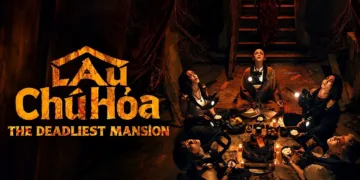
















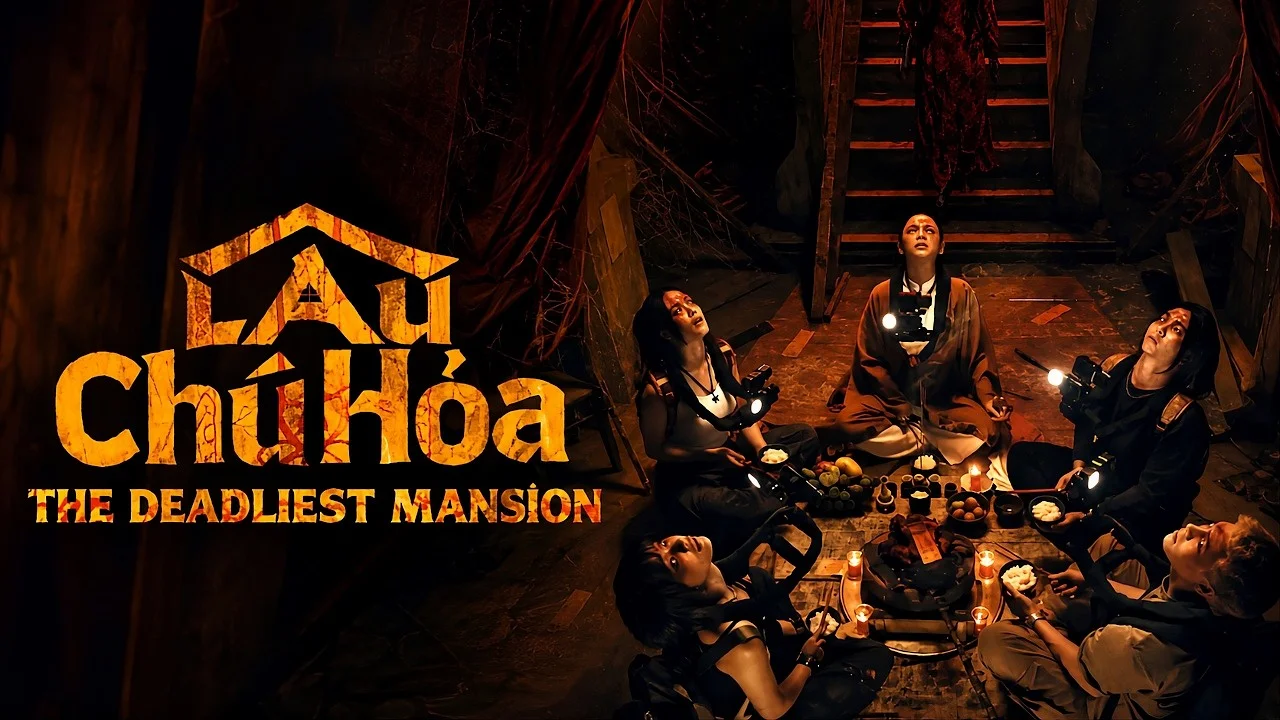

The streamers lying motionless on the floor are putting on a show for the shaman, and the image is unsettling even with its deception exposed. These people know how to arrange something for a camera. They have entered the abandoned Chu Hoa mansion to attract viewers, carrying recording equipment into a place already associated with the Hua family’s ghost. Their staged fright gives Hung Tran’s Lau Chu Hoa: The Deadliest Mansion an effective point of contact between its premise and its audience. We came looking for a scare, too. Knowing someone has prepared one does surprisingly little to protect us.
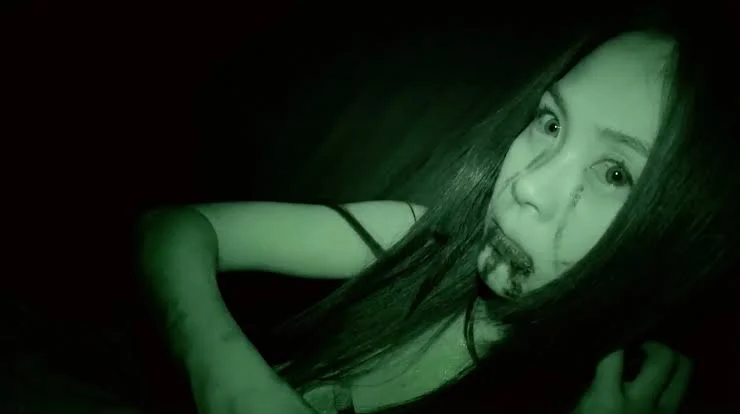
Phung Hoang makes that vulnerability feel personal during Nhan’s encounter with the ghost. The sound recedes, the buildup stretches, and her panic gives the quiet something to press against. There is time to register her fear before the film delivers the shock.
Hoang’s expressions elsewhere can be funny without feeling like a separate comic performance; she has an ease that makes Nhan approachable. Here, that familiarity helps. You want the encounter to release its grip on her, even while wanting the film to keep holding yours. The scene earns its tension through the uncomfortable duration of that divided wish.
Elsewhere, the camera points toward the floor when almost everything in you wants it raised. This is a wonderfully aggravating use of found footage. A conventional horror film can choose its revealing angle; these handheld, fixed, and body-worn viewpoints make looking feel dependent on someone inside the danger.
The frame offers enough information to make you anxious about what it excludes. You start trying to inspect the house on the characters’ behalf, despite having no control over where they look. The equipment brought to capture a spectacle becomes an obstacle to getting a reassuring view.
The mansion gives that searching attention somewhere to settle. Grey-white dust clings to objects, cobwebs occupy neglected spaces, and half-open doors provide incomplete invitations into rooms. Hung Tran keeps the lighting readable enough that watching the image remains an activity, rather than an exercise in guessing what a patch of black might contain.
The interiors have a tactile unpleasantness: they seem like places you would hesitate to touch. That matters because the film spends much of its roughly 92 minutes exploring a threatening space, with little need for a complicated investigation to keep it moving.
A low camera angle makes me want to see something; an edit that skips connective action can leave me unsure what I have missed. Some edits remain on frightened faces while the relevant action stays inaccessible, asking a reaction to carry information it cannot provide. During the scouting passage, Dung’s abrupt, panicked arrival beside Nhan produces that second kind of uncertainty.
His alarm reaches us without sufficient preparation, briefly making the sequence feel assembled around a reaction. The difference matters in a film whose best passages encourage close attention. If a sudden appearance might be a threat, a clue, or simply a missing transition, the spectator’s effort to follow the danger starts competing with the effort to follow the cutting.
The group’s behavior creates a related problem when characters head upstairs individually, leaving the half-conscious Miss Bach downstairs. The immediate objection is practical: why keep reducing the number of people available to help?
It also changes the emotional experience. Instead of sharing their urgent assessment of danger, you begin supplying obvious precautions from your seat. Hoang can make Nhan’s fear credible, but the staging around the ensemble sometimes treats isolation as something to arrange rather than a predicament these people have reached. More personal history would do little to repair that particular lapse.
Once the supernatural presence becomes explicit, the film retains some of its force. A ghost appearing plainly in front of someone can be frightening because visibility offers no useful protection. The pursuit passages exploit that helplessness: seeing the threat does not give the streamers control of the encounter.
The weaker scares hurry past this pressure toward a loud payoff. As quiet passages give way to repeated peaks in volume, the anticipation becomes easier to detach from the people experiencing it. You brace for the next blast, which is a narrower form of involvement than searching a room because someone is still inside it.
The distinction also exposes what remains thin in Miss Hua’s story. The iron chair, the mysterious room, and the opera-troupe lover suggest a haunting with particular attachments. They invite curiosity about the experiences that have left these traces. Yet the film develops their emotional relationships lightly, leaving the ghost’s motives less affecting than her manifestations.
An exhaustive account would risk slowing a film built around immediate fear; a clearer sense of what these details mean to her could have given the encounters a different weight. The lover offers the possibility of loss or longing, but receives too little dramatic development to make either feeling persist alongside the danger. The chair and the room hold our attention as things to fear before we have much chance to understand what anyone has suffered there.
Lau Chu Hoa: The Deadliest Mansion was released in theaters on September 4, 2026, via Mockingbird Pictures. Directed by Hung Tran, the Vietnamese found-footage horror film follows a group of streamers who break into a legendary haunted estate for fame and money, inadvertently provoking the malevolent spirits trapped inside.
Where to Watch Lau Chu Hoa: The Deadliest Mansion (2026) Online
Full Credits
Title: Lau Chu Hoa: The Deadliest Mansion (Lầu Chú Hỏa)
Distributor: Mockingbird Pictures
Release date: September 4, 2026
Running time: 1 hour 34 minutes (94 minutes)
Director: Hung Tran
Writers: Hung Tran
Producers and Executive Producers: RUNUP Vietnam, RUNUP Company, Hive Media Corp
Cast: Ngoc Chi Bao, Dung Ha, Phung Hoang, Tran Ky Anh, Nguyen Cong Nuong, Nguyen Minh Tho
The Review
Lau Chu Hoa: The Deadliest Mansion
Hung Tran makes looking around a room feel risky, and Phung Hoang gives that fear someone to cling to. The dusty interiors and patient silences earn this debut a place on a horror fan’s watchlist. Repetitive blasts, awkward cuts, and contrived separations weaken the spell, while Miss Hua’s history never gains the emotional weight its details suggest. There is enough well-directed anxiety here to make the visit worthwhile, especially when the film lets Nhan’s fear develop before demanding a scream.
PROS
- Restricted viewpoints turn exploration into sustained tension.
- Phung Hoang makes Nhan funny, approachable, and convincingly frightened.
- Dusty interiors and readable lighting reward close attention.
- Patient silence gives the strongest encounters room to develop.
CONS
- Abrupt cuts and withheld action sometimes obscure the danger.
- Contrived group separations strain belief.
- Miss Hua’s motives and relationships remain underdeveloped.