













The Johnny Carson clips preserve a peculiar kind of authority: a man speaking confidently about how much remains unknown. Carl Sagan makes uncertainty sound hospitable. His analogies offer ordinary things, apple pie among them, as points of entry into scales of existence that resist ordinary comprehension.
Nanette Burstein draws heavily on this recorded presence in Carl Sagan: We Are Made of Star Stuff, and the attraction is immediate. Sagan can hold a television audience without pretending that every question has an answer. Watching him, we can see how intellectual humility became a form of charisma.
The images Burstein supplies around that voice have a different relationship to knowledge. Imaginary Forces’ animation, including a flight through the solar system, gives the film an inviting visual fluency. It makes the subject easy to approach.
The probe imagery associated with Mariner, Viking, and Voyager carries another charge: these pictures were obtained by sending instruments into places humanity had never seen at such proximity. An animated passage can organize our idea of space; a transmitted photograph records an encounter with it. Burstein’s brisk treatment leaves little room to investigate that distinction, moving readily from discovery to the next biographical milestone.
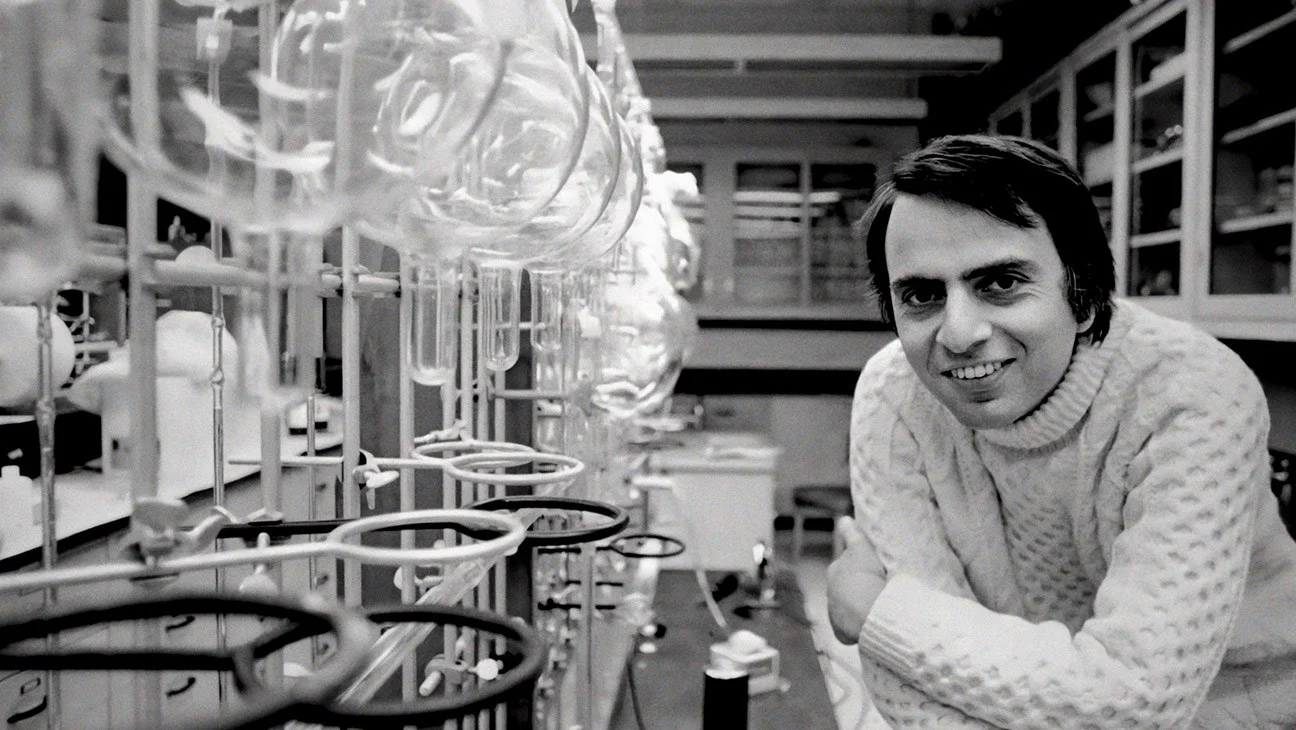
Across 98 minutes, the documentary is better at demonstrating Sagan’s ability to communicate than at explaining the intellectual work behind the communication. Childhood curiosity, academic accomplishment, and public recognition establish a clear route through his life, but the early career survey rarely stays with an idea long enough to examine its construction.
This need not become an astronomy seminar. Still, the ease of the telling sometimes substitutes for the pleasure of understanding. The archival appearances provide the stronger experience because Sagan’s delivery lets us watch him negotiate the distance between expertise and an audience.
That distance becomes a practical problem in the Voyager Golden Record material, the film’s richest account of work. What should an unknown intelligence hear of humanity? Ann Druyan’s recollections bring the selection process into focus: music, voices, whale songs, crickets.
Here, the ambition to represent life on Earth acquires the specificity missing from parts of the career survey. Someone has to decide which sounds belong. Seeking advice from other experts makes the task collaborative, while Druyan’s advocacy for animal and insect sounds expands the imagined portrait beyond human self-description. The record carries decisions about what deserves to be heard.
Druyan also has her brainwaves recorded while concentrating on thoughts about humanity, hoping that a sufficiently capable recipient might interpret them. The gesture is moving precisely because its intended reception remains speculative. The recording preserves an act of concentration; the intelligibility of that act to an alien listener is another matter.
Burstein finds emotional substance in the gap. An immense technological undertaking becomes entangled with the wish that another mind might understand us. Druyan emerges through these choices as an active contributor, with a conception of the project that helps explain the intellectual attraction between her and Sagan.
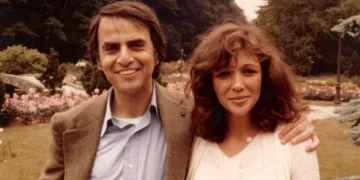
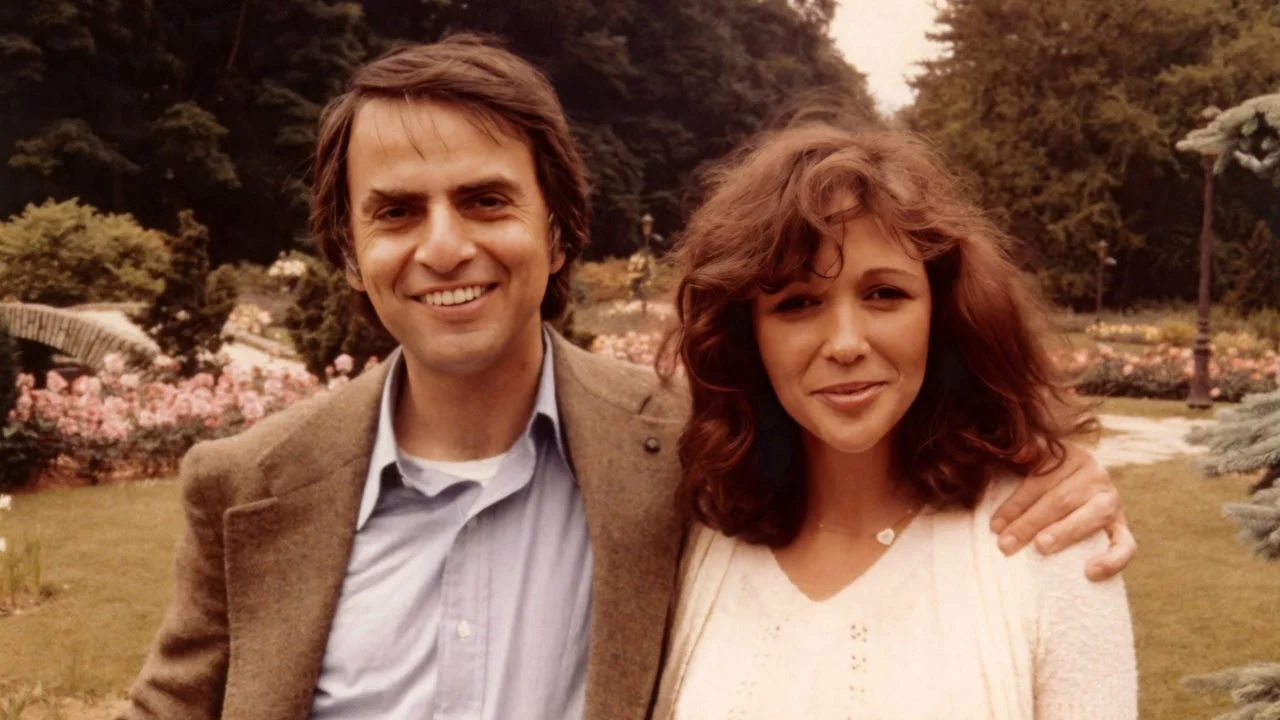
Her memory of meeting him at Nora Ephron’s apartment, while high and struck by his laugh, gives that attraction a disarmingly unceremonious beginning. The film gains momentum as shared decisions and remembered pleasure replace the succession of accomplishments. Their partnership extends into Cosmos and Contact, and the private recordings loosen the public figure’s polish.
Hearing Sagan dictate Cosmos material while apparently under the influence of cannabis offers an amusingly informal view of composition. Druyan credits the drug with improving the work. The recording cannot settle the pharmacology of eloquence, but it does let us hear a celebrated voice still making its sentences.
The romance also exerts a powerful organizing force on the family history. Sagan and Druyan leave existing relationships, and the documentary acknowledges the damage without giving every experience the same development. Jeremy, his son with evolutionary biologist Lynn Margulis, remembers paternal absence. The children of his marriage to Druyan recall an attentive, loving father.
These memories concern different households and periods; there is no obligation to make one invalidate the other. Their coexistence is among the film’s most valuable complications. A man can change, while the people who needed him earlier continue to live with the consequences of his previous behavior.
Nick, Sagan’s son with his second wife, Linda, complicates matters further through his affection for Carl and Ann’s relationship. His generosity belongs to him and deserves to be heard without suspicion. Yet Linda’s experience of the prolonged divorce receives relatively little exploration, while Margulis’s scientific distinction is acknowledged within a story chiefly concerned with the marriage’s failure. The later partnership has shared work, attraction, and a future; the earlier wives receive less room to exist outside their relationship to Sagan. Burstein allows criticism into the portrait, but the film’s romantic momentum gives that criticism a limited place to go.
Druyan’s position as both principal witness and producer helps explain the intimacy of the access, though it cannot establish interference with the account. The stronger concern is visible in the selection itself. We spend enough time with the later marriage to understand why it mattered to the people inside it; we receive less of the earlier partners’ experience on its own terms. Affection produces genuine insight here. It also concentrates attention, making Sagan’s eventual happiness easier to inhabit than the lives unsettled along the way.
The Pale Blue Dot material changes the scale of this question. Earth’s reduction to a tiny point within a vast field makes human dominion look absurdly disproportionate to its physical setting. Sagan reads that smallness as a reason for care, directing attention back toward the lives the image cannot resolve. His voice gives the distant photograph an ethical intimacy. After the children’s differing recollections, that intimacy has a difficult specificity: the people sharing the same small planet can remember the same father very differently, each from a distance he helped determine.
Carl Sagan: We Are Made of Star Stuff premiered at the Telluride Film Festival. Directed by Nanette Burstein, the documentary explores the life, scientific legacy, and public advocacy of the renowned astronomer and science communicator.
Full Credits
Title: Carl Sagan: We Are Made of Star Stuff
Distributor: National Geographic Documentary Films
Release date: September 6, 2026 (Telluride Film Festival)
Running time: 1 hour 38 minutes (98 minutes)
Director: Nanette Burstein
Writers: Nanette Burstein, Tal Ben-David
Producers and Executive Producers: Nanette Burstein, Ann Druyan, Erica Huggins, Seth MacFarlane, Timothy Moran
Cast: Carl Sagan, Ann Druyan, Sasha Sagan, Nick Sagan
Director of Photography (Cinematographer): Adam Beckman
Editors: Tal Ben-David
The Review
Carl Sagan: We Are Made of Star Stuff
Burstein makes Sagan’s charisma palpable, then finds her strongest material where the Golden Record turns cosmic ambition into shared work. The archive preserves a mind reaching toward its audience; the family interviews reveal how unevenly that attention was distributed at home. Scientific explanation remains brisk, and the romance grants earlier partners limited room. An affecting portrait, attentive to the power of Sagan’s voice and less searching about the lives outside its preferred love story.
PROS
- Archival appearances preserve Sagan’s magnetic public presence.
- Golden Record material gives the romance intellectual substance.
- Children’s differing memories complicate the family portrait.
- Private recordings reveal humor and the process of composition.
CONS
- Scientific ideas receive limited sustained explanation.
- Early career survey lacks the later material’s momentum.
- Earlier wives receive limited development beyond their marriages.