




























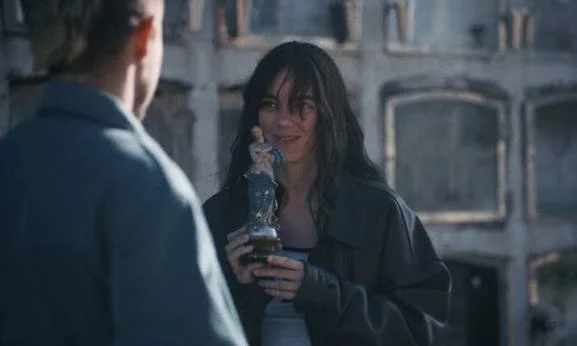

Gloria sends her daughter to the hospital chapel to pray, and Lali steals a saint instead. She has returned to Barcelona to care for her terminally ill mother, but proximity has done little to settle their strained relationship. The chapel gives the daughter something to do with a distress that has no easy outlet at home. Theft is already familiar territory for this gambler and petty criminal. Her mother’s illness has brought new responsibilities into a life accustomed to evading them, and the stolen figure lets her answer a request for devotion through an act she understands.
An antiques dealer supplies the next step: the saint has a market. Mikel Gurrea’s Catalan-language Sants follows that discovery into a criminal enterprise run by Rosario, a former nun whose defense of the business gives sacrilege a social purpose. Churches are losing their congregations, she argues, while selling their contents can help people in the neighborhood. The proposition makes a useful distinction between preserving objects and supporting lives. It leaves another distinction conveniently unsettled: local benefit can coexist with private acquisition by buyers abroad. Religious inheritance becomes a resource whose use is decided by whoever can take possession of it.
Her authority, however, rests on assistance that Lali can feel. Played by Eulàlia Ramon, Rosario has a reputation as a healer and helps both daughter and mother. A treatment ritual involving Gloria combines devotional practice with bodily care, giving Lali access to someone prepared to respond to her helplessness. Gurrea allows that response emotional weight without establishing a miraculous cure. Gratitude has a practical foundation here. Rosario becomes necessary at the precise point when Lali cannot make herself sufficient, and the younger woman’s attachment develops through the help she receives before it becomes a question of criminal loyalty.
Calling the gang a chosen family risks making choice sound simpler than the film permits. Lali enters coordinated work with a command structure, exchanging the freedom of petty theft for the protection and demands of an organization. Rosario’s former vocation remains legible in her capacity to gather people, conduct rituals, and expect obedience. Leaving the convent has given her new uses for familiar authority. The difference between Gloria and Rosario matters: one requires Lali’s care, while the other offers care herself. Yet both relationships organize the daughter’s life around obligations she cannot discharge simply by declaring her independence.
Victoria Luengo keeps Lali’s resistance physical and unruly. Quizzical looks and flashes of contempt interrupt the solemnity surrounding illness and religious objects; the excitement she takes in increasingly audacious thefts prevents necessity from becoming a complete excuse for her behavior. She enjoys this. That pleasure complicates the daughter’s vulnerability without cancelling it. When the group passes through a gymnasium and Lali tries a balance beam, the brief experiment allows her an appetite beyond money, escape, and maternal approval. Her playfulness survives the duties accumulating around her. Luengo makes that survival attractive without turning every impulsive act into evidence of innocence.

The saints themselves receive a heavier, stranger treatment. Julián Elizalde’s dim photography gives cathedral interiors and nocturnal criminal activity a density that resists the thieves’ brisk economic explanations. Laia Serra’s cavernous storeroom, crowded with religious figures, places devotional objects in the condition of inventory while retaining their imposing presence. Their commercial use has changed faster than their appearance can. Gurrea need not endorse their sacred power for the spectacle of their accumulation to feel charged. The figures carry the forms through which people have expressed dependence and hope, even as the gang prepares them for another transaction.
That visual weight comes at a cost during the robberies, where low illumination can make the action difficult to follow. Secrecy becomes an atmosphere shared by criminals and audience, occasionally at the expense of understanding the risk. Valentina Magaletti’s score supplies a sharper sense of pressure through percussion, bell-like sounds, and metallic guitar textures. The devotional associations of the bells acquire an impatient, bodily force alongside the work of stealing. Sound insists on urgency even when the darkness withholds useful information. The tension between those effects helps explain why individual passages can feel alive while the criminal plot develops less insistently.
The larger operation in a cathedral city should concentrate the demands gathering around Lali. Instead, the movement between caregiving and theft leaves some of their connection insufficiently developed. Gloria’s illness gives the criminal activity emotional pressure, but the heist does not consistently deepen the mother-daughter conflict in return. Rosario’s enterprise has a related weakness. The buyers and the onward trade remain distant, leaving her claim to redistribute neglected wealth less rigorously tested than her command over the gang. Detailed trafficking logistics would add little on their own; the missing pressure concerns the beneficiaries of the business she calls socially useful.
Lali’s challenge to Rosario acquires force when obedience begins to conflict with responsibility toward fellow thieves. Here the criminal plot gives the idea of family a necessary difficulty. Protection depends on people being prepared to act for one another, including when a leader’s rules make that inconvenient. Lali’s rebelliousness, so often a means of avoiding claims on her, can also make her answer a claim that the hierarchy would prefer to control. Her resistance remains entangled with the help Rosario has given Gloria, leaving the daughter’s responsibility to her mother inside a dispute over how the thieves treat one another.
Sants premiered at the 74th San Sebastián International Film Festival on September 24, 2026. Directed by Mikel Gurrea, the Spanish-Italian drama follows a woman who returns to Barcelona to care for her dying mother and becomes involved with a clandestine band of thieves who steal religious statues.
Full Credits
Title: Sants
Distributor: Elastica Films
Release date: September 24, 2026 (San Sebastián International Film Festival)
Running time: 1 hour 43 minutes (103 minutes)
Director: Mikel Gurrea
Writers: Mikel Gurrea, Fran Kosterlitz
Producers and Executive Producers: Laura Rubirola, Tono Folguera, Giovanni Pompili, Ariadna Dot
Cast: Victoria Luengo, Ariadna Gil, Eulàlia Ramon
Director of Photography (Cinematographer): Julián Elizalde
Editors: Chiara Dainese
Composer: Valentina Magaletti
The Review
Sants
Sants finds its sharpest cultural argument in the obligations attached to generosity. Rosario’s help makes her authority difficult for Lali to refuse, complicating the gang’s promise of belonging. Victoria Luengo’s unruly pleasure in theft and the imposing presence of the stolen saints keep that argument alive in bodies and objects. The heist develops less forcefully, and Rosario’s charitable justification receives insufficient scrutiny. Gurrea is most persuasive where care makes independence costly.
PROS
- Luengo preserves Lali’s vulnerability, defiance, and appetite for theft.
- Rosario’s healing ritual grounds the tension between care and obedience.
- Crowded religious statuary retains its unsettling presence as merchandise.
- Magaletti’s percussion and bell-like sounds give the robberies physical urgency.
CONS
- Low illumination sometimes obscures the criminal action.
- The heist insufficiently develops the mother-daughter conflict.
- Rosario’s redistribution claims receive limited dramatic scrutiny.