
























![Kingdom Hearts Collection [I-III] Review](https://gazettely.com/wp-content/uploads/2026/10/Kingdom-Hearts-Collection-I-III-1-360x180.webp "Kingdom Hearts Collection [I-III] Review: KHII Holds Steady as Newer Entries Fluctuate 37")



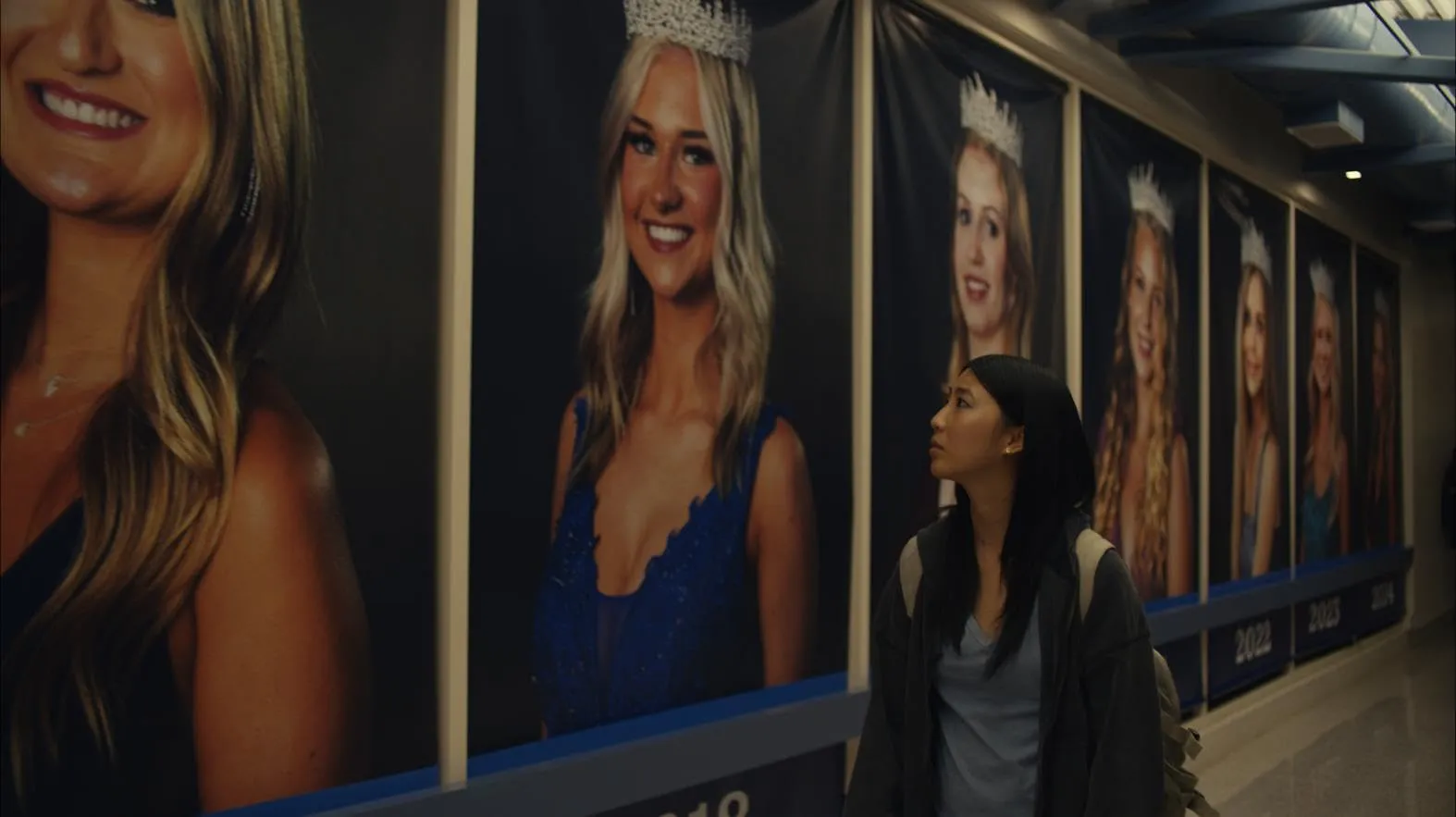

Amy Wang’s debut feature opens on a deceptively familiar scene: a shy Chinese-American girl pinching her nose before a classroom mirror. Set against a hall lined with oversized prom-queen portraits, Slanted mixes high-school comedy rhythms with body-horror jolts to ask a deeply urgent question: How far will someone go to claim acceptance? At its core is Joan Huang, whose longing to be crowned prom queen drives her into the offices of Ethnos—a clandestine clinic promising an “ethnic modification” that transforms her into the blonde, blue-eyed Jo Hunt.
Joan’s journey reflects a timely global trend in films that explore mutable identity, echoing recent South Korean and European titles grappling with digital self-image. Yet there’s a clear parallel with Indian parallel cinema of the 1970s and ’80s, when filmmakers like Shyam Benegal and Govind Nihalani used everyday settings to critique social pressures. Wang borrows that realism—portraying a janitor father’s quiet dignity, a mother’s whispered Chinese prayers—and then shatters it with a clinical sequence bathed in sterile light and echoing surgical clinks.
Visually, Wang contrasts a cramped, almost square aspect ratio during Joan’s early scrambles for belonging with a widescreen frame that blooms once she becomes Jo—only to warp into jagged close-ups as her new face literally peels away. The editing pulses between playful montages of social-media filters and jarring, almost operatic swells in the score, underscoring the film’s tension between façade and flesh. Through these choices, Slanted stakes its claim as a cross-cultural fable: a modern outsider story dressed in the garb of teen comedy, yet carrying the weight of a body-horror cautionary tale.
Mapping Joan’s Journey: From Immigrant Dream to Body-Horror Reality
Amy Wang structures Slanted with surgical precision, tracing Joan Huang’s transformation from hopeful newcomer to tragic subject of her own ambition. The film begins in 2015, when eight-year-old Joan arrives in the American South. We see her wide-eyed at massive billboards featuring blonde models, gym walls plastered with prom-queen portraits, and café signs boasting “Freedom Coffee.” These images echo Bollywood’s use of vibrant set pieces—like the crowded streets in Masaan or the schoolyards in Nauka Car—to establish a character’s cultural collision.
A key moment arrives when Joan follows her custodian father into a prom rehearsal in the gym. As the announcer declares the king and queen embodiments of national ideals, Joan’s aspiring gaze signals her naïve belief that acceptance equals whiteness. Here, Wang channels the coming-of-age honesty found in Indian parallel classics—think Mira Nair’s Salaam Bombay!—where a single scene crystallizes a young protagonist’s fragile dreams.
Fast forward seven years: we meet teenage Joan engaged in a daily ritual of nose-pinching, filter experiments, and the Ethnos app’s pale-skin previews. School corridors become battlegrounds of microaggressions—classmates tug at her eyes, mock her lunches—fueling her internalized shame. Then Ethnos offers a free blonde dye trial, setting up the irreversible makeover that prompts the swap from Shirley Chen to McKenna Grace. This actor change works like the dramatic leaps in Satyajit Ray’s episodic storytelling, underscoring Joan’s leap across an identity divide.
Once she morphs into Jo Hunt, the pace accelerates: instant invitations from Olivia’s clique, Brindha’s shocked betrayal, her parents’ anguished disbelief. The climax erupts as the surgery’s side effects emerge—molting skin, collapsing features—mirroring the physical rebellion of an imposed identity. In the prom’s stark light, Wang leaves us weighing cultural pressures against personal costs, a finale resonant with the moral reckonings of global realist cinema.
Faces of Ambition: Performances That Speak Volumes
At the heart of Slanted is Shirley Chen’s Joan Huang, whose quiet intensity evokes the restrained realism of Shabana Azmi in Mira Nair’s Salaam Bombay! Chen captures Joan’s yearning with subtle gestures—a lowered gaze, restless fingers—revealing a girl hollowed out by exclusion. When she shifts into Jo Hunt, McKenna Grace steps in with a performance that balances awe and mounting terror. Grace’s transition feels less like an actor swap and more like witnessing a single soul fractured by its own choices.
Maitreyi Ramakrishnan as Brindha provides the film’s emotional anchor. In her stand-off with Jo, Ramakrishnan channels the principled courage of a parallel-cinema heroine, refusing to abandon her friend despite betrayal. Her loyalty carries echoes of characters in Govind Nihalani’s work, grounding the story in cultural solidarity.
Amelie Zilber’s Olivia embodies the effortless allure of Hollywood’s popular-girl archetype, but with an edge honed by Zilber’s precise timing—an intersection of global teen-film swagger and Bollywood’s glam sheen.
Vivian Wu and Fang Du as Joan’s parents bring layered authenticity. Wu’s quiet grief and Du’s weary compassion recall veteran Bollywood parental roles that balance pride and heartbreak. Their scenes remind us that assimilation conflicts have resonated in South Asian dramas for decades.
Finally, R. Keith Harris’s Dr. Willie mixes charm with menace, echoing cinematic tricksters from world cinema. His polished delivery unveils the predatory mechanics behind cosmetic promises, turning every reassuring smile into a warning.
Mirror, Masks, and the Price of Belonging
Joan’s transformation echoes stories from Hindi parallel cinema, where protagonists wrestle with cultural dislocation. Like the migrant workers in Bharat Mata, she trades her native rituals for schoolyard acceptance, reluctantly replacing homemade dumplings with cafeteria trays. Her choice to bleach and reshape herself underscores the universal immigrant dilemma: at what cost do we erase our heritage to blend in?
The film casts whiteness as the apex of desirability, much as Bollywood once equated fair skin with virtue. Classmates tug at Joan’s epicanthic folds in a cruel parody of cosmetic enticement, while Ethnos’s surgical promise becomes a grotesque extension of India’s longstanding “fair and lovely” obsession. This body-horror twist exposes how beauty norms can dehumanize.
Ethnos operates like a hyper-targeted Instagram algorithm—sliding into DMs with tailored filters and overnight upgrades. In the same way Panga showed cricketing dreams staged through viral clips, Slanted reveals how online personas can trap us in endless editing loops, craving validation from a faceless audience.
Joan’s parents cling to their mother tongue and bamboo chopsticks, symbols of continuity, even as their daughter discards them for Western cutlery. This tension recalls family dramas such as Dilwale Dulhania Le Jayenge, where traditional values collide with modern desires—only here, the fallout is far more visceral.
Prom queen status stands in for citizenship in the land of promise, exposing brittle foundations beneath the red, white, and blue. The film’s carnival of blow-up portraits lampoons the idea that belonging is earned through superficial conquest.
As skin peels in jagged layers, Joan’s physical unravelling reflects the psychological toll of chasing impossible standards. This visceral metaphor aligns with global titles like South Korea’s I’m a Cyborg, showing that our collective hunger for flawlessness can be our undoing.
Crafting Contrast: Wang’s Directorial Tightrope
Amy Wang stakes her debut on a daring fusion of high-school comedy and visceral body horror, a choice that reflects her own experience navigating cultural duality. She treats the prom sequence like a bright Bollywood dance number gone awry—vibrant, choreographed, yet underscored by sharp camera angles that hint at Joan’s growing unease. In the surgical clinic, sterile lighting and piercing edits turn a makeover into a nightmarish rite of passage.
The screenplay’s humor lands with a blunt edge: Joan’s filter experiments and cafeteria mishaps draw genuine laughs, while the Ethnos pitch carries a sly menace. Yet the middle section sometimes stalls, as Joan’s assimilation scenes stretch without the same narrative propulsion. When the story pivots to the body-horror finale, the writing snaps back, delivering jolting revelations about identity and self-worth.
Wang divides her tale into three clear acts. Act I moves briskly, using flashbacks to young Joan’s first-day jitters to anchor her later choices. Act II settles into the rhythms of teenage social life—text threads, lunchroom cliques—allowing character bonds to deepen but occasionally losing momentum. Act III erupts in graphic crisis, the camera tightening on Joan’s peeling skin in rapid-fire cuts.
Visually, Wang signals Joan’s inner shift by swapping a boxy frame for widescreen once she becomes Jo, then reintroduces claustrophobic close-ups as her new self unravels. These aspect-ratio shifts and childhood flashbacks serve as bookends, reminding us that every transformation carries the weight of origins.
A Kaleidoscope of Surfaces: Visual and Sonic Textures
Wang’s deliberate shift from a narrow, almost claustrophobic aspect ratio to a full widescreen frame mirrors Joan’s fleeting taste of freedom—and then snaps back into close-ups as her new self unravels. This technique recalls the use of frame shifts in recent Indian thrillers like Andhadhun, where boundaries between control and chaos blur through changing lenses.
The production design leans into an exaggerated Americana: stretch of pastel lockers, massive prom portraits that loom like gods, and cotton-candy corridor lights. It’s akin to the technicolor spectacle of a Bollywood dance number—only here the frames feel unnervingly artificial, undercutting the fantasy of fitting in.
During the Ethnos procedure, the camera adopts a hazy, grainy gloss, intercutting static shots of surgical tools with handheld close-ups of Joan’s expression. This instability echoes the handheld realism in Indian parallel films such as Aakrosh, where grit serves to heighten emotional stakes.
Editing plays a vital role in the film’s heartbeat. Quick montages of filter-swipes and Instagram uploads shift abruptly into stark surgical sequences, jolting the audience much like the sudden cuts in Queen’s pivotal moments.
Sound design deepens the unease: each peel of Joan’s skin is met with a wet, squelchy foley that feels both repulsive and intimate. Beneath it all, an unsettling ambient score weaves through school bells and hallway chatter, underscoring how close acceptance and decay can truly lie.
When Prom Dreams Turn Nightmarish
Wang leans into teen-comedy staples—cliques exchanging whispered gossip, filter-fueled selfies, and the quest for prom glory—to lure us into familiar territory. The film’s early acts nod to Mean Girls with precision-edited hallway banter and ritualized cafeteria politics, setting the stage for its deeper critique of popularity culture.
Then comes the body-horror turn: what begins as a gleeful makeover montage morphs into grotesque physical collapse. Joan’s skin peels in stuttering close-ups that recall the visceral shocks of The Substance, yet Wang tempers outright terror with sly humor—one moment, a boastful filter reveal; the next, a wet tearing sound that feels all too real.
These tonal shifts are a high-wire act. Light-hearted scenes of lunch-tray trades and viral dances sit side by side with pulsating, almost surgical cuts. While the abrupt jumps can jar, they echo the rhythms of Indian horror classics like Raat, where sudden scares punctuate everyday family moments.
Moments of gallows humor—Joan swiping through Ethnos promos promising “instant upgrade”—sharpen the dread when her new face begins to sag. By warping the conventions of a coming-of-age story into a cautionary horror tale, Slanted upends audience expectations, transforming a prom-night fantasy into an allegory about self-hatred and the price of fitting in.
Full Credits
Director: Amy Wang
Writer: Amy Wang
Producers: Amy Wang, Mark Ankner, Trevor Wall, Adel “Future” Nur
Executive Producers: Hannah Pillemer, Fernando Szew, Tony Vassiliadis, Ani Kevork
Cast: Shirley Chen, Mckenna Grace, Maitreyi Ramakrishnan, Amelie Zilber, Vivian Wu, Fang Du, Elaine Hendrix, R. Keith Harris
Director of Photography (Cinematographer): Ed Wu
Editor: Ryan Chan
Composer: Shirley Song
The Review
Slanted
Slanted delivers ambitious satire and potent body horror, anchored by strong performances and cultural insight. While its tonal shifts occasionally jar, the film’s probing look at identity and acceptance leaves a lasting impact. Wang’s debut stakes out fresh territory in teen cinema, making for a memorable, unsettling experience.
PROS
- Sharp cultural critique woven into a teen-comedy framework
- Strong lead performances by Shirley Chen and McKenna Grace
- Visually inventive use of aspect ratios and color palettes
- Bold genre blend keeps the viewer off-balance
- Resonant themes of identity and assimilation
CONS
- Mid-section pacing dips during social-integration scenes
- Tonal whiplash can feel uneven for some viewers
- A few plot conveniences require suspension of disbelief
- Occasional underuse of supporting characters







