















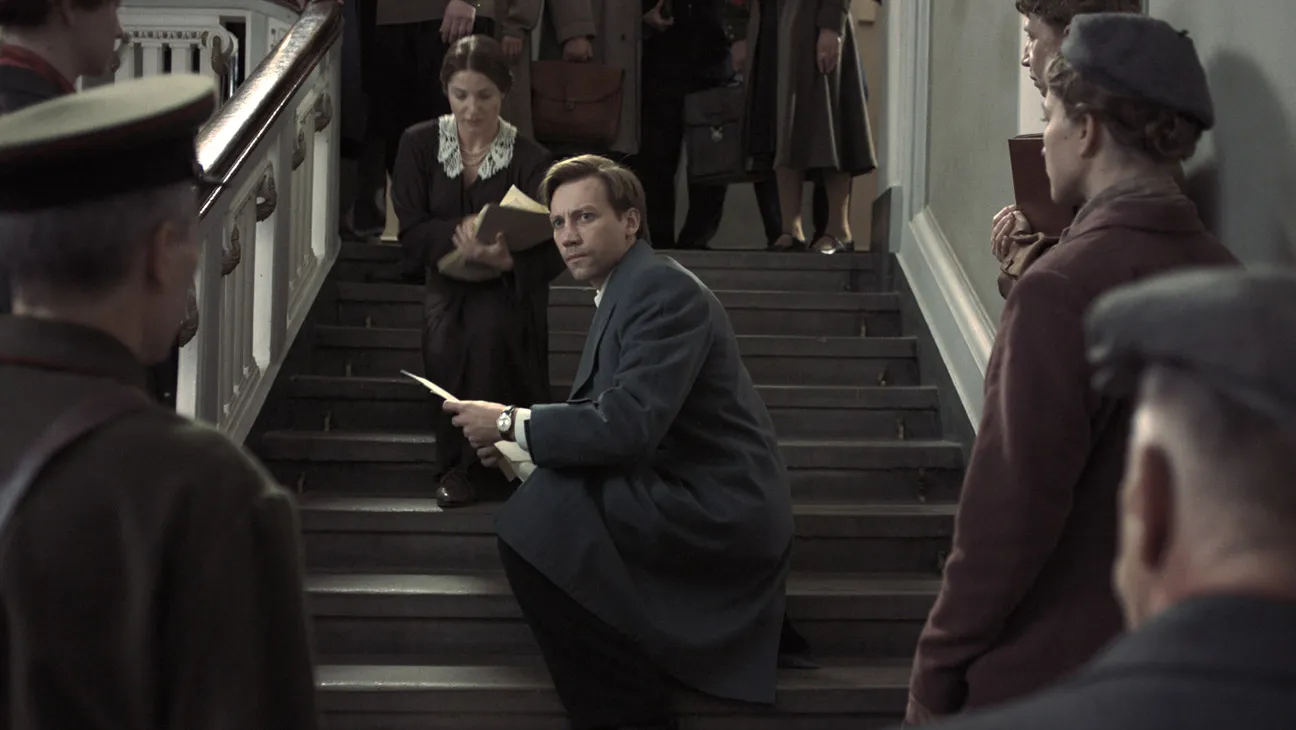

Sergei Loznitsa returns to fiction after a seven-year passage, transporting us to 1937’s Stalin-ruled Soviet Union, where every corridor feels like a cell. The film opens on a frost-bitten prison yard, the gate’s creak as chilling as a verdict. Within those walls, an aging inmate kindles a match to incinerate plea letters, yet rescues one stained with blood. That scrap becomes the spark for young prosecutor Kornyev’s arrival—a man whose faith in lawful process clashes with a system built on terror.
From the first frames, Loznitsa’s austere staging—locked-off camera in an Academy-ratio frame—insists on deliberate stillness. Light falls in rigid rectangles; shadows move like specters. A measured tempo unfolds: moments of waiting stretch into tension, as if silence itself might betray a secret. The atmosphere tightens around Kornyev’s idealism, testing whether belief in justice can survive when faced with the NKVD’s cold machinery.
This review will trace how each image, each pause, draws us into a world where truth becomes contagion, and hope itself risks infection. No outside commentary steers this analysis—here we explore the film’s own moral geometry.
Between Iron Gates and Marble Halls
In 1937’s Soviet Union, the air itself carries the weight of purges that swallow names like dust in a storm. Stalin’s Terror unfolds here as an all-consuming machinery: show trials staged to terrify, the NKVD empowered to rewrite reality with every forced confession. Ordinary citizens—party veterans once seduced by revolutionary promise—now tremble under the same banner they helped hoist.
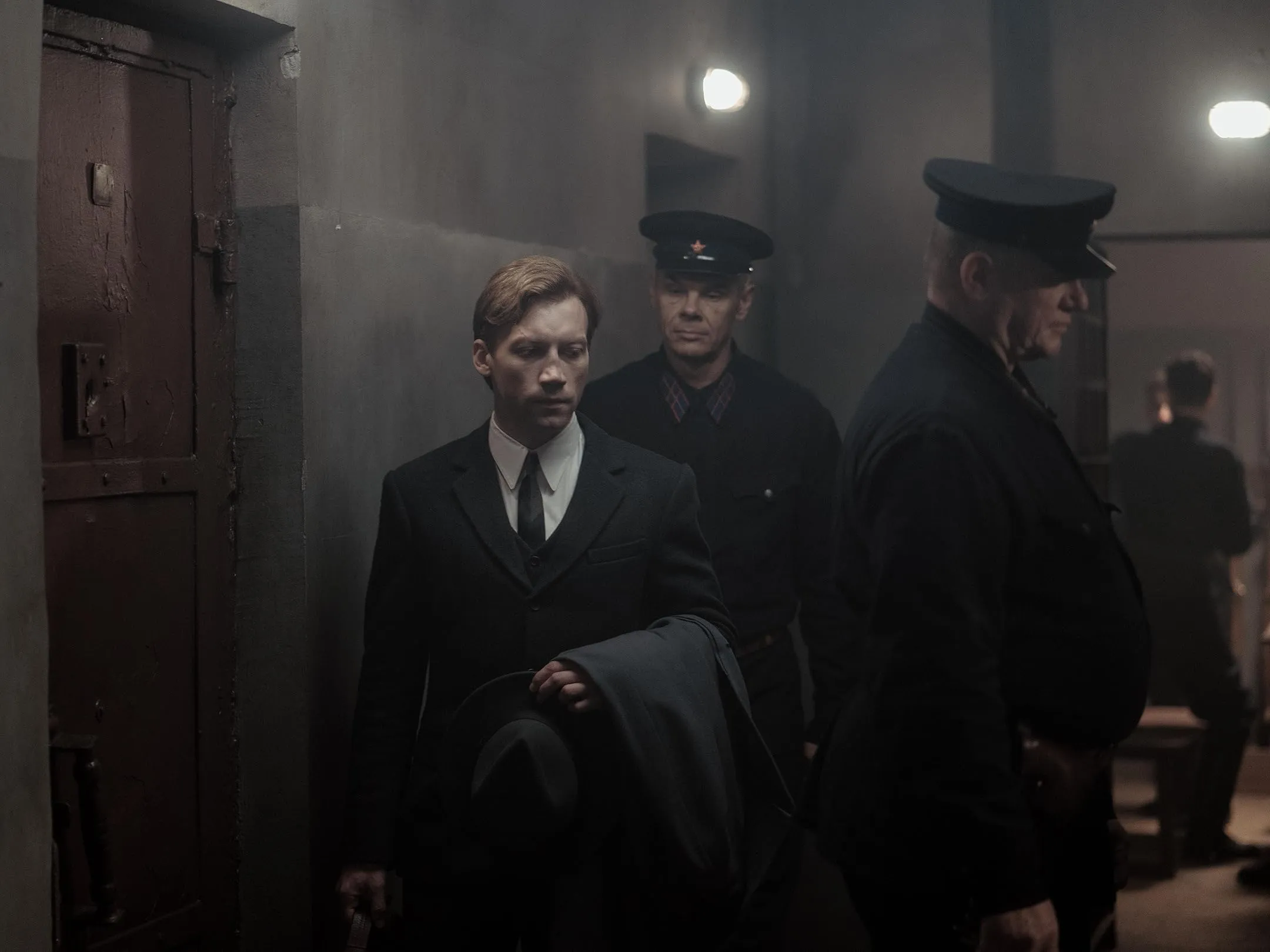
Within the prison’s stone embrace, gates clang shut on any spark of mercy. Courtyards ring with the shuffle of condemned work squads, each man a flicker of life on the brink of erasure. Cells stand in cold symmetry, lit by shafts of unforgiving light. Weathered wooden scaffolding groans like a ghost at every step, reminders that even architecture bows to fear’s ruthless decree.
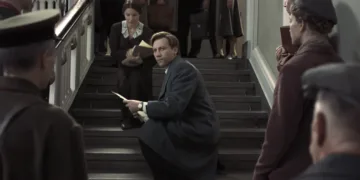
Moscow’s bureaucratic heart beats to a different rhythm. Monumental staircases rise in austere procession beneath portraits of Lenin and Stalin—silent sentinels of power. Hallways widen to swallow dissent, and polished marble floors echo the hollow certainty of Party decree.
Between these worlds, the train becomes a vessel of transformation. Through grimy windows, provincial injustice yields to institutional grandeur. Onboard, a war veteran’s hushed recollections ripple like dark water, and shadowy figures suggest allegiance to unseen masters. That journey across steel rails binds the filament of peripheral suffering to the iron core of authority.
Time’s Silent Accusation
The film’s catalyst arrives in the flicker of a single match: a blood-stained letter spared from an inferno of pleas. That scrap of crimson ink becomes a summons—an invitation to chase truth amid ruins. Its very survival hints at the fragile power of a solitary act against an mechanized state.
As Kornyev presses forward, each corridor stretch and locked door becomes a trial of patience. He sits on unyielding chairs whose count seems to grow with every refusal. A governor’s litany of feigned illnesses echoes like a dark joke. Waiting rooms accumulate tension, their emptiness resonating with the weight of unspoken horrors.
Moments of absurd clarity puncture the monotony. Footsteps trip over themselves in vast chambers. A chair arranged for one too many visitors speaks volumes about institutional folly. These vignettes form a mosaic of Kafkaesque delay, where every polite brush-off conceals a calculated test.
Arrival at Vishinsky’s office unfolds with courtly courtesy. Polished floors mirror a smile that never reaches the eyes. Words flow with the ease of ritual, yet each syllable carries the promise of erasure. In that interchange, Kornyev senses the irrevocable: his dossier inked in invisible blood, his fate sealed by a system that rewards complicity.
The narrative arcs back to the prison gate, the very portal that released our protagonist into disillusionment now looms as a quiet verdict. No final escape awaits—only the echo of steel against stone, suggesting that the wheel turns without end. Long, unmoving takes force us to inhabit each heartbeat of dread. Pauses swell until even silence seems an accusation.
Faces in the Forged Frame
Alexander Kornyev strides into the narrative with the confidence of a freshly minted jurist, his shoulders squared as if bearing the weight of statutes yet untested. In Kuznetsov’s compact frame, the boxer’s jaw becomes a sculpted promise: belief in law as salvation. Each ordered movement—buttoning a coat, adjusting a tie—speaks of ritual faith. But as he navigates sealed chambers, that faith cracks. The silent intensity in his gaze shifts from certainty to a hesitant quest, an internal fissure where hope fractures under the NKVD’s cold architecture.
Opposite him stands Stepniak, a living scar of Soviet betrayal. Filippenko’s gaunt figure evokes a martyr who traded robes for rags, his body a ledger of wounds. When he lifts tattered sleeves, the camera lingers on mottled skin and whispered confessions. His testimony is both evidence and elegy—corporeal proof that ideology can rend flesh and spirit. In Stepniak’s weary resolve, mentorship becomes sacrifice: he guides Kornyev toward truth, even as he embodies the cost of seeing it.
The prison governor and his deputies sculpt delay into weaponry. Their feigned concern for disease slides quickly into bullying bureaucracy. A litany of maladies falls like rote poetry, each name more absurd than the last. Their clipped apologies mask a chilling strategy: inertia as execution, time as torture.
Vishinsky greets Kornyev with polished civility—a jolly handshake against a backdrop of chilling intent. Beliy’s stately bearing recalls the architect of show trials; his smooth words land like weighted stones. That veneer fractures as we glimpse history’s echo: ritual courtesy hiding a ledger of condemnations.
Around them, guards shuffle like blank-etched witnesses, inmates move in silent packs, and on the train, a veteran’s half-spoken tale flickers with uncanny resonance. They orbit the main figures as human collateral, reflections of a system that grinds citizens into mythology of complicity.
Echoes in the Frame and Absence in the Sound
Loznitsa’s choice of the 1.33:1 aspect ratio transforms every shot into a vertical echo chamber. Walls press inward as if alive, their converging lines casting characters into miniature reliefs against monolithic architecture. The locked-off camera maintains a steady gaze, inviting detachment yet demanding witness; we become silent observers of a world that broods in stillness.
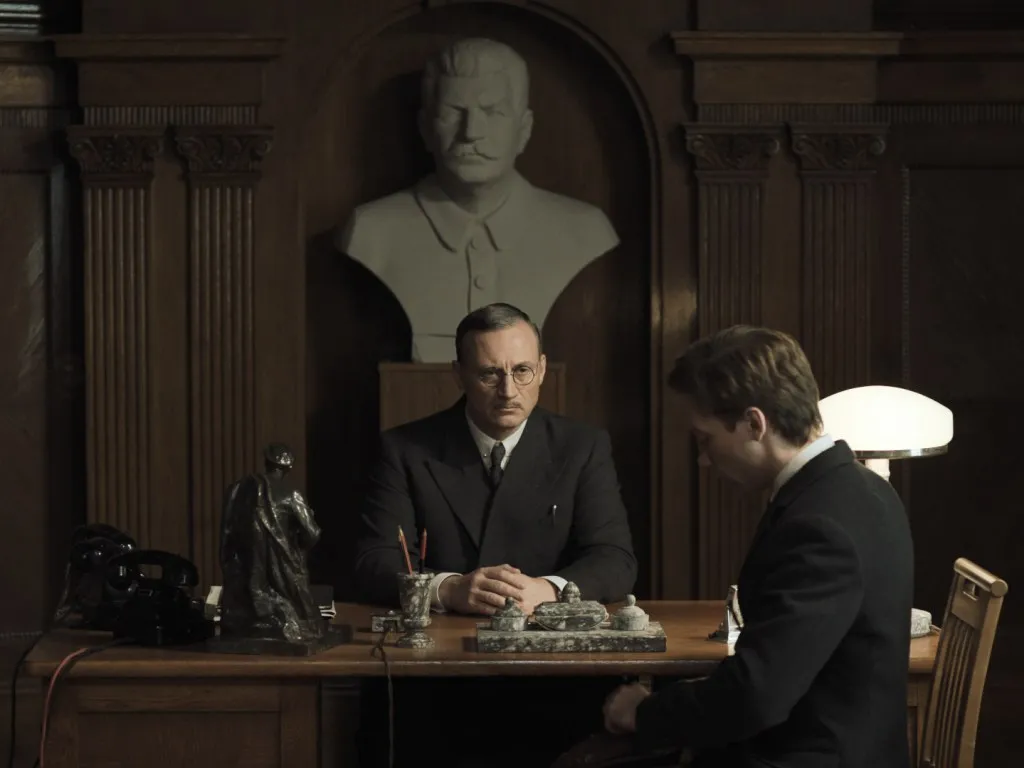
A muted palette reigns throughout: rusted reds bleed into cold grays and stifled browns, crafting a landscape drained of warmth. Within solitary cells, shafts of light carve fractured patterns across fractured lives. These chiaroscuro strokes feel like whispered promises—fleeting glimpses of hope that vanish when darkness shifts.
Production design roots the narrative in lived dread. A lone stove’s chipped enamel, a scaffold’s creaking timber, the coarse metal of prison gates—each prop resonates as testimony. Filming in Riga’s genuine cells and in Moscow’s cavernous halls deepens the sense of systemic rot. The environment itself becomes a character, its textures echoing the film’s moral decay.
Christiaan Verbeek’s score drifts between classical restraint and a Tati-like trumpet that parps with ironic detachment. That single brass flourish rings out, incongruous yet precise, underscoring the absurdity woven into cruelty. Diegetic sounds ground the drama: echoing boots, distant shouts, the soft hum of bureaucracy at work. These layers of noise and silence merge into a contrapuntal rhythm.
Editing shuns the quick cut. Extended takes linger on waiting rooms where time swells until tension crystallizes. Testimony scenes unfold with spare transitions, granting every syllable its full weight. In this space between images and silence, the film asks: what does it mean to bear witness when the world demands forgetfulness?
The Algebra of Oppression
A letter scrawled in blood becomes a cipher for true justice—a stark antithesis to the script of state-enforced guilt. That crimson plea pulses at the film’s core, demanding recognition of a wrong too vast for mere words. Kornyev’s belief in impartial law feels almost mythic, as if he wields the letter like a talisman against despotism. Yet faith here is a doomed currency; every signature, every seal, becomes a stone in the weight that drags him toward disillusionment.
Through corridors of indifference, we witness bureaucracy’s absurd geometry. Waiting rooms repeat like Möbius strips, each exit leading back to another reception desk. Meetings convene in phantom offices where echoes answer questions. Time morphs into a tool of subjugation—patience weaponized against dissent. In that sterile loop, truth itself transmutes into a contagion; knowledge spreads invisibly until the system quarantines any hint of resistance.
A silent poem unfolds in the film’s architecture of walls. The prison gate opens, then closes, mirroring an unending cycle of subjugation. Its iron fingers grip the same threshold through which hope slips away. These frames evoke historical reverberations—modern tyranny hidden beneath familiar rituals. The past and present merge as if both were performed on a single stage.
Kornyev’s initial conviction shatters against Stepniak’s scarred testimony, a testimony that reads like a cautionary fable. In that body, we encounter flesh historiography—each bruise a syllable, each scar an argument against collective amnesia. His story warns that loyalty without scrutiny invites annihilation of conscience.
Yet bleakness carries its own flicker of dark humor. A solitary trumpet parps with Jacques Tati’s mischief, while officials grin in grotesque choreography. Those moments of ironic detachment carve brief hollows in the film’s relentless tension. They remind us that humanity can survive even within machinery built to erode it—if only for an instant.
The Geometry of Control
Loznitsa orchestrates each frame with the precision of a watchmaker. Camera positions rarely shift; when they do, it feels like a deliberate breath in an austere chamber. Actors move along strict axes, their blocking recalling the rigors of stage choreography. Exposition arrives sparingly, each line of dialogue distilled to its fable-like essence.
Yet the screenplay rarely shies from explicitness. Stepniak’s monologues unfold with forensic clarity, laying bare the NKVD’s inner workings. Those moments risk draining dramatic suspense, but Loznitsa compensates by weaving the speech into long, silent takes—so that every word feels both necessary and uncanny.
Adapting Georgy Demidov’s novella, the film remains loyal to its narrative spine while introducing subtle nods to our own era. Key scenes—Kornyev’s first sight of Stepniak’s wounds, the conductor’s farewell on the train—are granted cinematic weight through measured pacing and visual emphasis.
Loznitsa’s tone shifts effortlessly between stark documentary sobriety and surreal absurdism. A bureaucrat’s jocular greeting can morph into a threat without warning. Performances ride that tension: Kuznetsov’s restrained fire, Filippenko’s haunted stillness. Under Loznitsa’s direction, each actor becomes an instrument tuned to the film’s relentless moral frequency.
Aftershocks of Silence
The film’s deliberate pacing coils tension around the viewer’s spine, each stationary shot extending suspense until it becomes almost tactile. We inhabit Kornyev’s anxious stillness and Stepniak’s quiet resignation, forging an empathy that persists long after the screen fades.
In an era where power often masquerades as order, Two Prosecutors feels eerily alive. Its portrayal of institutional cruelty resonates with contemporary anxieties, urging us to question how easily truth can be quarantined. The mechanized rituals here mirror tactics seen in today’s regimes, reminding us that justice proves fragile when vigilance wanes.
Certain images remain etched in the mind: the prison door’s iron arc, the single ember that ignites a letter’s salvation. These visual echoes stir an intellectual restlessness, prompting questions about individual agency under all-encompassing rule.
As shadows lengthen on each frame, we realize the film’s power lies in its refusal to offer easy answers. The haunting absence it leaves behind compels us to consider our own roles in bearing witness—and whether silence might become its own form of complicity.
Full Credits
Director: Sergei Loznitsa
Writers: Sergei Loznitsa (screenplay), Georgy Demidov (original novella)
Producers: Kevin Chneiweiss, Sergei Loznitsa, Maria Chneiweiss, Regina Bouchehri, Gunnar Dedio, Viola Fügen, Alise Ģelze, Uljana Kim, Vlad Rădulescu, Birgit Rasch, Cécile Tollu-Polonowski, Michael Weber
Executive Producer: Carmen Rizac
Cast: Aleksandr Kuznetsov, Aleksandr Filippenko, Anatoliy Beliy, Andris Keišs, Vytautas Kaniušonis
Director of Photography (Cinematographer): Oleg Mutu
Editor: Danielius Kokanauskis
Composer: Christiaan Verbeek
The Review
Two Prosecutors
Two Prosecutors stands as a spare, unforgiving study of dogma’s decay, its measured stillness forging a visceral empathy that outlasts the credits. Loznitsa’s austere vision and commanding performances transform archival wounds into living echoes of systemic cruelty, compelling us to confront justice’s precarious flame. Its deliberate unfolding may test patience, but those who endure will find a work of unsettling power.
PROS
- Unflinching build of suspense through stillness
- Powerful lead performances that carry moral weight
- Meticulous period design amplifies immersion
- Visual compositions that haunt long after viewing
- Soundscape balances silence and sparse score for tension
CONS
- Slow pacing may challenge viewers seeking momentum
- Explicit exposition occasionally strains dramatic subtlety
- Minimal character backstories beyond core trio
- Stark aesthetic can feel unyielding over its runtime