




















![Kingdom Hearts Collection [I-III] Review](https://gazettely.com/wp-content/uploads/2026/10/Kingdom-Hearts-Collection-I-III-1-360x180.webp "Kingdom Hearts Collection [I-III] Review: KHII Holds Steady as Newer Entries Fluctuate 37")



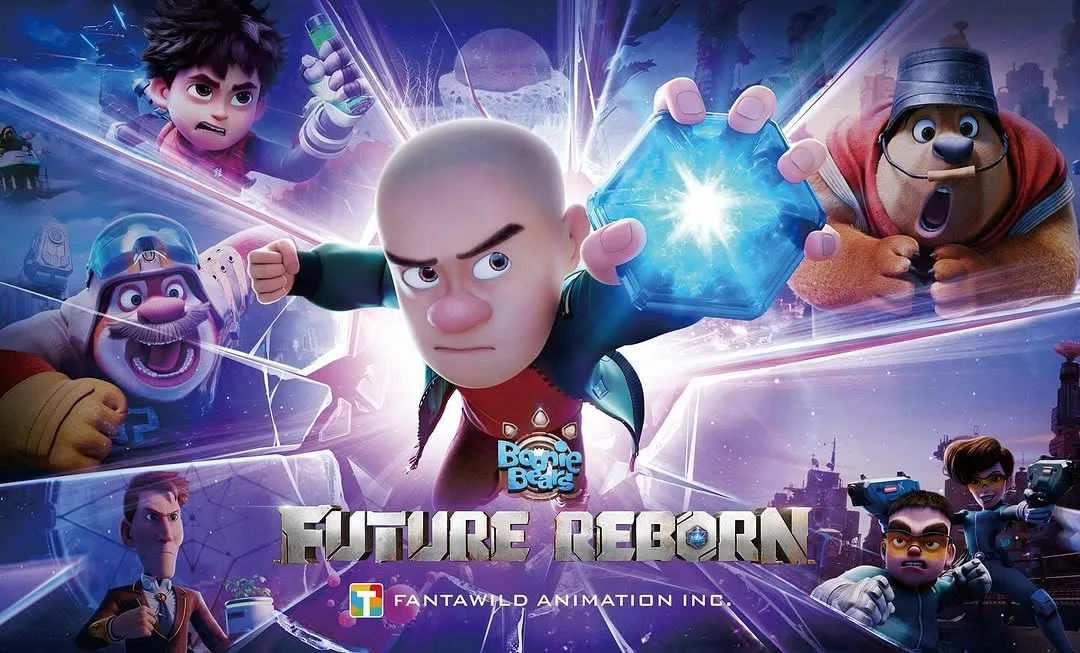

Chinese animation continues its relentless march toward spectacle with Boonie Bears: Future Reborn, the 11th installment in a franchise that has somehow managed to sustain itself through sheer kinetic energy and an almost manic commitment to cramming every conceivable plot device into its runtime.
This latest entry throws temporal mechanics into an already chaotic mix, following the time-traveling Saylor as he hurtles back a century to prevent the fungal apocalypse that has consumed his world. The culprit? Nature guide Vick, whose bumbling tourist excursions accidentally unleash toxic spores that transform Earth into a mycological wasteland dominated by towering mushroom formations that loom like monuments to ecological collapse.
The film wastes no time establishing its apocalyptic credentials, opening with a post-catastrophic prologue before yanking viewers through a wormhole alongside franchise stalwarts Bramble and Briar, the perpetually bickering bears who find themselves reluctant witnesses to humanity’s fungal future. What emerges is a narrative that operates at the intersection of environmental parable and Saturday morning cartoon logic, where the stakes couldn’t be higher and the tone couldn’t be more frenzied. The result is cinema that feels both exhausting and oddly compelling, a testament to the peculiar appeal of animation that refuses to pause for breath.
Visual Spectacle and Plastic Protagonists
The animation reveals a studio grappling with ambitious world-building while constrained by character design that feels curiously lifeless. The environmental artistry deserves recognition—blighted landscapes stretch across frames with genuine visual poetry, their fungal growths creating an alien topography that suggests both beauty and horror.
These spore-laden vistas, painted in sickly pinks and purples, achieve a kind of toxic sublime that elevates the film’s apocalyptic imagery beyond mere cartoon catastrophe. The floating cities and mechanized future settlements display impressive architectural imagination, their cyberpunk aesthetics lending weight to the film’s dystopian vision.
Yet this visual sophistication stumbles when it comes to character modeling. The protagonists appear oddly sanitized, their features rendered with a doll-like quality that strips away the tactile warmth one expects from animated personalities. While the bears’ movements are competently choreographed, they lack the expressive nuance that would make their emotional moments land with genuine impact. The animation team’s priorities become clear in the film’s spectacular action sequences, where mechanical precision takes precedence over character intimacy.
The color palette serves the film’s thematic ambitions well, with the contrast between the natural greens of the present and the sickly hues of the fungal future creating a visual language that speaks to environmental degradation without requiring exposition. When meteor-like spore storms rage across the screen, the animation achieves moments of genuine grandeur, suggesting the scale of ecological collapse while maintaining the cartoon accessibility that defines the franchise.
Narrative Architecture and Hollow Foundations
The film’s structural ambitions exceed its storytelling capabilities, creating a narrative that feels simultaneously overstuffed and undernourished. The time-travel premise offers rich possibilities for exploring causality and consequence, yet the script treats temporal mechanics as mere plot convenience rather than thematic foundation. What begins as a meditation on environmental responsibility quickly devolves into a series of chase sequences and action beats that prioritize momentum over meaning.
Character development suffers under this relentless pacing. While Saylor arrives with the weight of a doomed future on his shoulders, his arc feels perfunctory rather than earned. The franchise’s established characters—Bramble, Briar, and Vick—are relegated to supporting roles in their own story, their familiar dynamics overshadowed by the new character’s mission. This displacement creates a curious disconnect for franchise loyalists while offering little depth for newcomers to grasp.
Mayor Trystan emerges as a villain whose motivations remain frustratingly opaque. His authoritarian control over the future city suggests interesting possibilities for exploring power dynamics in post-apocalyptic societies, yet the film reduces him to a functional antagonist whose schemes feel arbitrary rather than inevitable. The environmental messaging, while admirable in intent, arrives with the subtlety of a sledgehammer, transforming what could be nuanced ecological commentary into sanctimonious lecturing.
The film’s treatment of comedy reveals similar structural issues. Moments of genuine humor—often involving the bears’ physical comedy or absurd situational gags—punctuate the narrative like brief respites from the relentless plot machinery. Yet these comedic interludes feel disconnected from the film’s more serious environmental themes, creating tonal whiplash that undermines both the laughs and the stakes.
The Exhaustion of Endless Energy
Boonie Bears: Future Reborn operates on the assumption that constant motion can substitute for emotional investment, a strategy that yields diminishing returns as the film progresses. The voice acting, while professionally competent, lacks the chemistry necessary to sell the characters’ relationships. The English dub maintains clarity without achieving the kind of personality-driven performance that might elevate the material beyond its functional requirements.
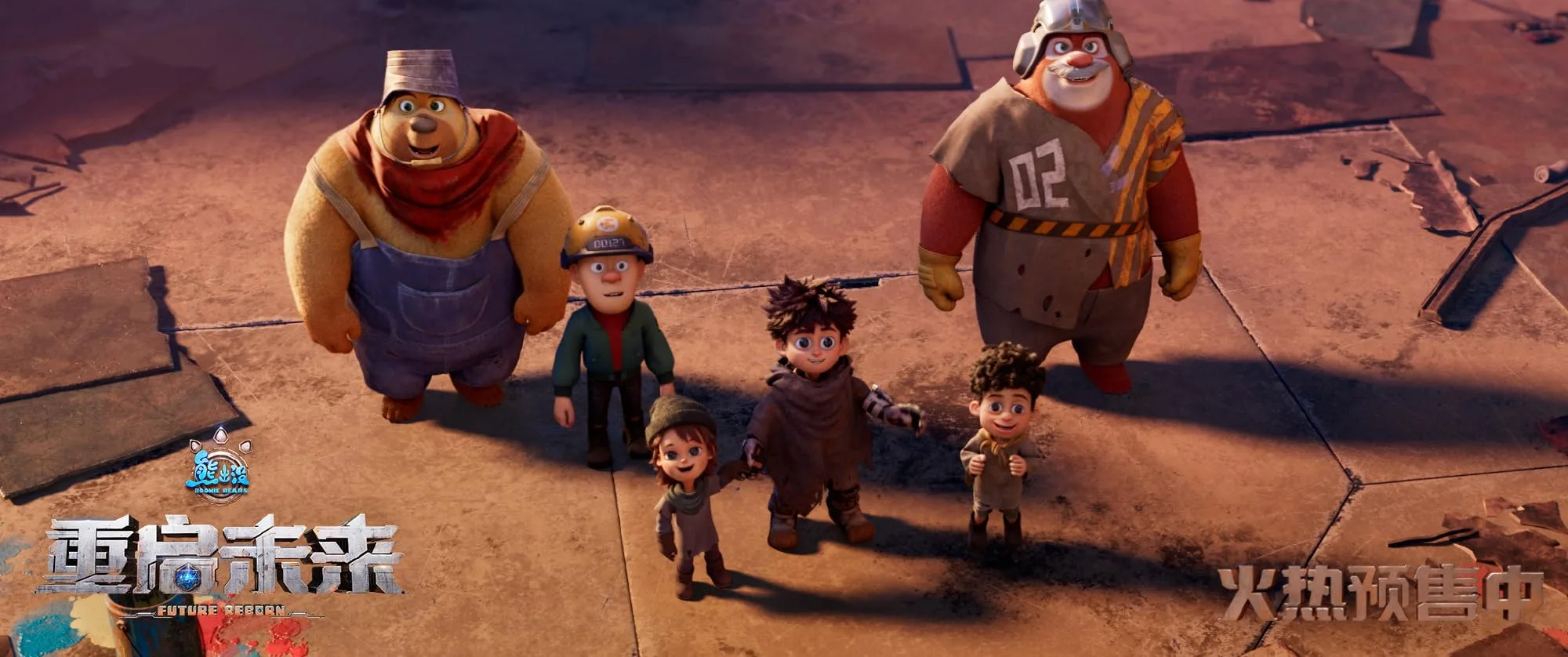
The film’s relentless energy becomes both its greatest asset and its most significant liability. Younger audiences will likely find themselves swept along by the constant stream of visual stimulation and kinetic action, while older viewers may find themselves yearning for moments of genuine quiet that allow the characters’ emotions to breathe. The film functions as a kind of animated sugar rush—intensely satisfying in the moment but leaving little lasting impression once the credits roll.
As a franchise entry, the film succeeds in maintaining the series’ established tone while expanding its scope to accommodate larger themes. Yet this expansion feels more like dilution than evolution, spreading the franchise’s core appeal across a canvas too large to maintain its intimate charm. The environmental message, while timely and important, arrives wrapped in packaging that may undermine its impact through sheer sensory overload.
What emerges is a film that embodies the contradictions of contemporary children’s animation: technically accomplished yet emotionally hollow, visually spectacular yet narratively conventional, environmentally conscious yet aesthetically excessive. It represents animation as pure spectacle, a medium pushed toward its technical limits while losing sight of the human connections that give such spectacle meaning.
Boonie Bears: Future Reborn is a 2025 Chinese animated fantasy comedy film, the eleventh in the Boonie Bears franchise. The film premiered in Beijing on January 22, 2025, and was released in China on January 29, 2025 (Chinese New Year). It was released theatrically in the UK on April 18, 2025. The movie became available digitally in China on Mango TV on May 1, 2025. It was released digitally in the US on Disney+ on July 8, 2025.
Full Credits
Director: Yongchang Lin
Writers: Tiechi Cui, Zhenjie Liu, Rachel Xu
Producer: Shang Linlin
Cast: Chris Boike, Patrick Freeman, Kieran Katarey, Joseph S. Lambert, Christopher Price, Xiao Tan, Ruth Urquhart, Nicola Vincent
The Review
Boonie Bears: Future Reborn
Boonie Bears: Future Reborn succeeds as visual spectacle while failing as meaningful storytelling. The impressive environmental animation and kinetic energy will satisfy younger audiences seeking sensory stimulation, but hollow character development and heavy-handed messaging prevent it from achieving lasting impact. It's competent franchise filmmaking that prioritizes technical achievement over emotional resonance, resulting in an exhausting experience that feels more like animated fast food than substantial entertainment.
PROS
- Impressive environmental and background animation
- Spectacular visual effects in spore storms and action sequences
- Strong cyberpunk-influenced future city designs
- Maintains franchise's energetic tone
- Ambitious scope and world-building
CONS
- Lifeless, doll-like character models
- Heavy-handed environmental messaging
- Underdeveloped villain motivations
- Relentless pacing that exhausts rather than engages
- Hollow character development for franchise favorites