










The post-apocalyptic genre has, for decades, been a canvas for our collective anxieties, a space to game out the collapse we secretly fear is just around the corner. Forgive Us All enters this crowded field not with a bang, but with a low, mournful hum.
Its world is one we recognize: a virus has unspooled civilization, leaving behind the usual assortment of savage cannibals—here called “howlers”—and the desperate, untrusting survivors. The film establishes itself as a bleak neo-Western, a story set on a frontier where the only law is what you can enforce with a rifle.
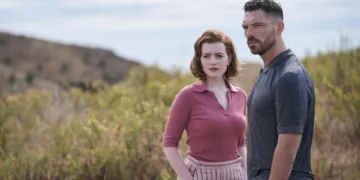
Our guide through this ruin is Rory, a woman entombed in a remote cabin, though her true prison is a paralyzing grief. She is a ghost haunting her own life. Into this stasis walks Noah, a wounded stranger carrying both a dangerous secret and the faint, almost foolish, glimmer of a future. His arrival forces a question that defines every soul in a broken world: is it better to rot away in the safety of one’s own despair, or to risk annihilation for the mere possibility of redemption?
A Sepia-Toned Purgatory
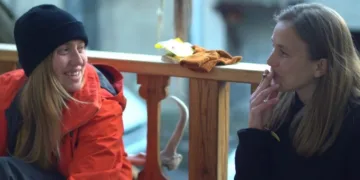
It must be said, this particular apocalypse is breathtakingly rendered. The camera work in Forgive Us All is its most confident and articulate feature. The vast New Zealand landscapes are captured not merely as a backdrop but as an active participant in the story, their severe beauty mirroring the characters’ own isolation. This is a world you can feel—the chill in the air, the grit under your fingernails. The visuals build an atmosphere of profound loneliness that is often more expressive than the script.
Everything is drenched in a deliberate, almost aggressive, yellow hue. This is not the warm glow of nostalgia; it is the jaundiced color of sickness, of dust settling on a world that has stopped turning. It’s a bold stylistic choice that commits to the tone of decay. When violence does erupt, it is staged with a clean competence (which is critic-speak for ‘perfectly fine’).
The makeup on the infected is suitably grim. One climactic action sequence is a masterclass in restraint, prioritizing the terrible dramatic weight of the moment over the mechanics of the violence. It proves the filmmakers understand how to shoot for the heart. Which makes their other choices all the more baffling.
The Doctrine of Narrative Withholding
Forgive Us All positions itself as a character drama, a meditation on guilt and absolution that just happens to have zombies in it. The entire emotional architecture rests on Rory’s shoulders, on her journey from a state of living death toward some form of self-forgiveness. This is a noble ambition.

It is an ambition, sadly, that is fatally undermined by what can only be described as a doctrine of narrative withholding. The film’s most critical flaw is its refusal to show us the very source of its protagonist’s trauma. We are told, repeatedly, about the tragedy that broke Rory.
We see flashbacks that dance around the edges of it. But the defining moments, the images that surely play on a loop in her own mind, are kept from us. This is a profound miscalculation. By denying the audience this access, the film keeps us at an analytical distance, understanding her pain as a concept but never truly feeling it.
This emotional void creates a vacuum that collapses the surrounding characters. Rory’s quiet companion, Otto, is a sketch, his shared past with her a footnote. The antagonists are given a sliver of internal conflict that goes nowhere, reducing them to simple obstacles. They exist only in relation to Rory, yet we are never allowed to get close enough to her for their presence to matter.
A Western in Search of Its Horror
The “howlers” are the film’s biggest tell. They are spoken of as a constant, terrifying threat, yet for most of the runtime, they function as little more than a distant sound effect—less an existential menace and more an inconveniently loud plot device. Their arrival in force during the final act feels less like a natural culmination of dread and more like a screenwriter’s frantic push toward a climax. As a result, the movie fails as a piece of sustained horror.

This identity crisis stems directly from the dramatic failings. Because the emotional core is so guarded, the film’s slow, contemplative pace often feels inert. The quiet moments, which should be filled with simmering tension and character insight, are simply empty.
The abrupt turn from a pensive Western into a full-blown action-horror spectacle in the last twenty minutes is jarring and unearned. It is the move of a film that doesn’t trust its own quiet heart. Forgive Us All is a work of immense visual confidence and thematic potential. It looks and feels like a significant film, but it is ultimately too timid to show us its own scars.
Forgive Us All released theatrically in New Zealand and Australia on May 8, 2025 by Rialto Distribution. The film was released in the United States on July 11, 2025 via video on demand platforms like Amazon Prime Video, Apple TV, and Fandango At Home, distributed by Samuel Goldwyn Films.
Full Credits
Director: Jordana Stott
Writers: Jordana Stott, Lance Giles
Producers: Lance Giles, Jared Connon
Executive Producers: Richard Roxburgh
Cast: Lily Sullivan, Callan Mulvey, Richard Roxburgh, Dean O’Gorman, Bree Peters, Lawrence Makoare, Lance Giles
Director of Photography (Cinematographer): Peter McCaffrey
Editors: Michael J. Horton
Composer: Brandon Roberts
The Review
Forgive Us All
Forgive Us All is a visually masterful but frustratingly hollow experience. It builds a stunning, atmospheric world and demonstrates technical confidence, especially with its breathtaking cinematography. However, the film’s emotional ambitions are crippled by a narrative that stubbornly refuses to show its own heart. By keeping the protagonist's core trauma off-screen, it asks for an emotional investment it never earns. What remains is a beautiful shell; a film that looks and feels profound but ultimately says very little, leaving you to admire the scenery of an empty landscape.
PROS
- Stunning cinematography and use of the New Zealand landscape.
- A strong, consistent, and bleak atmosphere.
- Technically competent direction and effective makeup effects.
- An ambitious central theme of grief and self-forgiveness.
CONS
- Fails to show crucial character-defining moments, creating emotional distance.
- Underdeveloped supporting characters and antagonists.
- The slow pacing feels tedious without a strong emotional core.
- A disjointed blend of genres that feels jarring in the final act.