


















Documentaries about legal battles often fall into a familiar rhythm: a righteous fight, a clear villain, and a climactic courtroom showdown. Sam Feder’s Heightened Scrutiny has all the components of such a story, yet its construction aims for something more profound and unsettling.
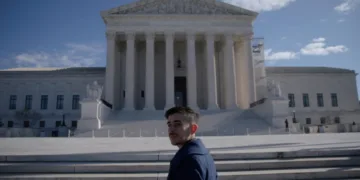
The film centers on ACLU attorney Chase Strangio as he prepares to argue United States v. Skrmetti before the Supreme Court, a case concerning a Tennessee law banning gender-affirming care for minors. On the surface, it is a portrait of a landmark civil rights moment.
Yet the film quickly establishes that the real trial is not the one happening inside the court, but the one playing out in the public square. Feder frames the story not as a simple procedural but as an intimate character study set against a backdrop of immense cultural friction.
The narrative anchor is Strangio, the first transgender lawyer to argue before the highest court, but the story’s scope expands to diagnose the very source of the legal threat he confronts. It captures the tension of a society at a crossroads, where personal identity has become a matter of legal and political warfare.
The Personal is Political
The primary narrative engine of Heightened Scrutiny is its deep commitment to humanizing its subjects, a structural choice that elevates it beyond mere polemic. The film understands that for its legal arguments to land with force, the audience must first connect with the lives at stake.

Also Read





Chase Strangio is presented not as an abstract symbol of a cause but as a meticulously rendered person. The camera follows him through moments of intense professional preparation and disarming domesticity, from poring over legal texts to picking out an outfit or fawning over his cat.
These scenes are not filler; they are a deliberate storytelling strategy to build a powerful empathetic bond. By showing the quiet, almost mundane reality of the man whose very existence is being debated on a national stage, the film disarms an audience’s preconceptions.
This narrative technique extends to the film’s other subjects. Parents of trans children, activists like Elliot Page and Laverne Cox, and journalists are not treated as talking heads deployed for a quick soundbite. Feder gives each voice the space to become a fully-formed character with a small but resonant arc.
We witness a father’s emotional testimony, his voice breaking not with political fervor but with simple paternal love and fear. We see the quiet confidence of a 12-year-old girl named Mila living her life. Their stories translate abstract legal principles into tangible, undeniable human stakes.
An Indictment of the Fourth Estate
After establishing its emotional foundation, the documentary pivots to its most incisive and damning argument, constructed with the precision of a legal brief. Heightened Scrutiny methodically builds a case against the American media, not just the usual conservative suspects, but the very mainstream institutions that position themselves as objective arbiters of truth.

The film holds publications like The New York Times and The Atlantic accountable, exposing how their persistent “just asking questions” approach to transgender lives has manufactured a climate of doubt and fear that serves as political kindling. This critique is the film’s boldest move, as it refuses to attack an easy target and instead examines the institutional failures of its own side.
Feder presents evidence with a prosecutor’s clarity, drawing a direct and damning line from the specific phrasing in supposedly thoughtful opinion pieces to the exact rhetoric used by politicians seeking to strip away rights. The editing is key, visually juxtaposing a newspaper headline with a clip of a lawmaker on the floor of a statehouse, making the transmission of language undeniable.
By intercutting these analyses with chilling footage from political rallies where the quiet dog whistles of print become explicit calls for eradication, the film reveals a devastating feedback loop. It is a potent and rigorously argued piece of media criticism that exposes how journalistic norms, when applied without care, can become inadvertent tools for political persecution.
A Deliberate Form for an Urgent Message
On a purely formal level, Heightened Scrutiny employs a conventional documentary toolkit: sit-down interviews, archival footage, and explanatory graphics. Yet there is nothing commonplace about its execution. The film’s straightforward style feels less like a limitation and more like a deliberate choice, a sturdy and reliable vessel built to carry a heavy and complex argument.

A more experimental or flashy aesthetic might have distracted from the necessary clarity of the film’s thesis. Its sobriety and meticulousness are part of its persuasive power; it adopts the language of reason and evidence to dismantle arguments that are often emotional and unfounded. This structural integrity is critical to the film’s purpose, which extends far beyond the screen.
Released in the precarious window between the Supreme Court’s oral arguments and its impending decision, the film is not a retrospective. It is a calculated and urgent intervention into an ongoing national conversation, designed to educate and persuade in real time.
Its final scenes move from righteous anger toward a determined resolve, perfectly captured in the image of Strangio getting a tattoo of a Pauli Murray poem. This closing act is a brilliant narrative choice, ending not on a note of despair but on one of historical continuity and profound self-affirmation, suggesting that true hope lies not in the hands of nine justices, but in the resilience of a community fighting for its own future.
Full Credits
Director: Sam Feder
Producers: Amy Scholder, Paola Mendoza, Sam Feder
Executive Producers: Laverne Cox, S. Mona Sinha, Bill Harnisch, Ruth Ann Harnisch, Lisa Freeman, Sara Hinkle, Charlotte Cook, Andrew Kim
Cast: Gina Chua, Jelani Cobb, Lydia Polgreen, Chase Strangio
The Review
Heightened Scrutiny
Heightened Scrutiny is an essential documentary that succeeds by being both intellectually rigorous and deeply human. It meticulously unpacks the connection between media rhetoric and anti-trans legislation while grounding its powerful arguments in the compelling, personal stories of its subjects. Far more than a simple legal drama, it is a timely, expertly constructed, and vital piece of media criticism that demands to be seen.
PROS
- A deeply humanizing and multifaceted portrayal of its central subject, Chase Strangio, and other community members.
- Presents a meticulous and damning argument that traces anti-trans rhetoric directly back to mainstream media sources.
- The intelligent structure builds its case with both emotional weight and intellectual precision.
- Functions as a timely and urgent work of advocacy released at a critical political moment.
CONS
- Its conventional documentary style, while effective, may not engage viewers looking for a more innovative or experimental cinematic form.