



























The documentary A Star Without a Star: The Untold Juanita Moore Story presents itself as a campaign film, an argument for a piece of terrestrial brass and terrazzo on a famous sidewalk. Its subject is Juanita Moore, an actress of formidable power whose 1959 Academy Award nomination for Imitation of Life should have secured her place in the firmament. Instead, her legacy is a case study in what we might call institutional forgetting.
The film uses the quest for a posthumous star on the Hollywood Walk of Fame as its narrative engine. But that public crusade is merely the glossy invitation to a far more complex and somber exhibition. This is not a film about a star; it is a film about the architecture of the sky that prevented certain lights from being seen. It asks us to look past the pavement and consider the machinery that polishes some names while letting others tarnish.
A Career in Counterpoint
The film sketches a life of profound artistic dissonance, a career spent navigating contradictions that would have broken a lesser spirit. We see Juanita Moore’s beginnings as a dancer at the Cotton Club, that peculiar crucible of the Harlem Renaissance where Black genius was put on spectacular display for an exclusively white audience.
This context is vital; she was trained from the start to perform within a system of carefully circumscribed admiration. Her subsequent escape to the stages of 1930s Paris, performing at the London Palladium and Moulin Rouge, is therefore depicted as less of a career move and more of a spiritual exhale.
In Europe, she experienced a startling sense of personal liberty, a freedom from the oppressive racial calculus that defined her existence back home. This Parisian interlude is presented not as a flight of fancy but as a moment of genuine self-possession, making her eventual return to the United States feel all the more claustrophobic and artistically stifling.
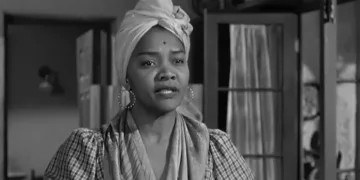
Back in Hollywood, she was an artist in a system that had no vocabulary for her. She took bit parts, often uncredited, a face in the crowd or a fleeting presence in early “soundies.” Then came her monumental turn as Annie Johnson in Douglas Sirk’s luridly effective melodrama Imitation of Life.
The performance is a masterclass in quiet suffering and luminous dignity, earning her an Oscar nomination that felt like a promise. It’s a performance that transcends the genre’s occasionally soapy tendencies, grounding the film’s high emotions in a bedrock of authentic human pain. It was a promise the industry promptly broke.
The documentary details with painful clarity how the nomination led not to substantive roles but to a regression. She was once again offered the same tray carrying parts she had worked so diligently to transcend. Through archival interviews, Moore recounts this professional heartbreak with a quiet resilience that is more damning than any tirade could be. Her grace becomes the film’s sharpest weapon, illustrating the immense psychological fortitude required to maintain one’s dignity when the industry that just celebrated you refuses to truly see you.
The Industry as Microcosm
This documentary succeeds by refusing to isolate Moore’s story, instead weaving it into the very fabric of American social history. Director Kirk E. Kelleykahn, Moore’s grandson, leverages his intimate access to position her biography as a mirror to a century of social tectonics. Her professional life becomes inseparable from the archival footage of the Civil Rights Movement that flickers across the screen.

Her struggle was not a private one; it was a public condition, a single data point in a vast, unjust equation. The film makes it clear that the casting decisions made in Hollywood suites were extensions of the segregationist policies being fought in the streets.
The film makes a particularly sharp connection between industry practices and national policy, specifically with its treatment of McCarthyism. It reframes the Red Scare beyond a simple anti-communist panic, presenting it as a convenient cudgel used to enforce segregation and silence socially progressive art.
The integrated Actors Lab, where Moore studied alongside James Dean and Marilyn Monroe, was targeted not just for its politics but for its very existence as a space that defied the era’s racial order. This was not just about politics; it was about maintaining a certain kind of story, a certain kind of star, and a certain kind of hierarchy. Interviews with contemporaries like Sidney Poitier are crucial here.
He speaks not of malice but of necessity, of the complex negotiations and artistic compromises Black actors performed just to survive. He gives voice to a kind of “survivalist aesthetic,” where the primary goal was simply to remain in the picture, to work, to eat. This context prevents any simplistic judgment of actors for taking demeaning roles; it reveals the stark lack of choices available. Moore’s career becomes emblematic of this survival, a tightrope walk between artistic integrity and economic reality.
Deconstructing the Constellation
The narrative returns, finally, to that slab of granite on Hollywood Boulevard. The film pulls back the curtain on the Walk of Fame, revealing it to be less a meritocracy and more a costly, bureaucratic maze. It is an honor one must apply and, crucially, pay for, a fact that strips it of some of its celestial mystique and recasts it as a form of commemorative real estate.

The statistic that hangs in the air is telling: of the thousands of stars embedded in that famous walk, only about 5% represent Black entertainers. This is not an oversight; it is a data point proving the film’s thesis. The number quantifies a history of exclusion, turning a vague feeling of injustice into a cold, hard fact.
What makes Moore’s story so potent is her response to this systemic indifference. When Hollywood would not make room for her, she built her own stage. Her work founding the Cambridge Players, a theater group committed to producing meaningful plays for and about the Black community, feels far more significant than any sidewalk star.
It was a tangible act of creation, not validation seeking. The film posits this community-focused work, this fostering of other talents, as a more authentic form of stardom—a legacy built on uplift, not just visibility. It argues that a true star illuminates others.
The film’s quiet victory lap is learning that, after years of advocacy by her grandson and others, Juanita Moore was finally approved for her star. It feels like a necessary correction to the historical record, a long-delayed invoice finally being paid.
But the film has already made its point so effectively that the achievement feels almost secondary. It was never about Moore needing Hollywood’s approval, but about Hollywood needing, for its own soul, to finally acknowledge the talent it had so long left in the margins.
The documentary film, “A Star Without a Star: The Untold Juanita Moore Story” recounts the life and career of trailblazing Black actress Juanita Moore, focusing on her significant contributions to Hollywood despite facing racial barriers and a lack of proper recognition. The film highlights the irony of a talented and impactful actress not receiving a star on the Hollywood Walk of Fame during her lifetime. It had a limited theatrical release in November 2022 and became available for rent and purchase on various digital platforms like Fandango At Home, Apple TV+ and Amazon Video on July 4, 2025.
Full Credits
Director: Kirk E. Kelleykahn
Writers: Celeste Bedford, Kirk E. Kelleykahn
Cast: Juanita Moore, Sidney Poitier, Louise Fletcher, T’Keyah Crystal Keymáh, Amentha Dymally, Art Evans
The Review
A Star Without a Star: The Untold Juanita Moore Story
A Star Without a Star is a powerful and necessary documentary that transcends its biographical subject. It functions as a sharp, poignant critique of the systemic injustices that have long defined Hollywood, using Juanita Moore’s story not as a tragedy, but as a testament to resilience. It is a meticulously argued, deeply personal, and ultimately moving piece of historical correction that reveals how some of the brightest stars are those the system tried hardest to keep in the dark.
PROS
- Masterfully connects one actress's career to the broader historical currents of racism, McCarthyism, and systemic inequality.
- Paints a vivid portrait of Juanita Moore's immense talent, quiet dignity, and unwavering spirit.
- The direction by Moore's grandson provides a heartfelt and personal dimension that elevates the narrative.
- Seamlessly integrates historical footage and interviews to build a potent, context-rich argument.
CONS
- The film follows a fairly traditional documentary format which, while effective, may not feel stylistically innovative.
- At times, the narrative struggles to find a definitive conclusion, exploring multiple potential ending points before settling on one.