































In the gleaming towers of Seoul’s legal district, where ambition is the currency and billable hours are the gospel, Yullim Law Firm stands as a monument to cutthroat excellence. It is a place where careers are forged in fire or extinguished without a second thought.
Into this crucible walks Beyond the Bar, a legal procedural that understands the genre’s playbook but wisely bets its entire case on character. The series centers on the firm’s notoriously demanding litigation department, a place rookies avoid like a surprise deposition.
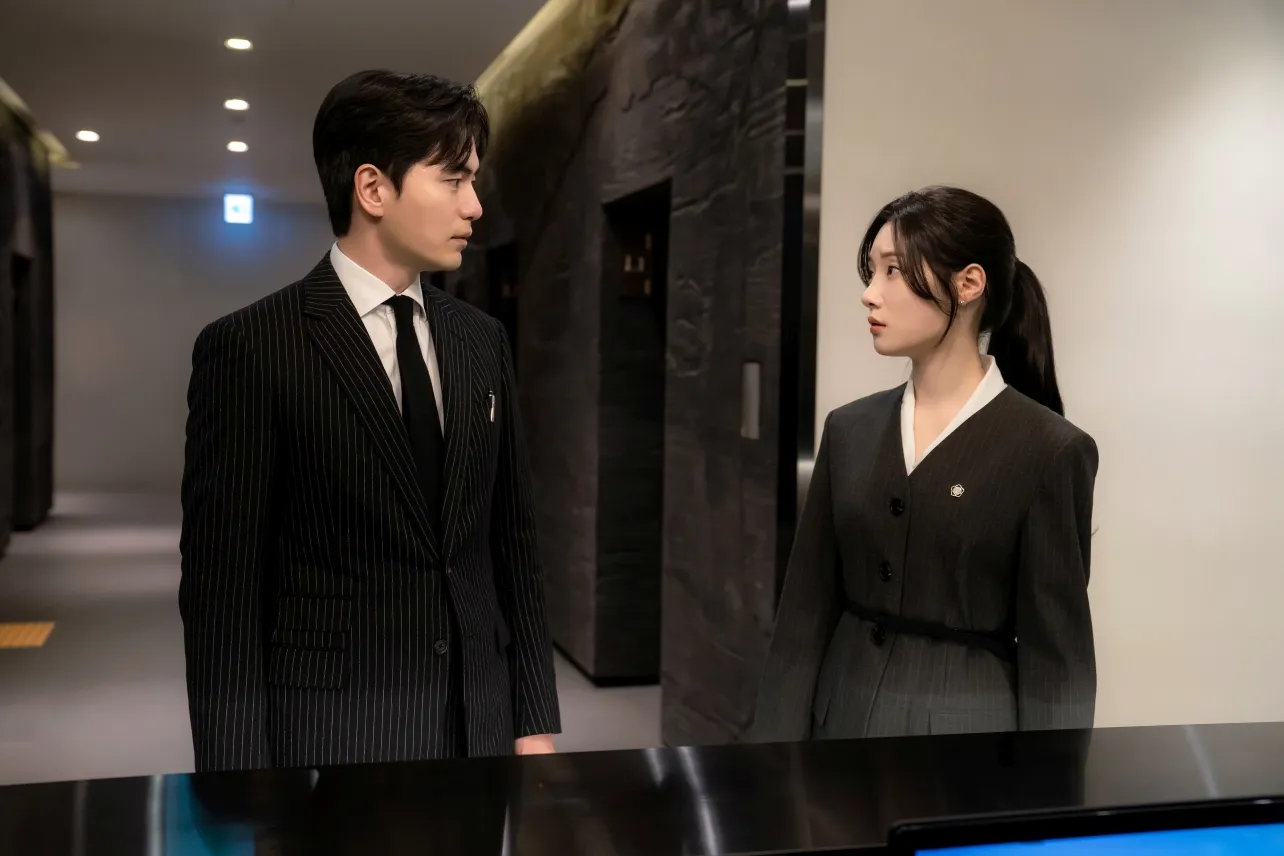
Here, the brilliant yet unpolished Kang Hyo-min must find her footing under the icy glare of her new boss, the formidable Yoon Seok-hoon. Their immediate dynamic is a classic clash of instinct versus intellect, of raw talent versus rigid discipline. It is a partnership that promises to be the main event, and the show smartly places it front and center from the opening scene.
The Odd Couple of Litigation
The series lives or dies on the chemistry of its leads, and Beyond the Bar presents a compelling duality that fuels its narrative engine. Kang Hyo-min (Jung Chae-yeon) makes an entrance that is less of a professional debut and more of a quiet disaster. She arrives at her group interview late, flustered, with scuffed shoes and a hastily applied patch of correction fluid over a shirt stain.
It is a perfect visual gag that immediately establishes her as someone for whom appearances are a distant afterthought to the racing thoughts in her head. Yet beneath this chaotic exterior is a first-class legal mind, one that won mock trial championships and earned her an offer from a rival firm. This contrast is the core of her character. The show reveals she is the daughter of a chief judge and a law professor, a pedigree she actively conceals from a world eager to label her a “nepo baby.”
Her true depth is exposed not through her intellect, but through a painful family secret about a twin sister born with a hereditary hearing impairment. This history informs her fierce belief in seeing people beyond their perceived flaws and causes the collapse of her relationship with a superficial boyfriend, Seong-chan, who views her “imperfect” genetics as a dealbreaker.
This backstory gives her a powerful, empathetic streak that defines her professional approach. She investigates cases with a hands-on method, disappearing for days to follow a hunch and arguing in court with a passion that is both confident and, at times, surprisingly loud. Jung Chae-yeon’s performance captures this mix of social awkwardness and professional fire, making Hyo-min feel real and relatable.
Her polar opposite is Yoon Seok-hoon (Lee Jin-wook), the head of litigation. He is a man seemingly constructed from pure logic and glacial disdain. His recruitment speech is a masterclass in anti-inspiration, promising only long hours, immense pressure, and a high failure rate.
Lee’s performance is one of controlled stillness, using sharp glances and clipped sentences to build an intimidating presence. The show hints at a deep-seated grief over a lost love that explains his emotional armor and zero-tolerance policy for carelessness.
We see cracks in the facade only in small, private moments, like the genuine affection he shows his dog, Hash. He initially dismisses Hyo-min as an unreliable nuisance. But his quiet, grudging respect grows with each case she cracks.
A simple “you did well” or a shared cup of tea, shot with an intimacy that separates it from the cold office environment, becomes a monumental concession. Their dynamic is built on this friction. The show even offers a handy metaphor: hot water is the test for tea and love. Seok-hoon provides the heat, and Hyo-min’s true strength is steeped as a result.
The Case Is the Catalyst
Like any good procedural, Beyond the Bar uses its case-of-the-week structure as a delivery system for character growth and vital social commentary. The legal disputes are rarely just about points of law; they are pressure cookers for the protagonists’ values. The first episode’s gas company heist seems like a dry corporate advisory case, the kind of assignment designed to test a rookie’s patience.

Hyo-min, however, turns it into a field mission. Spotting an anomaly in the revenue reports, she vanishes for two days, traveling to a remote hot spring to prove her theory about stolen gas. The editing here effectively cuts between her dogged, on-the-ground investigation and Seok-hoon’s mounting fury back at the firm, creating a tension that pays off when she returns with incontrovertible evidence.
The case itself is less important than what it establishes: her methods are unorthodox, her instincts are sharp, and she is willing to defy her boss to get results. This immediately sets the terms of their professional conflict.
The second episode raises the stakes with a far more emotional case involving a fertility clinic’s negligence. The client, Park Gi-beom, is a man whose last chance at fatherhood was destroyed after he became infertile following cancer treatment. The story is a powerful vehicle for Hyo-min to demonstrate her profound empathy, particularly in a standout scene where she makes the male client comfortable discussing sensitive topics.
It also allows Seok-hoon to showcase his strategic cunning, as he weaponizes the press and the dramatic courtroom appearance of the client’s disfigured wife, Ye-rim, to gain leverage and force a settlement. This plotline digs into a potent cultural theme: South Korean society’s fixation on appearance and “perfection.”
The physical scars of Ye-rim are paralleled with Hyo-min’s own “imperfect” family history, creating a powerful contrast between the client couple’s unwavering loyalty and her boyfriend’s shallow rejection. While the show occasionally throws around legal jargon that might leave a layman scrambling for a glossary, it mostly succeeds in keeping the human stakes clear. The arguments about the monetary value of sperm are deftly translated into a moving story about one couple’s hope for a future.
The Shark Tank Firm
The world of Yullim Law Firm provides a rich, conflict-heavy backdrop that expands the show’s scope beyond the two leads. The litigation department is more than just a setting; it’s a living ecosystem of ambition and anxiety. We are introduced to key supporting characters like Lee Jin-woo and the notably competent Heo Min-jeong (Jeon Hye-bin), a senior associate whose calm authority suggests she is a significant figure and a potential mentor or rival for Hyo-min.
The series quickly introduces internal strife that feels authentic to a high-pressure workplace. The subplot of Na Dong-su, an arrogant and lazy lawyer protected by his powerful family connections, serves as a direct critique of nepotism. He is a “salary thief” whose presence erodes morale and stands in stark opposition to the department’s otherwise high standards, creating an inevitable collision course with the meritocratic Seok-hoon.
This internal tension is compounded by external pressures that add another dimension to the firm’s politics. We learn that Seok-hoon, for all his courtroom skill, is not considered a “rainmaker”—an attorney who brings in the big, lucrative clients. This detail positions him as a craftsman in a world that increasingly values salesmen, adding a layer of professional vulnerability to his character.
He is respected for his talent but perhaps not fully valued by partners who are more focused on the bottom line. The show sharpens this conflict through the rivalry with the opposing counsel, Lee & Seo Law Firm. In a satisfyingly dramatic twist, Hyo-min’s ex-boyfriend, Seong-chan, works there and acts as their representative in the fertility case settlement. This move neatly braids the personal and professional, forcing Hyo-min to face her recent heartbreak across the negotiation table and giving her a very personal stake in victory.
Objection Sustained
Ultimately, Beyond the Bar succeeds because it understands that the most compelling legal dramas are never just about the law. Its primary strength is the magnetic pull between its two leads, using each case as a crucible to test their opposing worldviews and forge an unlikely, powerful bond.
The narrative is propelled by their evolution, which the show paces with admirable restraint. Hyo-min’s journey from a scattered, insecure rookie to a self-assured litigator and Seok-hoon’s gradual thawing from an impenetrable block of ice are the central pillars of the viewing experience.
The show balances its intricate legal puzzles with genuine emotional weight, making it an intelligent and satisfying entry into a crowded genre. It is a sharp, character-focused series for viewers who want their legal procedurals to come with a side of soul. The question is not whether Hyo-min will win her cases, but how many of Seok-hoon’s carefully constructed walls she will demolish along the way.
Beyond the Bar is an upcoming South Korean legal drama series directed by Kim Jae-Hong. It premiered on JTBC on August 2, 2025, and is scheduled to air on Saturdays and Sundays at 22:40 (KST). The series will consist of 12 episodes, with two episodes released every week, and the finale is scheduled for release on September 7, 2025.
Full Credits
Director: Kim Jae-Hong
Writers: Park Mi-Hyun
Cast: Lee Jin-wook, Jung Chae-yeon, Lee Hak-joo, Jeon Hye-bin, Kim Eui-sung, Kim Yeo-jin, Hong Seo-jun, Yun Yu-sun, Cho Seung-yean, Lee Sang-yeob
Composer: Kim Min-ji, Yoo Min-ho
The Review
Beyond the Bar
Beyond the Bar rises above the standard legal procedural with its sharp focus on the compelling dynamic between its leads. The "case-of-the-week" format serves as a vehicle for rich character development and thoughtful social commentary. While the legal jargon can sometimes be dense, the powerful performances and the slow-burn evolution of the central mentor-mentee relationship make this an intelligent and emotionally resonant watch. It proves that the most interesting objections are not legal, but personal.
PROS
- Excellent chemistry between the two leads, Kang Hyo-min and Yoon Seok-hoon.
- Strong character development, with compelling personal backstories that influence their professional lives.
- Uses legal cases effectively to explore deeper themes of loyalty, justice, and societal pressures.
- Engaging office politics and rivalries add texture and stakes to the world of the firm.
- Solid performances that bring nuance to familiar archetypes.
CONS
- Legal terminology can occasionally become dense, potentially alienating viewers without a background in law.
- Relies on some familiar K-drama tropes, such as the cold, emotionally scarred boss and the brilliant but clumsy rookie.