



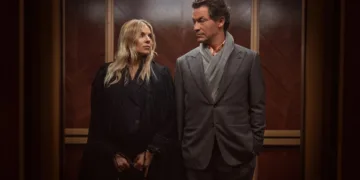
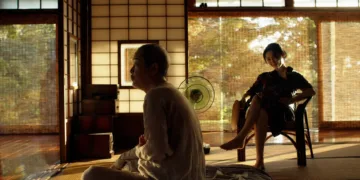




Jim Jarmusch’s Father Mother Sister Brother is a film constructed from negative space. It operates with a delicate, observational patience, finding its narrative pulse in the interactions between adult children and their parents.
The drama is not located in grand confrontations or cathartic revelations; it lives in the loaded quiet between sentences, the awkward pauses over tea, the small gestures that betray a lifetime of shared history. Its mood is meditative, almost placid, yet it captures a profound truth about kinship: that a deep, abiding affection can exist alongside a fundamental sense of unknowing.
We are seated next to people who share our blood, yet they remain foreign territories. The film documents these strange, authentic meetings with a quiet humor that resists any slide into sentimentality, presenting family as it often is: a collection of loving strangers.
A Geography of Estrangement
The film’s first panel is a study in American gothic isolation. Siblings Jeff (Adam Driver) and Emily (Mayim Bialik) navigate snow-rimmed roads to the remote outpost of their father, a recluse played with theatrical decay by Tom Waits.
Frederick Elmes’s cinematography frames them against a cold, unforgiving landscape, the washed-out winter light mirroring their emotional chill. Inside the house, the camera adopts a static, almost theatrical distance, composing shots that emphasize the empty space between the characters. The visit itself is a masterclass in tension, a dark comedy built from the architecture of avoidance.
Every stilted question about the plumbing or a gift box of groceries becomes a placeholder for a conversation they are incapable of having. Jarmusch subtly introduces a neo-noir current of suspicion. The father’s performance of poverty feels too practiced, and a glimpse of a genuine Rolex on his wrist recasts him as a potential grifter, a figure of profound moral ambiguity running a long con on his own flesh and blood.
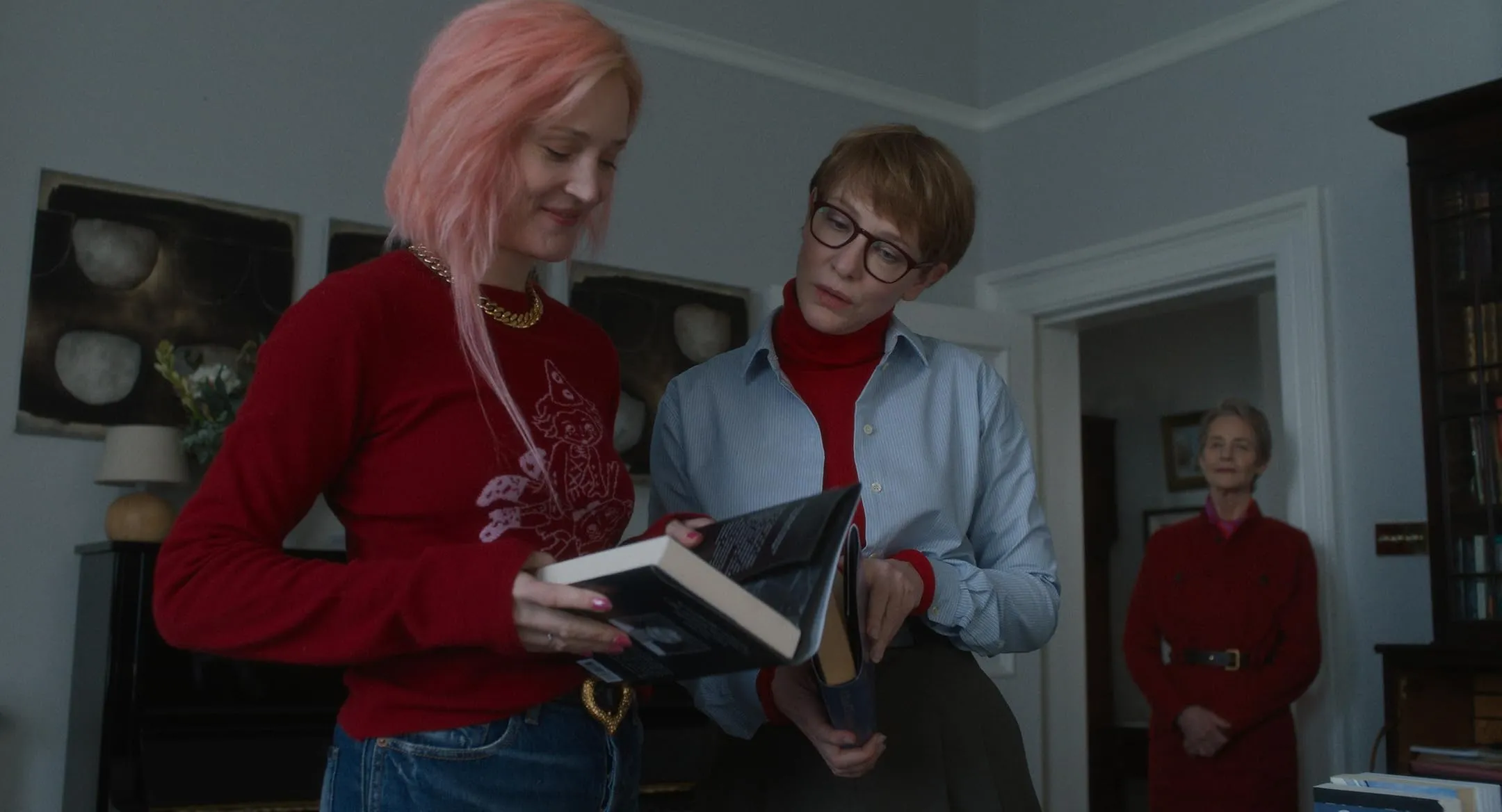
From there we are transported to a Dublin townhouse, a perfectly curated stage for a different kind of familial warfare. A chilly, successful author (Charlotte Rampling) awaits her annual tea with her daughters. Here, cinematographer Yorick Le Saux uses soft, controlled lighting to create an atmosphere of impeccable, airless propriety.
The deceptions are less about money and more about identity. The prim Timothea (Cate Blanchett) plays the diplomat, policing the fragile peace, while the rebellious Lilith (Vicky Krieps) acts as a beautiful saboteur, arriving in a fabricated Uber to maintain a facade of success. Overhead shots of the immaculate tea table render the characters as specimens, their precise movements dictated by unspoken rules.
The humor is cutting, born from the friction between Lilith’s mischievous provocations and her mother’s weaponized decorum. Yet in stolen glances and shared smirks, the sisters form a silent conspiracy, a fleeting alliance against the oppressive elegance of their upbringing.
The final segment in Paris dismantles the tension of the first two. The tone softens, the camera becomes more fluid. Twins Skye (Indya Moore) and Billy (Luka Sabbat) meet after the sudden death of their parents. The guarded postures of the previous characters are replaced by an easy, tactile intimacy. They lean on each other, their physical closeness a stark contrast to the emotional chasms seen earlier.
Here, the parents are ghosts, their presence felt only in the empty rooms and boxes of belongings they left behind. The narrative pivots from the anxiety of parental obligation to the melancholy archaeology of their legacy. As the twins unearth evidence of their parents’ secret lives, they confront an existential question. They are not grieving the parents they knew; they are grieving the strangers they are just beginning to discover.
The Grammar of Silence
Jarmusch’s direction is a patient act of witnessing. His aesthetic is one of deliberate restraint, allowing meaning to accumulate in the margins. The camera’s unblinking gaze lingers on details a lesser filmmaker would discard: a hand stirring a cup of tea, the way sunlight falls across an empty Parisian apartment, the geometric arrangement of cakes on a porcelain plate.

The visual language, though split between cinematographers Frederick Elmes and Yorick Le Saux, feels seamlessly unified in its purpose. It finds a quiet beauty in the mundane, elevating everyday textures into significant visual information. The film’s three disparate narratives are woven together by a series of recurring motifs, almost like a quiet formalist experiment. A luxury watch, its authenticity perpetually in doubt, appears on a wrist.
The ritual of a hot beverage provides a space for stilted communion. The odd British idiom “Bob’s your uncle” surfaces like a linguistic phantom. These repetitions function as more than simple cinematic grace notes. They create a resonance between the stories, manipulating the audience’s perception to create a sense of a shared, almost cosmic, rhythm binding these lives. It suggests a universe where our small, personal dramas are merely variations on a universal theme.
An Elegant Ambiguity
The film’s philosophical core is its exploration of distance as a fundamental component of intimacy. It suggests that the empty spaces between family members are not failures of connection but an inherent, even necessary, part of the bond itself. We are defined by a legacy we can never fully decode. The performances are perfectly calibrated to this theme of elegant ambiguity.
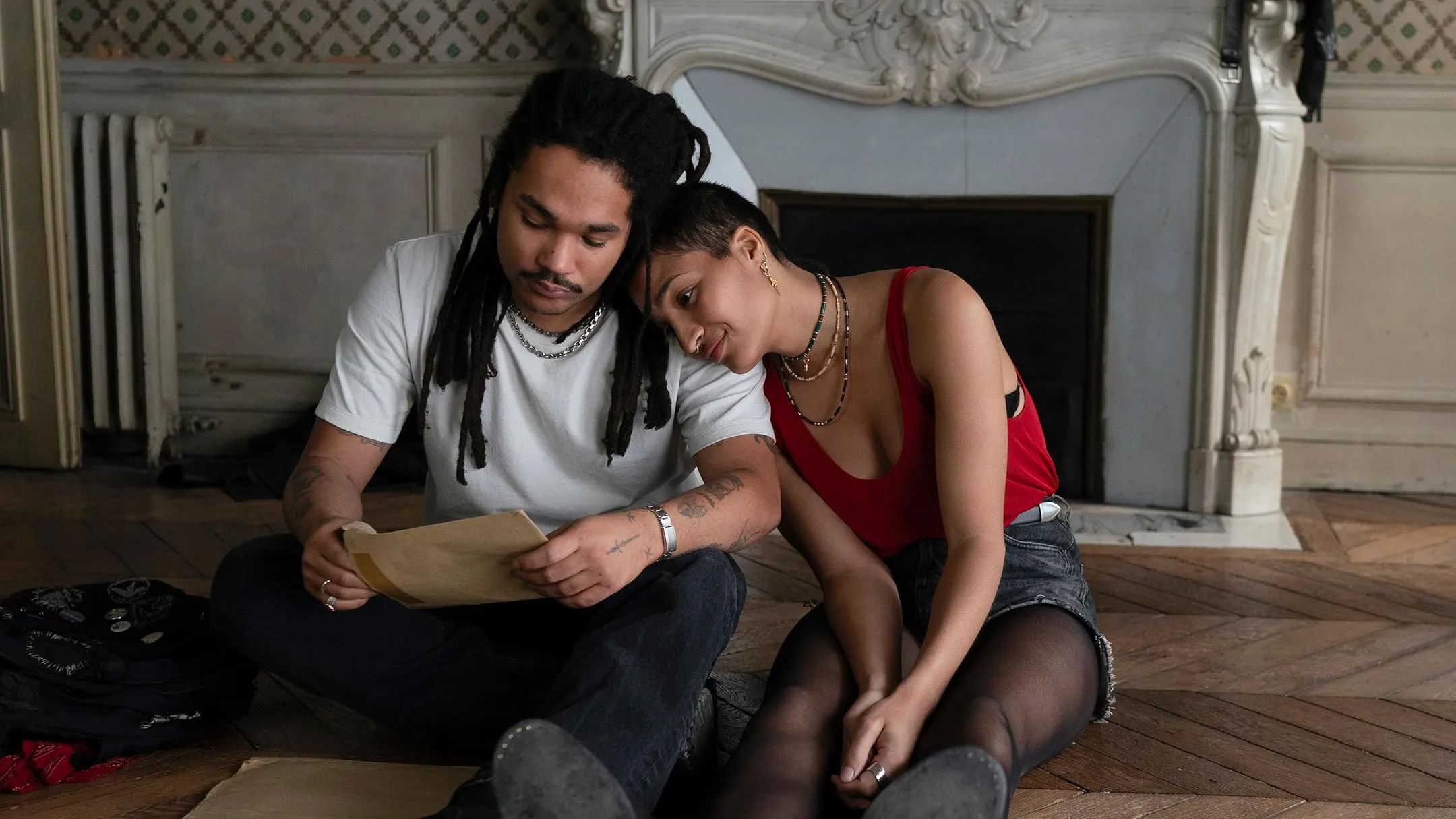
Tom Waits’s father is a brilliant creation, a Shakespearean fool disguised as a backwoods hermit, his performance a sly wink at the audience. Vicky Krieps imbues Lilith with a delicious, disruptive energy that animates the film’s driest comic moments. The undeniable chemistry between Indya Moore and Luka Sabbat provides the story its emotional anchor, their shared glances and physical ease conveying a history that needs no dialogue.
Jarmusch has created a work that operates in a rare emotional register, a kind of domestic noir where the mysteries are not criminal but existential. He sidesteps both the explosive confrontations of family melodrama and the cheap grace of sentimental fiction. What remains is a mature, profoundly human portrait of the beautiful, imperfect, and ultimately unknowable connections that shape our lives.
The movie Father Mother Sister Brother premiered at the Venice Film Festival on August 31, 2025. It is scheduled for a limited theatrical release in the U.S. by Mubi on December 24, 2025. It was also screened at the Busan International Film Festival on September 19, 2025, the New York Film Festival on October 3, 2025, and the Vancouver International Film Festival on October 10, 2025. It will also be released in Spain, France, and Germany in late 2025 and early 2026. The film is 110 minutes long and is presented by Mubi, Saint Laurent by Anthony Vaccarello, and The Apartment.
Full Credits
Director: Jim Jarmusch
Writers: Jim Jarmusch
Producers and Executive Producers: Charles Gillibert, Joshua Astrachan, Carter Logan, Atilla Salih Yücer, Jim Jarmusch, Efe Cakarel, Jason Ropell, Zane Meyer, Anthony Vaccarello, Lorenzo Mieli, Annamaria Morelli, Alex C. Lo
Cast: Tom Waits, Adam Driver, Mayim Bialik, Charlotte Rampling, Cate Blanchett, Vicky Krieps, Sarah Greene, Indya Moore, Luka Sabbat, Françoise Lebrun
Director of Photography (Cinematographer): Frederick Elmes, Yorick Le Saux
Editors: Affonso Gonçalves
Composer: Jim Jarmusch, Anika
The Review
Father Mother Sister Brother
Jim Jarmusch has assembled a quiet masterpiece of domestic observation. Father Mother Sister Brother is a precisely calibrated study of the affectionate distances that define family. Anchored by a superb ensemble and a patient, visually rich directorial style, the film finds profound meaning in awkward silences and unspoken histories. It is a mature, deeply human work that forgoes melodrama for a more resonant truth about the strangers we call family. A beautifully melancholic piece of cinema.
PROS
- Exceptional ensemble performances that are perfectly understated.
- Patient and visually artful direction from Jarmusch.
- Stunning and atmospheric cinematography across all three segments.
- A thoughtful and nuanced exploration of complex family dynamics.
- Subtle, intelligent humor that punctuates the drama.
CONS
- The deliberately slow pace may not suit all tastes.
- Its episodic structure lacks a conventional narrative drive.
- The emotionally reserved tone might feel cold to some viewers.