























![Kingdom Hearts Collection [I-III] Review](https://gazettely.com/wp-content/uploads/2026/10/Kingdom-Hearts-Collection-I-III-1-360x180.webp "Kingdom Hearts Collection [I-III] Review: KHII Holds Steady as Newer Entries Fluctuate 37")



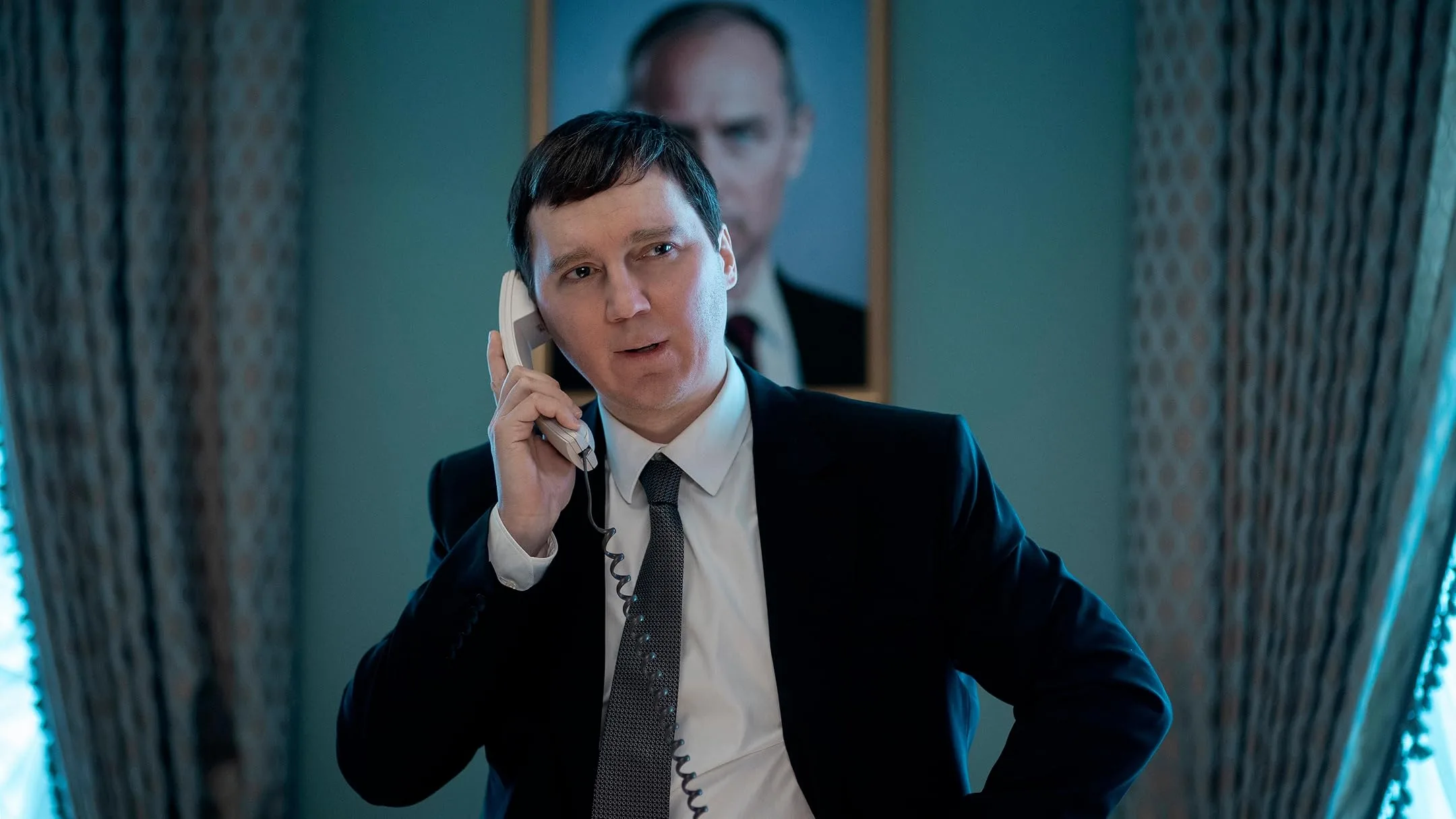
There’s always been something fascinating about the political strategist, that shadowy figure who operates just outside the spotlight. They are the ghostwriters of history, crafting the narratives that define an era. Olivier Assayas’s The Wizard of the Kremlin dives headfirst into this world, giving us the story of Vadim Baranov, a brilliant and inscrutable spin doctor at the center of Vladimir Putin’s rise to power.
The film isn’t a simple biopic or a straightforward political thriller. It’s a dense, ambitious look at how modern autocracy is built, not with tanks and secret police alone, but with the careful manipulation of television, the internet, and the very idea of truth itself. It’s a story about manufacturing a new Russian reality from the ashes of the old one.
A Three-Decade Sprint Through the New Russia
The film has a massive historical canvas, attempting to chronicle nearly thirty years of Russian history in just over two and a half hours. It plunges the audience into the dizzying, often terrifying atmosphere of the 1990s following the Soviet collapse. I remember watching news reports from that time, and Assayas captures the visual texture of that chaos perfectly: the frenetic energy of underground punk clubs, the garish opulence of the newly minted oligarchs in their sprawling mansions, and the pervasive sense of a society unmoored from its own history.
Through Baranov’s detached perspective, we witness the violent birth of this new capitalist class, the brutal Chechen War, and the eventual annexation of Crimea. The film hurtles through these milestones with a breathless, almost frantic pace, giving us an insider’s view of the backroom deals that shaped a nation. It feels less like a traditional story and more like a fever dream of recent history, a highlight reel of a country reinventing itself in real time.
At its core is the theme of media as a political weapon, a concept that feels more urgent now than ever. Baranov’s personal journey is the film’s central metaphor. He begins as an avant-garde theatre director, an artist supposedly committed to challenging the system. His evolution into a producer of trashy, wildly popular reality television and then into the chief architect of the Kremlin’s propaganda machine is a chilling depiction of ideals being subsumed by power.
We watch him pioneer the strategies that have since become standard in the global political playbook. The film visualizes the birth of troll farms not as a high-tech spy operation, but as a drab office of keyboard warriors tasked with flooding the internet with confusion. He brilliantly co-opts fringe movements, funding biker gangs and nationalist ideologues to create a controllable “opposition.” It is a masterclass in manufacturing the illusion of democracy, making politics another form of spectacle where the outcome is always fixed.
This process is framed within the ideological shift from a “horizontal” to a “vertical” society. The 1990s are depicted as a time of horizontal chaos, a free-for-all where power was diffuse and oligarchs behaved like modern-day robber barons. The film does not shy away from the ugliness of this supposed freedom.
Putin’s arrival signals the restoration of the “vertical,” a rigid, top-down power structure promising order, stability, and national pride. The film’s most provocative idea is its suggestion that after the trauma and national humiliation of the Yeltsin years, this return to authoritarian control was exactly what many Russians craved. It challenges us to see this shift not as a simple hijacking of a nation, but as a grim transaction willingly made.
The Wizard and His Tsar
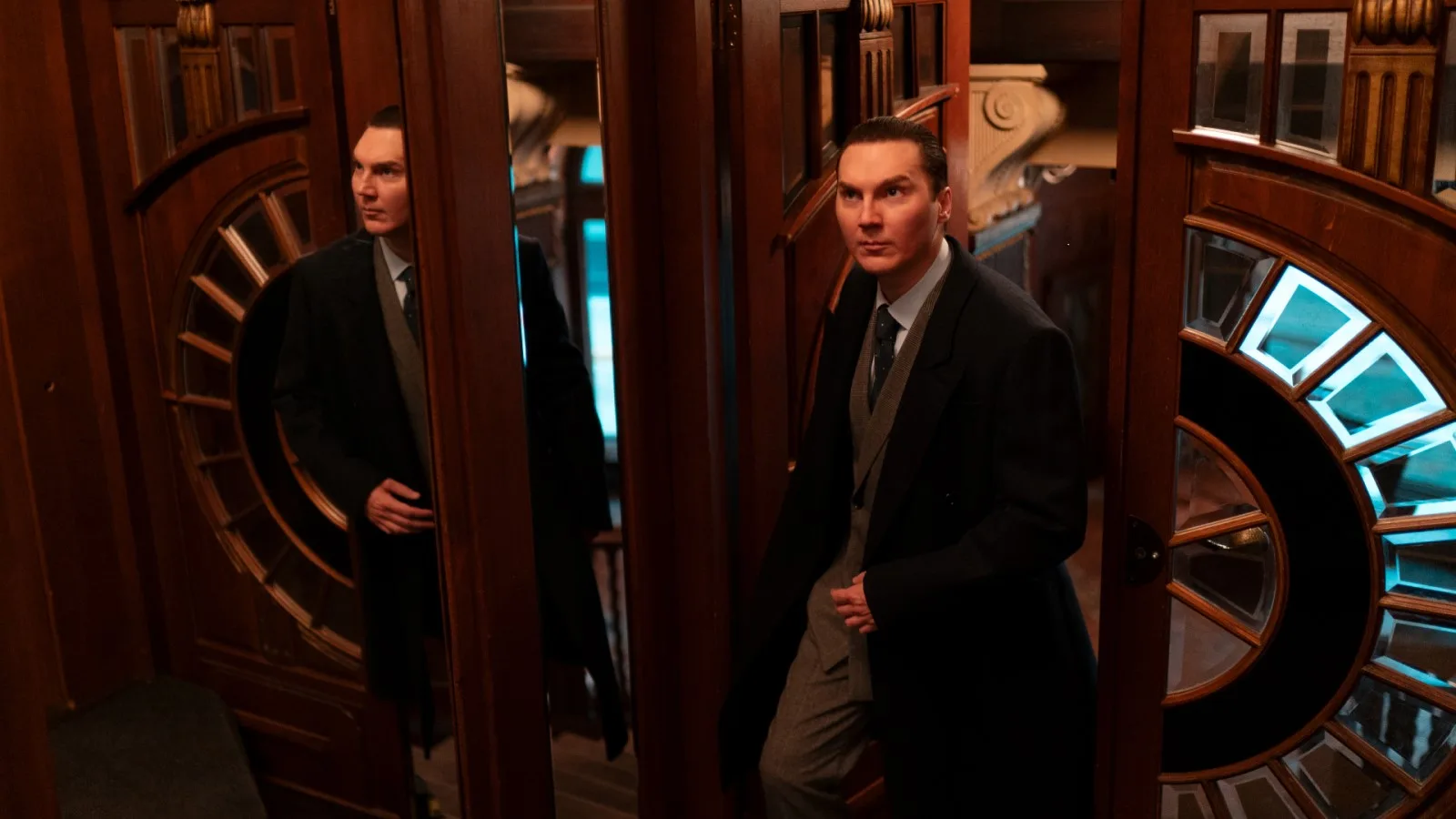
At the center of this political vortex is Vadim Baranov, played by Paul Dano with a quiet, mannered, and deeply unsettling detachment. His delivery is a soft, almost hypnotic singsong, his physicality muted and contained. It’s a stark contrast to his more explosive roles; here, all the action is internal. Dano’s Baranov is an intellectual force, but he remains emotionally sealed off, a ghost haunting the corridors of power.
We understand his tactics, but we never truly grasp his motivations. Is he a disillusioned idealist who decided to burn the world down, a cynical opportunist grabbing for influence, or simply an empty vessel animated by proximity to greatness? The film steadfastly refuses to give a clear answer. This choice is a significant gamble.
Baranov’s coldness keeps the audience at arm’s length, forcing us into a purely observational role. He is a fascinating puzzle, certainly, but his opacity makes him a difficult anchor for such a sprawling story. He is more of an intellectual concept than a man of flesh and blood, a decision that defines the film’s chilly, academic tone.
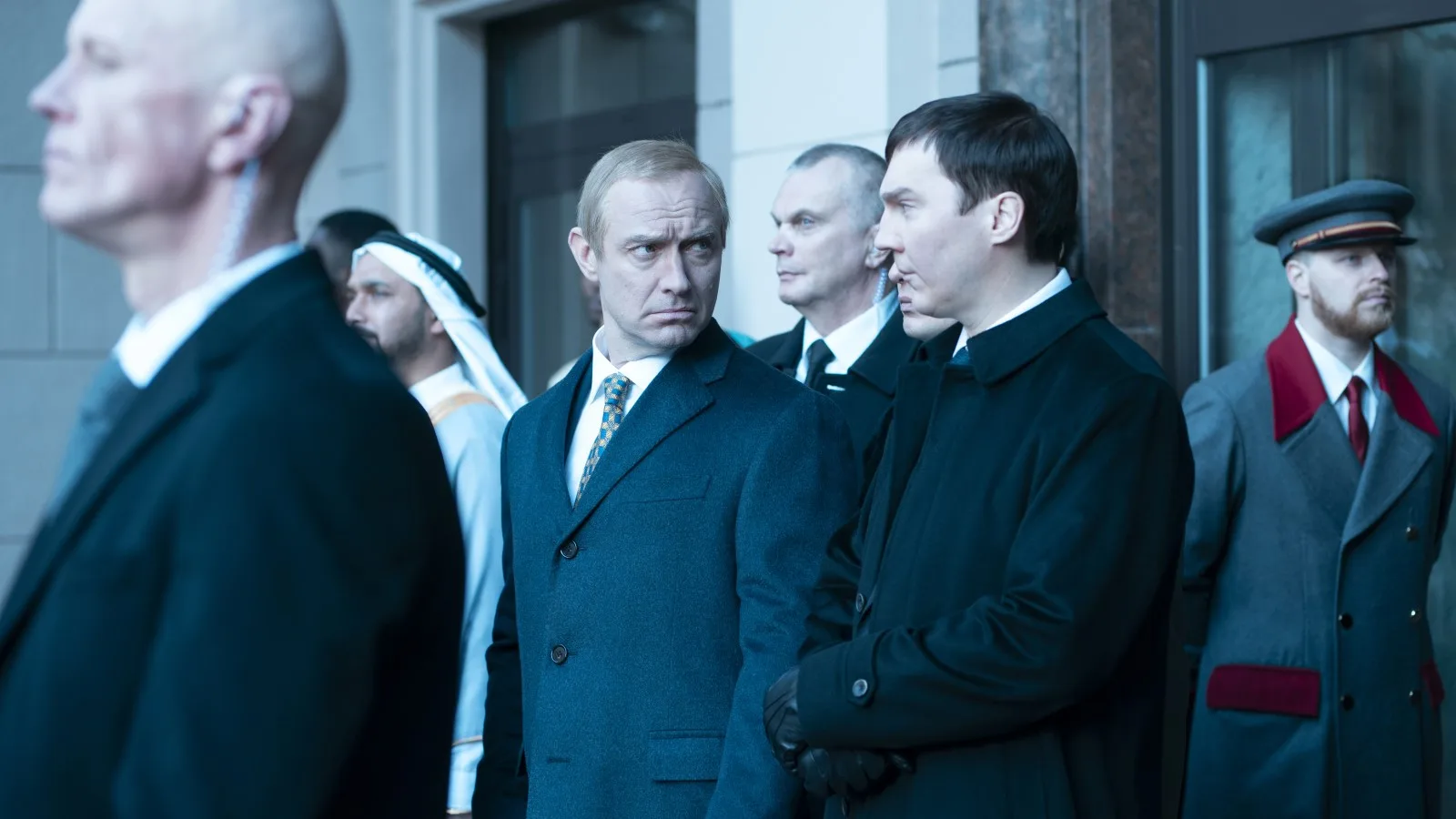
If Baranov is the film’s brain, its gravitational pull comes entirely from Jude Law’s transformative performance as Vladimir Putin. This is not a cheap impersonation found on a sketch comedy show; it’s a terrifying embodiment of controlled menace. Helped by subtle makeup, Law captures the man’s physical presence, from the dead-eyed stare to the slight, predatory forward lean. He uses silence as a weapon, letting his presence fill a room with unspoken threat.
He avoids caricature, presenting Putin as a shrewd, intelligent, and deeply intimidating political operator who moves with absolute certainty. Law is the most magnetic force in the movie, a man who understands that what the Russian people truly want after years of chaos is a leader who projects unshakeable strength. Whenever he is on screen, the film snaps into sharp, terrifying focus. The portrayal is deeply provocative because it presents him not as a one-dimensional villain, but as a rational tyrant, a frighteningly logical product of the historical instability that created him.
The Miniseries Squeeze
Director Olivier Assayas, who has explored similar sprawling narratives in films like Carlos, brings his signature kinetic style to the proceedings. The film is sleek, polished, and always in motion. The camera glides through opulent Moscow mansions, sterile Kremlin offices, and European capitals with a restless energy.
The editing is crisp, and the soundscape often buzzes with the ambient noise of a world in flux. Yet, this stylish surface serves a script that is overwhelmingly expository and dialogue-heavy. There are moments where the visual flair can’t hide the fact that we are essentially watching a series of well-staged lectures on Russian political philosophy. It feels more intent on educating its viewer than creating a potent emotional experience.
This points to the narrative’s biggest structural challenge: its sheer density. The Wizard of the Kremlin attempts to pack decades of complex history, dozens of real-life figures, and intricate political machinations into its runtime. The ambition is admirable, but it often works against the drama. The screenplay becomes a checklist of historical events.
Figures like the nationalist writer Eduard Limonov appear for a scene, deliver a key ideological point, and then vanish. This name-checking might reward viewers with a deep knowledge of the period, but for many it will make the picture feel episodic and rushed. It often seems like you’re watching a six-part miniseries on fast forward, catching the crucial plot points but missing the texture, nuance, and character development that would make them land with force.
The storytelling structure itself relies on a classic, almost creaky framing device. A retired Baranov recounts his life story to an American author, played by the great Jeffrey Wright. The scenes between them are visually static, a stark contrast to the fluid motion of the flashbacks. While this provides a clear entry point into the complex history, it is also a conventional choice for a filmmaker as adventurous as Assayas. It leans heavily on voiceover to convey information, leading to long stretches where the film tells us what happened instead of letting us experience it, sacrificing cinematic momentum for the sake of clarity.
Ghosts in the Machine
The supporting characters, while well-acted, often function more as historical signposts than as fully realized people. Will Keen is particularly effective as the hubristic oligarch Boris Berezovsky, a man who sees himself as a kingmaker but is ultimately undone by the king he helps create.
He is a vibrant, tragic figure, but like others, he primarily serves to illustrate a point about the old guard of power brokers that Putin systematically dismantles. Tom Sturridge also appears as a rival oligarch, representing the flashy, swaggering capitalism of the 90s that would soon be brought to heel. They are chess pieces on a grand board, swept aside with cold efficiency.
This lack of deep human connection is most apparent in the film’s perfunctory romantic subplot. The on-again, off-again relationship between Baranov and Ksenia, an artist played by Alicia Vikander, feels like an afterthought, a structural requirement for a mainstream film that feels out of place here. Her character is thinly written, a cynical free spirit whose motivations are as murky as Baranov’s, but without his intellectual weight.
The subplot fails to humanize the protagonist or offer a meaningful emotional counterpoint to the relentless political maneuvering. Instead, it feels like a distraction, an inorganic element that only highlights the film’s defining feature: a cold, intellectual fascination with the mechanics of power that leaves little room for the people, and the hearts, caught in the machine.
Full Credits
Director: Olivier Assayas
Writers: Olivier Assayas, Emmanuel Carrère, Giuliano Da Empoli
Producers: Olivier Delbosc, Alexandra Abrams, Justin Ardalan-Raikes, Sylvie Barthet, Niraj Bhatia, Lee Broda, Patrick Doherty, Max Kondziolka, Robert K. MacLean, Stuart Manashil, Joel Michaely, Michael Paletta, Max Pavlov, Thomas Pierce, Jeff Rice, Ian Fulton Roberts, Dean Sansovich, Theodore Shivdasani, Hugh Strange, Scott Weber, Sidonie Dumas
Cast: Paul Dano, Alicia Vikander, Tom Sturridge, Will Keen, Jeffrey Wright, Jude Law, Andris Keiss, Magne-Håvard Brekke, Anton Lytvynov, Zach Galifianakis
Director of Photography: Yorick Le Saux
Editors: Marion Monnier, Joël Li
The Review
The Wizard of the Kremlin
The Wizard of the Kremlin is an intelligent and ambitious political epic, anchored by a mesmerizing performance from Jude Law. While its sprawling historical scope is impressive, the film remains an emotionally cold exercise. Its detached protagonist and overstuffed narrative keep the audience at a distance, making it a fascinating but ultimately unaffecting docudrama. It is a film easier to respect for its sharp ideas about the mechanics of power than to connect with as a human story.
PROS
- Jude Law's transformative and chilling performance as Vladimir Putin.
- An intelligent and ambitious attempt to chronicle three decades of complex Russian history.
- A sharp, insightful examination of modern political manipulation and media's role in building autocracy.
- Sleek, kinetic direction from Olivier Assayas.
CONS
- Emotionally cold and intellectually detached, keeping the audience at a distance.
- The central character, Vadim Baranov, is an opaque and unengaging protagonist.
- The narrative is overstuffed and episodic, feeling like a compressed miniseries.
- An underdeveloped and unnecessary romantic subplot.