











The story of Chloe Ayling, a British glamour model, is one of those modern fables that seems too outlandish for fiction. In 2017, at the age of 20, she was lured to Milan for a photoshoot that never existed. What she found instead was an ambush.
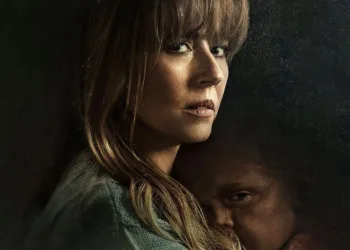
She was drugged, stuffed into a holdall, and driven to a remote farmhouse. Her captor informed her she was now the property of a shadowy organization called “Black Death” (a name seemingly chosen for maximum B-movie effect) and would be auctioned on the dark web unless a hefty ransom was paid. This is the setup for the BBC series Kidnapped.
The show, however, is less interested in the mechanics of the crime itself. Its true subject is the second act of Ayling’s ordeal, which began the moment she was freed. Her release was not an ending, but the start of a public trial where the evidence against her was her own survival.
The Theatre of Survival
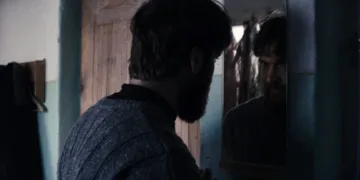
The series devotes its initial episodes to the six days of captivity, creating a claustrophobic and deeply unsettling atmosphere. The remote Italian farmhouse is less a setting and more a state of being, an isolated bubble where the rules of civilization are suspended.
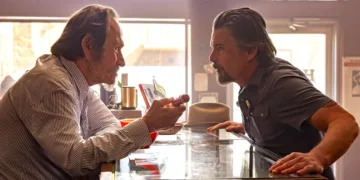
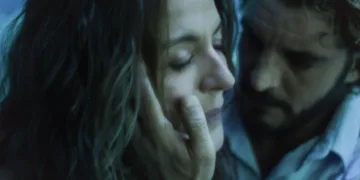
The direction enhances this feeling of dislocation, using tight, confining shots and a palette of washed-out colors that suggest a world drained of vitality. This is the stage for a tense psychological two-hander between Ayling (Nadia Parkes) and her captor, Lukasz Herba (Julian Swiezewski). Herba is a confusing antagonist, a man-child playing a game far too serious for his limited intellect. He shifts between outright menace and an odd, almost pitiable friendliness.
One moment he is explaining the cold logistics of her sale into sex slavery; the next he seems to be seeking her approval. He is a bungler playing at being a criminal mastermind, and this amateurishness makes the situation profoundly more dangerous. A professional has predictable rules; a fool has none.
Faced with this unpredictability, Ayling deploys the only weapon she has: a carefully calibrated performance of compliance. What the series depicts is not a simple case of Stockholm Syndrome, but a conscious and exhausting act of what might be called ‘survivalist theatre.’ She assesses her captor’s ego, his loneliness, his delusions of grandeur, and she plays to them.
When he offers to un-cuff her from a chest of drawers if she agrees to share his bed, the show presents her acceptance not as a surrender but as a strategic calculation. She trades one form of imprisonment for another that offers a sliver more agency. She develops a sort of tactical empathy, a feigned friendship designed to keep him docile.
This strategy extends to bizarre, surreal moments that would later be used to discredit her, like accompanying him on a shoe shopping trip in a nearby village. To an outsider, the act is incomprehensible. Within the warped logic of the farmhouse, it is the only sane move.
She was, in essence, directing her own escape, one placating smile at a time, performing a role so completely that she risked losing the distinction between the character and herself. It is an exhausting performance of self-preservation that is both logical and, to an outside world hungry for simple narratives, completely unbelievable.
Judging by Appearances
Once free, Ayling’s trauma moves into the public square, and the series shifts from a psychological thriller to a sharp cultural critique. Kidnapped masterfully dissects the societal and media mechanisms that turn a victim into a suspect. It captures a specific moment in time, late 2017, on the very precipice of the #MeToo movement’s explosion.

The case became an unfortunate barometer for the default public settings on female credibility. The media swarm her mother’s home, their cameras hungry for a specific kind of image: the broken, weeping survivor. Ayling does not give it to them. Her composure, her profession as a model, even her choice of clothing become articles in the case against her. The public, it seems, has a rigid script for victimhood. It requires a performance of visible fragility and moral purity.
Ayling, a woman from the world of glamour modeling, already occupied a space that many deemed morally unserious. Her decision to face the press in stylish clothes was read not as resilience, but as a sign of inauthenticity. The series presents this with a cold, observational eye, showing how every choice she made was filtered through a lens of suspicion.
The show finds its symbolic apex in the recreation of her interview on Good Morning Britain. Robert Glenister’s portrayal of Piers Morgan is chillingly accurate, a performance of journalistic belligerence aimed at getting a confession, not the truth. The interview is presented as a public flogging, a ritual of purification where a difficult woman is put in her place.
The central “gotcha” moment revolves around an inconsistency in her police statement, a detail that ignores the psychological fog of trauma. The very survival tactics she employed in captivity are twisted into proof of her complicity. She convinced her kidnapper she liked him, a ruse that saved her life and later fueled a narrative that she was a willing participant.
The series also expands the circle of judgment beyond the television studio. It shows Ayling scrolling through an endless feed of social media comments, a torrent of anonymous vitriol that constitutes the modern pillory.
This is ‘crowdsourced disbelief,’ where uninformed opinion gains the weight of fact through sheer volume. Even her own agent (a squirrelly Adrian Edmondson) seems more concerned with the optics than her well-being, representing a world that viewed her as a commodity long before her abduction. She survived the kidnapping. The media interviews were another matter.
The Face of Muted Trauma
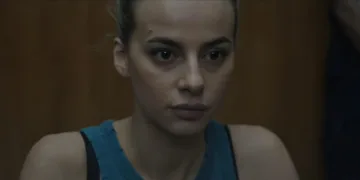
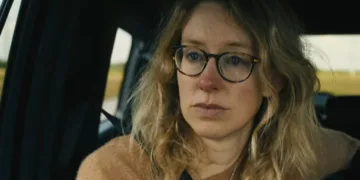
The series rests on the phenomenal performance of Nadia Parkes. It is a work of immense subtlety and intelligence. She captures the specific blankness of Ayling’s public persona, a sullen, almost bored exterior that masks a simmering, tightly controlled fear. Parkes makes you understand how this flat affect could be so easily misinterpreted as deceit or a lack of feeling.
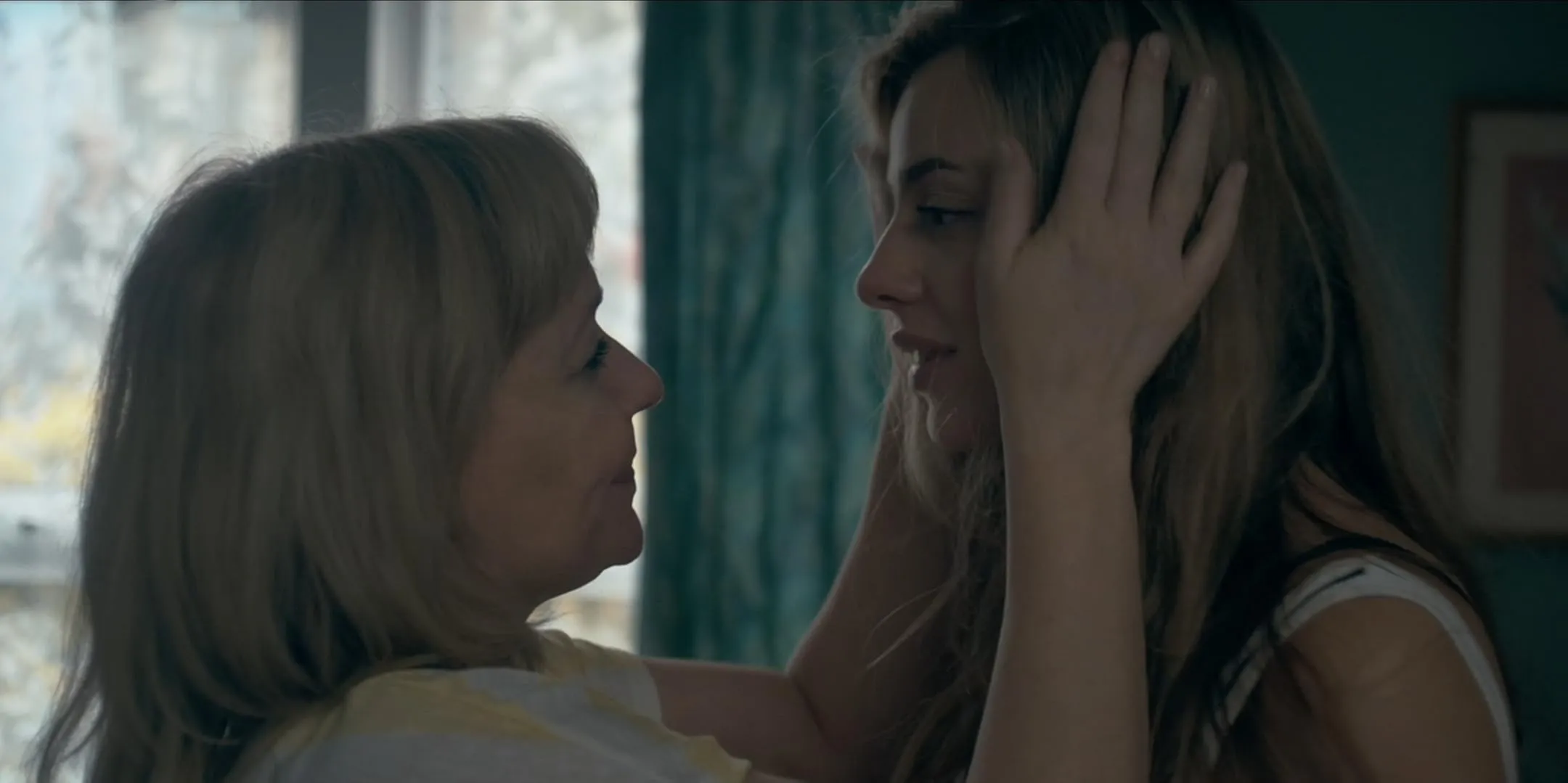
She doesn’t perform trauma in the way television usually demands, with theatrical breakdowns and tearful monologues. Instead, she embodies its strange, quiet aftermath: the disassociation, the emotional exhaustion, the defensive shell built to withstand a world that refuses to believe you.
Her physicality is precise, from the rigid set of her shoulders to the slight hesitation in her voice. It is a portrait of a non-normative trauma response, a state of being that our culture has no vocabulary for and little patience with. Parkes makes the audience feel the psychic cost of having to justify your own suffering.
The supporting cast provides perfect thematic foils. Julian Swiezewski is effective as the volatile Herba, a man whose pathetic aspirations and profound loneliness make him dangerously unpredictable. He is not a Bond villain; he is a far more recognizable type of inadequate man seeking power.
Robert Glenister’s Morgan is not just a caricature; he is the embodiment of a media ecosystem that thrives on conflict and treats human stories as content to be monetized. The show’s creative team, led by writer Georgia Lester, makes the crucial choice to frame the entire story with the Morgan interview.
By opening with a flash-forward to her public interrogation, the series tells us immediately that the real danger isn’t the man in the farmhouse, but the court of public opinion. This structure transforms the narrative from a simple “what happened” into a more profound “why wasn’t she believed.”
The show succeeds by blending the mechanics of a thriller with a sensitive, angry examination of a society that demands its victims look and act the part. It is a necessary document, forcing a re-examination of a story people thought they knew, and in doing so, it holds a mirror to our own uncomfortable biases.
Kidnapped: The Chloe Ayling Story is a six-part British television series that premiered on BBC Three and BBC iPlayer in the UK on August 14, 2024, and became available on AMC+ in the US starting August 28, 2024. The series is based on the real-life kidnapping of British model Chloe Ayling. It is a fictionalized drama produced by BBC Studios and was filmed in both the UK and Italy.
Full Credits
Director: Al Mackay
Writers: Georgia Lester, Nessa Wrafter, Tolula Dada
Producers and Executive Producers: Clare Shepherd (producer), Michael Parke, Andrew Morrissey, Georgia Lester, Al Mackay, Priscilla Parish, Lucy Richer (executive producers)
Cast: Nadia Parkes, Adrian Edmondson, Nigel Lindsay, Julian Świeżewski, Olive Gray, Christine Tremarco, Lorenzo Richelmy, Jaroslaw Ciepichal
Composer: Music Supervisors: Danny Layton, Ross Sellwood
The Review
Kidnapped: The Chloe Ayling Story
Kidnapped is an intelligent, unsettling series that uses a bizarre true story to dissect the modern media landscape and our society’s rigid expectations of victimhood. Anchored by a masterful and subtle performance from Nadia Parkes, the show is less a crime procedural and more a sharp cultural critique. It forgoes simple thriller mechanics for a deeply thoughtful, and often infuriating, examination of a woman whose greatest ordeal began after she was set free. It is essential, uncomfortable viewing that lingers long after the credits roll.
PROS
- A phenomenal and subtle lead performance from Nadia Parkes.
- An intelligent script that functions as a sharp critique of media culture and victim blaming.
- Tense, atmospheric direction that creates a palpable sense of psychological dread.
- Successfully elevates a true-crime story into a thoughtful examination of belief and perception.
CONS
- Viewers seeking a conventional, fast-paced crime thriller may find the deliberate pacing and analytical focus less engaging.
- The subject matter is inherently difficult and infuriating, making for an uncomfortable watch.