















![Kingdom Hearts Collection [I-III] Review](https://gazettely.com/wp-content/uploads/2026/10/Kingdom-Hearts-Collection-I-III-1-360x180.webp "Kingdom Hearts Collection [I-III] Review: KHII Holds Steady as Newer Entries Fluctuate 40")

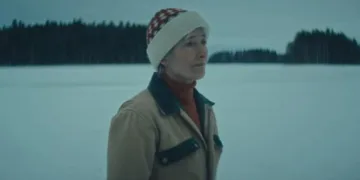
The Minnesota landscape of The Dead of Winter is a void waiting to be filled with violence. Director Brian Kirk opens on an expanse of punishing white, a blank page on which a story of grief will be violently overwritten. Emma Thompson plays a widow on a quiet, somber mission: to deliver her husband’s ashes to a frozen lake that holds the geography of their shared past.
The film’s initial rhythm is meditative, almost funereal. Then, a wrong turn. She stumbles upon a remote cabin, a place that radiates a deep sense of wrongness. The narrative pivots sharply when she discovers a young girl held captive, pulling an ordinary woman from her private sorrow into a brutal ethical dilemma. Her personal ritual is shattered, replaced by an immediate, life-altering choice.
Two Queens on a Board of Ice
The film rests upon the shoulders of its two female leads, who represent opposing answers to the question of human desperation. Emma Thompson’s performance is a masterclass in physical and psychological transformation. Initially, she carries her grief like a heavy coat, her movements contained and her gaze distant.
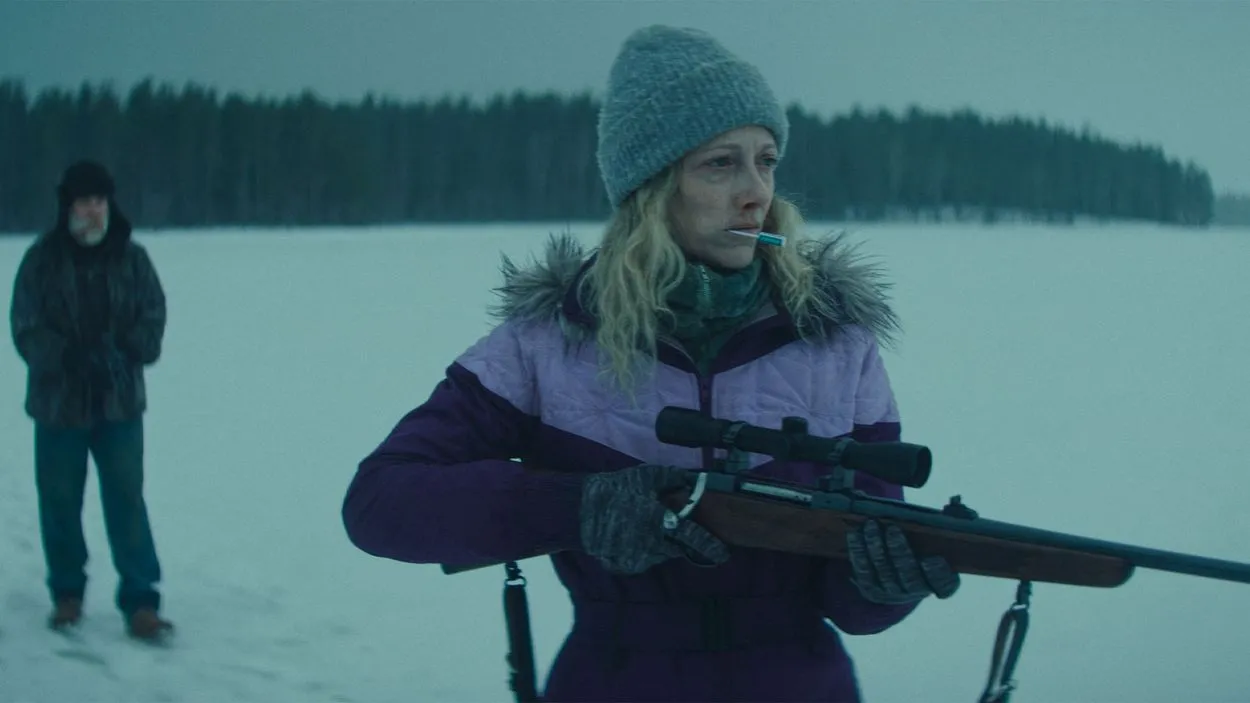
After the discovery, her posture shifts, her resourcefulness dredged up from a past life spent in the outdoors. It is a capability born of necessity, not heroism. The Mid-Western accent she adopts is a fascinating layer; it is both a genuine marker of her identity and a performance of neighborly normalcy that she clings to as her world descends into chaos. Her fight for the captive girl becomes a transference of her grieving, protective instincts, a desperate attempt to impose order on a universe that has become senselessly cruel.
In the opposite corner, Judy Greer delivers a career-redefining performance as the antagonist, a dark mirror to Thompson’s reluctant samaritan. She is not a simple monster but a figure of chilling pragmatism. Her terminal illness functions as a philosophical release from the social contract, a black ticket that grants her the freedom to pursue her goals without moral constraint.
Greer portrays her not as sadistic, but as terrifyingly logical, an agent of pure, self-interested will whose impending death has erased the line between right and wrong. Their conflict is not one of good versus evil. It is a collision of two irreconcilable desperations, a protector defined by a past loss versus a predator defined by a future one. Marc Menchaca’s brutish husband, a figure of pathetic menace, serves as a classic noir heavy, a blunt instrument whose presence only highlights the sharp, cold intelligence of the woman who wields him.
The Geometry of Cold
Brian Kirk and cinematographer Christopher Ross render the Minnesota winter as an architectural prison of overwhelming scale. The visual language is one of stark, high-contrast chiaroscuro, where the brilliant, featureless snow is sliced apart by the hard, black lines of barren trees and long shadows.
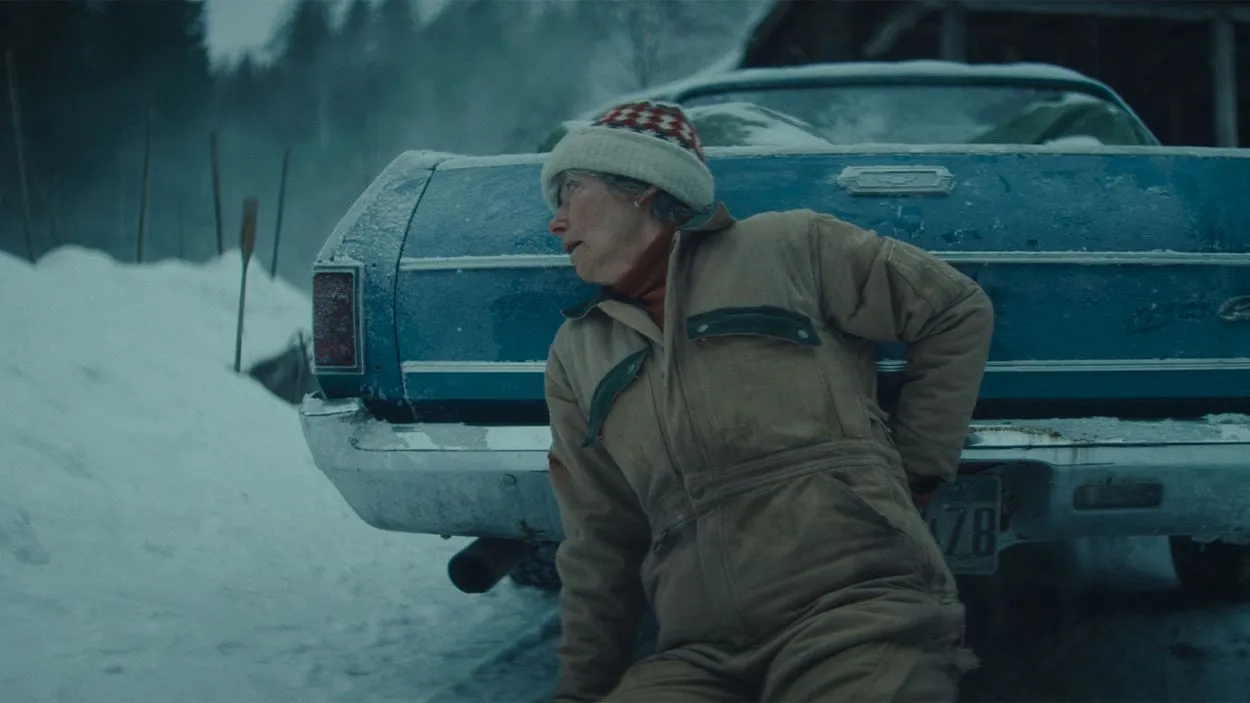
Wide, isolating shots dominate, shrinking the characters into vulnerable specks against an indifferent landscape, emphasizing their existential solitude. These moments are then violently contrasted with tight, claustrophobic close-ups during sequences of intense action, trapping the audience inside a cramped car or the suffocating confines of an ice-fishing shelter.
The color palette is a carefully controlled wash of whites, grays, and icy blues, making the sudden appearance of a vivid red bloodstain feel like a profound violation of the natural order.
This oppressive atmosphere is weaponized by the sound design and Volker Bertelmann’s score. The soundscape uses silence as a tool of terror, where the only thing more frightening than the violence is the quiet anticipation of it. The simple crunch of snow underfoot becomes a signal of impending doom, a sound that generates paranoia for both the characters and the viewer.
Bertelmann’s score avoids melodic sentimentality, opting instead for atonal strings and sharp, percussive jolts that mimic a frantic heartbeat, a sonic manipulation that plugs directly into the audience’s nervous system. Kirk’s direction is precise, his camera movements often smooth and deliberate, creating a sense of mechanical inevitability, as if guiding these characters toward a collision they are powerless to avoid.
Old Tropes, New Wounds
Structurally, The Dead of Winter is a tightly wound thriller, its chassis built from the reliable components of classic noir. The protagonist is an archetypal figure: the ordinary citizen who accidentally stumbles through a doorway into a criminal underworld and must navigate its treacherous terrain.
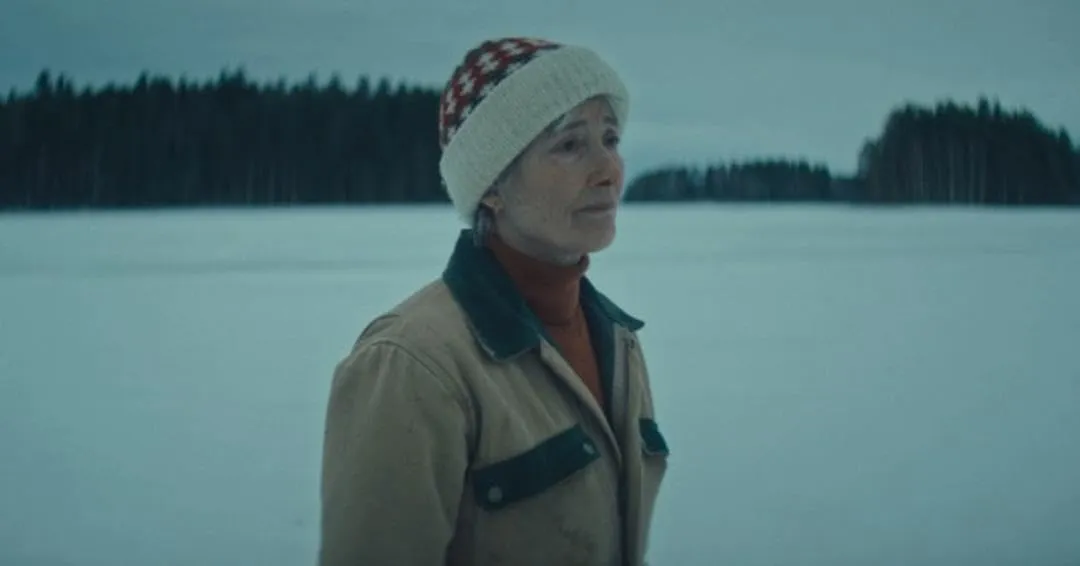
The snowbound wilderness, while a world away from the rain-slicked streets of classic noir, functions as the same kind of moral labyrinth—isolating, disorienting, and governed by its own brutal logic. Yet the film populates this conventional framework with deeper thematic inquiries. The protagonist’s journey becomes an existential exploration of purpose. When grief has hollowed out one’s identity, what new meaning can be forged in the crucible of violence?
The film subverts genre expectations by placing its female characters at the absolute center of its moral universe. Greer’s antagonist is a radical reinvention of the femme fatale; she is undeniably fatal, but her danger emanates from her own mortality and nihilistic philosophy, not her sexuality.
The conflict becomes a complex dialogue about feminine rage, empathy, and desperation, moving far beyond the simplistic archetypes the genre can sometimes default to. It questions how we channel loss, suggesting that finding a new mission can be both a path to survival and a dangerous deflection from the internal work of healing. The narrative may follow a recognizable map, but the psychological wounds of its characters feel immediate and painfully new.
The Dead of Winter is a 2025 film that premiered at the 78th Locarno Film Festival on August 8, 2025. It is set to be released theatrically in the United States on September 26, 2025. The film was distributed in North America by Vertical Entertainment. You can expect to find the movie in theaters starting on September 26, 2025.
Full Credits
Director: Brian Kirk
Writers: Nicholas Jacobson-Larson, Dalton Leeb
Producers: Jon Berg, Oana Iancu, Jonas Katzenstein, Maximilian Leo, Greg Silverman, Gideon Yu
Executive Producers: Emma Thompson, Gideon Yu, Chris Bosco, Elizabeth A. Bell, Oana Iancu, Jonathan Saubach, Klaus Dohle, Samuel Hall, Michael Rothstein
Cast: Laurel Marsden, Emma Thompson, Judy Greer, Gaia Wise, Marc Menchaca, Lloyd Hutchinson, Brían F. O’Byrne
Director of Photography (Cinematographer): Christopher Ross
Editors: Tim Murrell
Composer: Volker Bertelmann
The Review
The Dead of Winter
A brutally effective thriller, The Dead of Winter is anchored by commanding performances from Emma Thompson and Judy Greer. Its narrative may follow a familiar path, but the film’s oppressive atmosphere and precise direction create a chilling, psychologically rich experience. This is a stark, intelligent piece of neo-noir filmmaking that lingers long after the credits roll.
PROS
- Emma Thompson and Judy Greer deliver powerful, career-redefining performances that ground the film's psychological conflict.
- The skillful use of cinematography, sound design, and the stark Minnesota setting creates a tangible sense of cold and dread.
- Brian Kirk’s direction is taut and efficient, building relentless suspense.
- The film successfully explores complex ideas of grief, survival, and female agency within its genre framework.
CONS
- The plot adheres closely to established thriller and neo-noir conventions.
- The film's brutal and harrowing sequences may be difficult for some viewers.