





























Australian television seems to have an inexhaustible supply of picturesque coastal towns with dark secrets. It’s a genre so established it borders on self-parody. Into this crowded landscape arrives The Family Next Door, set in the fictional town of Osprey Point. The series opens on Pleasant Court, a cul-de-sac radiating a quiet, almost suffocating, sense of order.
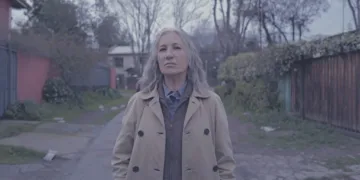
This fragile peace is immediately disrupted by the arrival of Isabelle, a stranger played with coiled intensity by Teresa Palmer. She tells her new neighbors she is a writer researching the area, a paper-thin cover for a deep, unspoken purpose. We see her fleeing a past she cannot articulate, her private grief raw and jarring against the community’s placid facade.
The show sets up a familiar premise: an outsider’s arrival forces a community to confront its hidden truths. The initial question is whether the series can find a new frequency in this well-worn narrative space, or if it will simply echo mysteries we have seen before.
The Curated Self and Its Discontents
The series anchors its drama in the dynamic between two women who represent opposing forces in this suburban ecosystem. Isabelle is a vehicle of disruption. Her quest for answers about a hidden past makes her a threat to the unspoken social contract of Pleasant Court: the agreement to maintain a placid surface at all costs.
Her intensity is not just a character trait; it is an ideological challenge to the community’s curated tranquility. In contrast, Ange, the real estate agent, acts as the chief defender of that contract. Her ambition is tied directly to the maintenance of appearances, both her own and the town’s.
Her immediate suspicion of Isabelle is the system’s natural response to an element it cannot control or commodify. Their conflict examines two versions of contemporary womanhood: one defined by the weight of an unresolved past, the other by the precariousness of a carefully constructed future.
This central tension is amplified by the surrounding ensemble, a collection of residents who offer a detailed portrait of privileged anxiety. The show gives space to Essie’s struggle with new motherhood, depicting her isolation with a candor that moves beyond television’s often-sanitized images of family life.
Her story reflects a wider cultural shift toward acknowledging the profound difficulties that can accompany major life events. Elsewhere, we see familiar archetypes of suburban drama: the husband who may be having an affair, the depressed man whose wife carries the emotional and professional load.
These figures, while not groundbreaking, are presented as further evidence of the community’s internal decay. The inclusion of Lulu and Holly, who run a local vegan café, seems designed to signal a modern, progressive sensibility, though their function is primarily to fill out the social fabric of the cul-de-sac.
Through these characters, the series probes the idea of the “curated self,” a distinctly 21st-century condition where personal identity becomes a performance for public consumption. The residents of Pleasant Court are not just living their lives; they are managing their brands, and the strain of this constant performance is the show’s true subject.
Pacing a Plot in the Binge Era
The Family Next Door employs a narrative strategy that has become dominant in the age of streaming: the slow burn. The story resists easy resolutions, choosing instead to let its central mystery unfold at a deliberate, almost leisurely, pace. Information about Isabelle’s past and her connection to Osprey Point is dispensed in small, carefully measured doses, demanding considerable patience from the viewer.

This decompressed storytelling is a direct product of the binge-watching model, which favors long-form engagement over the tighter plotting of traditional broadcast television. The approach can, in theory, allow for deeper character development and a more immersive world.
The question the series poses is whether its central plot has enough substance to justify the protracted timeline. When a mystery is stretched thin over many hours, it risks losing its narrative pull, becoming secondary to the atmospheric exploration of its setting.
The show’s episodic structure attempts to mitigate this by shifting its focus between the residents of Pleasant Court. Each installment foregrounds a different character’s personal crisis, weaving a web of interconnected dramas. This novelistic technique aims to create a complex social world, where the main investigation is just one of many threads. It positions the series less as a conventional thriller and more as a social drama that happens to contain a mystery.
The subplot involving Ange’s controversial property development serves as the show’s most direct link to contemporary social issues. It taps into real-world anxieties about gentrification, the destruction of the environment for profit, and the erosion of community identity. Ange’s fraught interactions with a spooked investor hint at larger systems of power and corruption operating just beyond the frame.
This narrative thread suggests a critique of a culture fixated on real estate, where the value of a place is measured in dollars instead of human connection. The show’s structure suggests that the true mystery is not a single event from the past, but the collective, ongoing moral compromises of the present.
No Filter: The Look of Modern Malaise
The most potent element of The Family Next Door is its visual language. Director Emma Freeman, known for her work on other series that interrogate Australian identity, uses the camera to deconstruct the myth of idyllic coastal life.

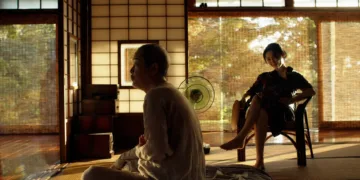
The cinematography by Craig Barden is distinctive and purposeful, avoiding the lush, inviting look of a travel advertisement. Instead, the series is given a harsh, over-exposed texture, as if the film itself has been left out in the sun too long. This “burnt” aesthetic bleaches the color palette, creating a world that feels simultaneously bright and depleted.
Shots of crashing waves and sea foam, staples of this genre, are rendered not as beautiful but as turbulent and raw, reflecting the characters’ inner turmoil. This is a deliberate artistic choice that weaponizes the Australian climate, turning the relentless sun from a symbol of vitality into an oppressive, clarifying force that leaves no flaw hidden.
This aesthetic is not mere decoration; it is the show’s primary mode of commentary. The sun-beaten look of the town is a direct visual metaphor for the emotional state of its residents. Their lives, like the landscape, are bright on the surface but weathered and worn down by hidden pressures.
The series presents Osprey Point as a place whose original charm has been “concreted over,” a physical manifestation of a cultural shift toward commercialism. The community’s fixation on real estate becomes a stand-in for a broader spiritual emptiness.
The camera lingers on manicured lawns and sterile modern architecture, suggesting a world where authenticity has been systematically replaced by a bland, marketable version of success. By refusing to romanticize its setting, the show offers a sharp visual critique of modern suburbia.
The atmosphere of unease it generates comes not from the threat of a single secret being revealed, but from the pervasive sense that this entire way of life is hollow and unsustainable. The look of the show tells a more powerful story than its plot sometimes manages.
“The Family Next Door” is a drama series produced in Australia, with six one-hour episodes. It premiered on Sunday, August 10, 2025, at 8pm on ABC TV in Australia, with all episodes available for streaming on ABC iview. The series is an adaptation of Sally Hepworth’s novel of the same name.
Full Credits
Director: Emma Freeman
Writers: Sarah Scheller, Pip Karmel, Julia Moriarty, Andrew Anastasios
Producers and Executive Producers: Melinda Wearne (Producer), Dean O’Toole (Series Producer), David Ogilvy, Jenny O’Shea, Joel Rice, Meghan Mathes Jacobs, Rachel Okine, Rebecca Anderson (Executive Producers)
Cast: Teresa Palmer, Bella Heathcote, Philippa Northeast, Bob Morley, Catherine McClements, Ming Zhu Hii
Director of Photography (Cinematographer): Craig Barden
The Review
The Family Next Door
The Family Next Door is more successful as a sharp visual critique of suburban anxiety than as a mystery. Its deliberate pacing and familiar plot are elevated by strong performances and a potent, sun-bleached aesthetic that captures a sense of modern discontent. While the narrative may not always surprise, the unsettling atmosphere it creates is effective and memorable.
PROS
- A distinct and powerful visual style that enhances its themes.
- Offers sharp social commentary on suburban life and the "curated self."
- Strong performances from the ensemble cast.
- Successfully creates a potent atmosphere of malaise and unease.
CONS
- The central mystery plot feels conventional and lacks narrative urgency.
- The slow-burn pacing may not hold every viewer's attention.
- Operates within the familiar confines of the Australian coastal mystery genre.
- The character-driven subplots sometimes overshadow the main story.