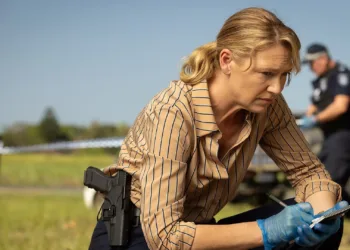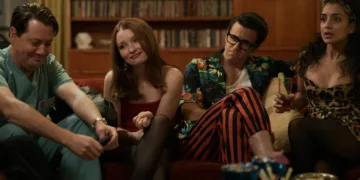















On the precipice of a new millennium, the world held its breath for the Y2K bug, a digital apocalypse that never quite arrived. One More Shot resurrects that specific, widespread anxiety and distills it into a personal crisis. The film is set on New Year’s Eve 1999, a night crackling with the ambient fear of a global system crash.
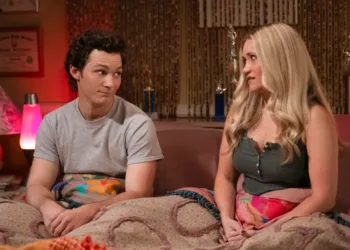
Our guide through this temporal minefield is Minnie (Emily Browning), an anaesthetist whose professional life is in order but whose personal life feels distinctly out of sync with her peers. She is a woman adrift, prodded into attending a party by the news that her ex-flame, Joe, the one who presumably got away, will be present.
Here lies the hope of rewriting a personal history. The mechanism for this revision is not a souped-up car or a complex machine, but something far more pedestrian and potent: a dusty bottle of tequila. A single shot sends her hurtling back to the start of the evening. Given the power to endlessly reset a single night, what exactly is the right thing to do? Or, perhaps, the most interesting?
Chronological Narcissism
Minnie’s initial use of her strange new gift is anything but noble; it is an act of pure chronological narcissism. She weaponizes it. Her objective is a small-scale demolition project: break up Joe and his new girlfriend, Jenny. The power is entirely solipsistic, a tool to bend a small pocket of reality to her will without any initial thought for the collateral damage to the lives orbiting hers.

Her first forays into this temporal sandbox are exercises in clumsy manipulation, positioning her as an anti-heroine of romantic revisionism. It is a testament to Emily Browning’s performance that Minnie remains watchable, even when her actions are deeply questionable. Browning performs a delicate ballet of comedic petulance and raw desperation, her expressions flickering between scheming confidence and the sudden, gut-punch realization of her own foolishness.
She gives Minnie a prickly, difficult charm that makes her accessible. The repetitive structure of the evening becomes a crucible for a kind of iterative morality. Each failed attempt chips away at her certainty. The endless do-overs force an evolution. Her mission, initially a myopic quest for a man, slowly transforms into a journey of self-excavation. She learns.
Slowly. The power that trapped her in a loop of her own making becomes the very thing that frees her from her obsession. She is both helpless and omnipotent, a goddess of a single, disappointing party, grappling with a free will so absolute it becomes its own cage.
Collateral Epiphanies
The film smartly populates its world with more than just Minnie’s romantic target, preventing the narrative from collapsing into a simple two-person drama. Joe is less an idealized prize and more a flawed, somewhat passive human, and his new partner Jenny serves as the inconvenient face of reality.

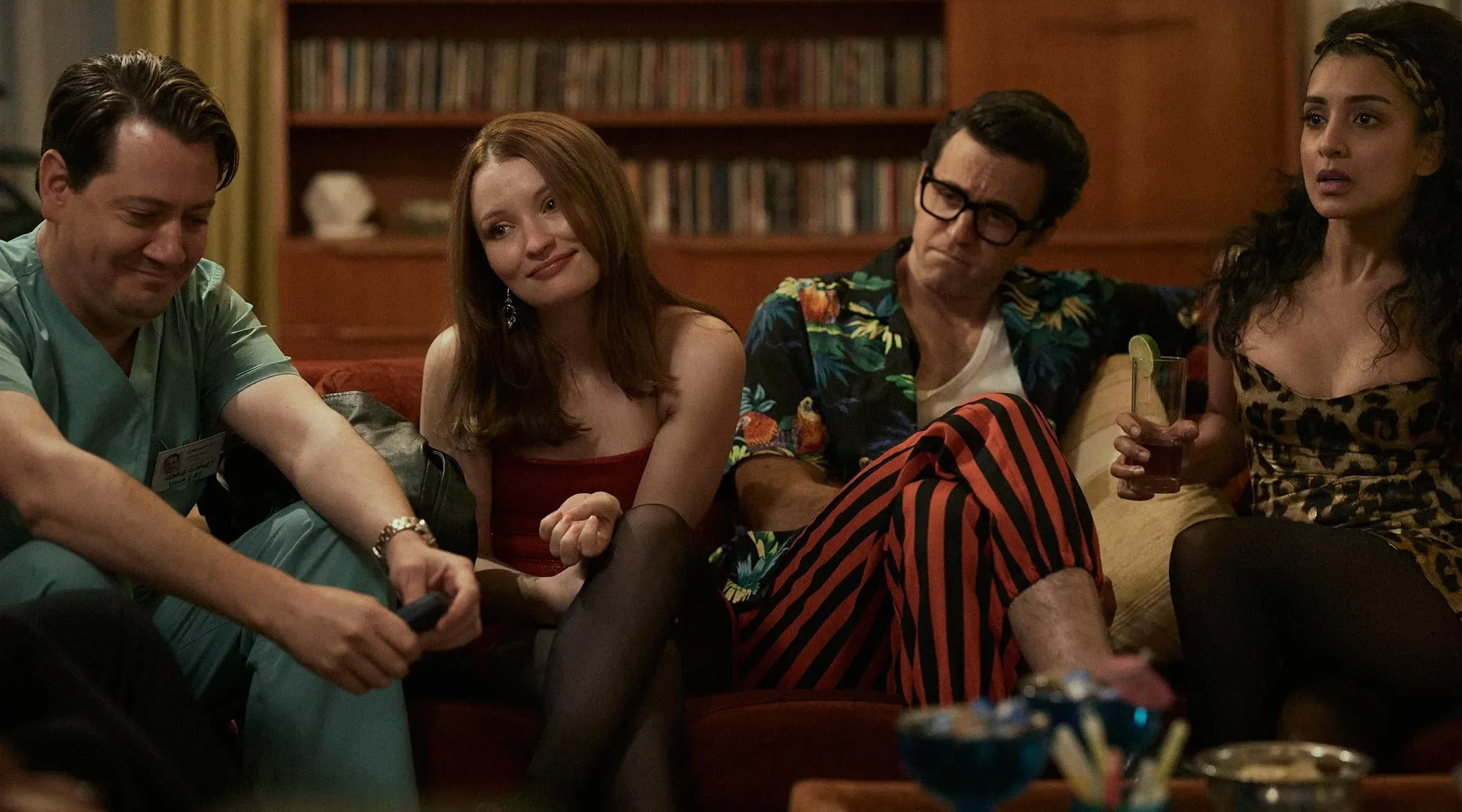
The story finds its richest soil in the subplots Minnie uncovers, the collateral epiphanies she stumbles upon while pursuing her own selfish ends. The most telling is the quiet friction in the marriage of her friends, Rodney and Pia. With each reset, Minnie gains a god’s-eye view of their domestic discontent, like a researcher observing subjects who don’t know they’re in an experiment.
Pia, a brilliant programmer who once worked on Y2K compliance (a delicious irony), now feels sidelined and intellectually starved as a stay-at-home mother. Rodney’s casual, clueless remarks about the impending technological collapse land with an unintended cruelty that only Minnie, through repetition, can fully register.
This discovery provides a vital counter-narrative; the seemingly perfect, settled lives of her friends are just as buggy and prone to crashing as her own. The party becomes a pressure cooker for the hidden anxieties of thirtysomethings pretending to have it all figured out. Minnie’s temporal meddling peels back the layers of performance, revealing the complex, often lonely, realities of modern friendship.
Pleasantly Derivative, Profoundly Human
Visually, the film is a simple affair. It is a functionally shot piece that places its faith in the script and the performers, not in any stylistic flourish. Some might call the aesthetic plain, but this choice keeps the focus squarely on the characters’ internal mechanics. The tone is playful and energetic, a necessary counterweight to the potential bleakness of the premise.

The 1999 setting works as more than simple nostalgia; it is a potent metaphor for Minnie’s own threshold anxiety. The collective uncertainty about the future mirrors her personal uncertainty about her life’s path. The period soundtrack, featuring tracks from The Cranberries and James, functions as an effective emotional shorthand for her internal state.
The movie does not seek to reinvent the time-travel genre. Its rules are fuzzy, its central gimmick a MacGuffin in the truest sense. This lack of explanation is a strength, preventing the story from getting bogged down in pseudo-scientific exposition. Its success is not in its novelty but in its application of a familiar device to a deeply human story about regret and self-acceptance. A brisk pace keeps the cyclical plot from feeling stagnant, making it an amusing film with a surprisingly sober core.
One More Shot is an Australian time-loop romantic comedy. It had its world premiere at the 2025 SXSW Film Festival on March 7, 2025. It also premiered at the Melbourne International Film Festival on August 9, 2025, and at the CinefestOz Film Festival on September 5, 2025.
Full Credits
Director: Nicholas Clifford
Writers: Alice Foulcher, Gregory Erdstein
Producers and Executive Producers: Virginia Whitwell, Nick Batzias, Jim Wright, Elise Trenorden (Producers); Dave Bishop, Alicia Brown, Michael Ciccone, Nicholas Clifford, George Hamilton, Abigail Hargrave, Cailah Scobie, Paul Wiegard, Heathcote Wright (Executive Producers)
Cast: Emily Browning, Aisha Dee, Sean Keenan, Pallavi Sharda, Ashley Zukerman, Hamish Michael, Anna McGahan, Contessa Treffone
Director of Photography (Cinematographer): Simon Ozolins
Editors: Julie-Anne De Ruvo
Composer: Justin Stanley
The Review
One More Shot
While One More Shot leans on a familiar genre framework, it uses it to ask surprisingly sharp questions about memory, regret, and the stories we tell ourselves about the past. Carried by a wonderfully layered performance from Emily Browning, the film is a witty and thoughtful comedy that finds its strength in character insight rather than narrative novelty. It’s a clever, enjoyable piece that punches above its weight.
PROS
- A strong, multifaceted lead performance by Emily Browning.
- The witty script effectively explores the complexities of long-term friendships.
- The Y2K setting provides a rich backdrop for themes of uncertainty.
- Prioritizes deep character development over explaining genre mechanics.
CONS
- A visually plain and aesthetically simple presentation.
- The central time-travel premise is not original.
- Some supporting characters feel underdeveloped.
- Its intentionally vague plot mechanics may not satisfy all viewers.