
























The machinery of the action comedy often begins with a man seeking stasis. For Russell, an armored truck driver played by Eddie Murphy, that stasis is a 25th wedding anniversary, a domestic horizon he intends to reach after one final shift. His world is one of routine, of quantifiable risk.
The narrative architecture introduces its destabilizing force not as a great cataclysm, but as a minor irritant: a new partner. This figure, Travis (Pete Davidson), is an avatar of noisy incompetence, a random variable inserted into a controlled system.
The true catalyst, however, arrives in the form of Zoe (Keke Palmer), a woman who presents as a romantic possibility but is, in fact, the architect of the day’s chaos. A simple pickup spirals into a kidnapping, pulling the mismatched men into a criminal enterprise far beyond their job description. Their day becomes a frantic, unwilling negotiation with fate.
Three Figures in a Moral Void
The film offers its central trio not as an ensemble but as discrete philosophical positions adrift in a shared space. At its center, Eddie Murphy’s Russell is a quiet study in ontological weariness. Here is a performer once defined by his kinetic, almost electric, command of the screen, now receding into a state of profound passivity.
This is more than playing the straight man; it is an embodiment of existential exhaustion. His stillness could be interpreted as a character choice—the man yearns for retirement, for an end to motion—but it creates a gravitational dead zone, draining energy from his scenes.
He feels less like a participant and more like a hostage to the plot, a man whose agency has been surrendered long before the criminals arrive. His brief moments of connection with Eva Longoria’s Natalie are telling; they hint at a life and a personality existing entirely outside the film’s primary narrative, a world to which he, and we, would rather retreat.
Opposite him is Pete Davidson’s Travis, a being of pure, unexamined impulse. The character is a chaotic assemblage of tics and a relentless verbal static that fills the film’s many silences. The script gifts him a savant-like mathematical ability, a peculiar trait that is introduced with sonic flourishes and then promptly abandoned.
This is not merely a loose thread; it is a perfect metaphor for the character himself—a collection of half-formed ideas signifying nothing. He is a post-modern jester whose jokes are not punchlines but placeholders. The dynamic with Murphy never ignites because it is a pairing of voids: one of exhaustion, the other of incoherence.
Into this vacuum steps Keke Palmer as Zoe, the only figure attempting to impose a rational will upon the universe. Palmer’s undeniable charisma is the film’s sole life force, a desperate attempt to animate the inert material. She is tasked with an impossible dual role: to be the menacing antagonist and the sympathetic antihero.
The script forces her to pivot from a coolly efficient mastermind to a woman with a flimsy, socially conscious motive, a move that sanitizes the noir archetype of the femme fatale into something far less dangerous and far less interesting. Palmer almost succeeds in bridging this gap through sheer performative strength, but she remains a solitary spark in a vast darkness.
The Blueprint’s Flaw
The narrative structure of this film is an act of careful replication, an assembly line product built from a well-worn schematic. The story progresses with a sense of grim inevitability, its beats pre-ordained by a thousand other genre pictures. There is no suspense in its trajectory, only the mild curiosity of seeing how it will connect its established points.

Unlike the intricate narrative clockwork of a superior caper, this plot feels sluggish, its mechanics exposed and grinding. This sense of artifice is heightened by the film’s very world-building. The highways of New Jersey are rendered as a desolate, unpopulated expanse, a non-place existing purely for the convenience of vehicular combat. These are not oversights but tacit admissions of the film’s disinterest in reality, transforming its setting into an abstract video game level.
This shaky foundation supports an equally flawed moral architecture. The screenplay attempts to imbue Zoe’s heist with significance through a late-stage reveal of her motives, a clumsy graft of social justice onto a simple crime story.
This maneuver, intended to add emotional weight, accomplishes the opposite. By making the antagonist righteous, it removes all moral ambiguity and deflates the stakes to nothing. The tension evaporates. Suddenly, there are no villains, only misunderstood people in unfortunate circumstances.
The film’s comedy suffers a similar fate, a string of repetitive gags that lack the sharpness or insight to land effectively. Character development is handled not through action or behavior but through blunt expositional dialogue, a crude tool used to tell us what a more confident film would have shown. The characters talk about who they are because their actions fail to define them.
Direction Without a Destination
A film’s soul is often located in its visual choices, in the way light and shadow sculpt its meaning. The direction here is an exercise in proficient neutrality. The visual palette is dominated by a bright, even, high-key lighting that is the antithesis of suspense.

It is the flat, shadowless illumination of a sitcom, a choice that robs the thriller elements of any potential menace or atmosphere. Every surface is visible, every corner exposed, and consequently, nothing holds any mystery.
There is no psychological landscape here, no expressionistic framing to suggest a character’s fractured internal state. The camera is a passive documentarian, observing events from a safe distance with conventional master shots and coverage. It refuses to take a side or offer a perspective.
This aesthetic inertia extends to the action sequences. They are technically serviceable constructions of twisted metal and orange fireballs, yet they are weightless. The physics of destruction are on display, but the human consequences are absent.
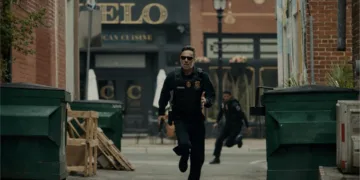
A chase sequence unfolds without a coherent sense of geography or escalating peril; it is a montage of discrete impacts rather than a fluid, heart-pounding event. The compositions frequently recall other, better films—a figure strapped to a car hood, a warehouse standoff—but these are citations without comprehension, gestures toward a cinematic language the film itself does not speak.
The underuse of the supporting cast further contributes to this feeling of emptiness. Figures appear briefly and vanish, their presence too fleeting to register, serving only to highlight the hollowness of the central story.
A Forgettable Caper
The film is a cascade of failures, a system where a disengaged lead performance, a rote screenplay, and direction devoid of personality amplify one another’s weaknesses. The parts do not form a satisfying whole; they create a vacuum. Its most profound artistic offense is not that it is memorably bad—for a truly awful film can be instructive, even enjoyable in its ineptitude.

Its crime is its profound blandness. It is a work that actively resists memory, a frictionless object that passes through the consciousness and leaves no trace. This movie feels less like a creative act and more like a contractual obligation, a product designed to fill a vacant slot on a streaming service’s digital shelf. The Pickup represents a significant squandering of its charismatic cast, a hollow enterprise that promises a joyride but delivers only a long, featureless road.
“The Pickup” is an action-comedy film released by Amazon MGM Studios and distributed via Prime Video. It premiered globally on Prime Video on August 6, 2025. It blends fast-paced action with humor, centering on a routine cash pickup that takes a wild turn when two mismatched armored truck drivers, Russell and Travis, are ambushed by ruthless criminals led by a savvy mastermind, Zoe.
Full Credits
Directors: Tim Story
Writers: Kevin Burrows, Matt Mider
Producers: John Davis, John Fox, Eddie Murphy, Tim Story, Charisse Hewitt-Webster
Cast: Eddie Murphy, Pete Davidson, Keke Palmer, Eva Longoria, Andrew Dice Clay, Marshawn Lynch, Ismael Cruz Córdova, Jack Kesy
Director of Photography (Cinematographer): Larry Blanford
Editors: Craig Alpert
Composer: Christopher Lennertz
The Review
The Pickup
A hollow cinematic exercise, The Pickup squanders a charismatic cast on a journey defined by its profound lack of energy, wit, and visual imagination. Eddie Murphy’s disengaged presence creates a vacuum that a weak script and lifeless direction cannot fill. Keke Palmer’s spirited performance is the sole point of light in an otherwise generic and instantly forgettable action-comedy that is less a movie and more a 90-minute placeholder. It is a film whose greatest crime is not being bad, but being a complete and utter blank.
PROS
- Keke Palmer delivers a charismatic and energetic performance, elevating the material she is given.
- The action sequences, while uninspired, are staged with technical competence.
- Eva Longoria provides a brief, welcome spark of energy in the third act.
CONS
- Eddie Murphy’s lead performance feels disengaged, tired, and lifeless.
- The script is generic, riddled with plot holes, and reliant on predictable genre tropes.
- Direction and cinematography are flat and visually uninteresting, lacking any distinct style.
- The humor consistently fails to land, and crucial plot points are delivered through clumsy exposition.
- The film ultimately feels bland, hollow, and instantly forgettable.