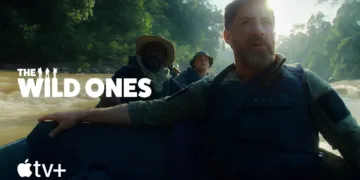













In the crowded jungle of nature documentaries, a new series always needs a hook. For Apple TV+’s The Wild Ones, that hook is a team of specialists whose mission is part David Attenborough, part A-Team. The six-part series follows former military commando Aldo Kane, wildlife cinematographer Vianet Djenguet, and camera-tech expert Declan Burley as they hunt for Earth’s most reclusive and endangered creatures.
They venture into remote locations to find species like the Malayan tiger and the Gobi bear. Their stated goal is not simply to get the shot; it is to provide data and footage that actively aids conservation, from helping scientists track breeding patterns to giving governments evidence to expand protected lands. The show sells itself as an intervention, a direct answer to the viewer’s cry of “Why don’t they do something?”
The Grind Behind the Glamour Shot
Forget sweeping aerial shots of untouched vistas set to a soaring orchestra. The Wild Ones spends most of its time in the mud with its hosts, and it wants you to feel every squelch. The series is fundamentally a process documentary, a format that has become increasingly prevalent in an era obsessed with “authenticity.” Like a cooking show that focuses on the chef’s frantic search for a rare ingredient rather than just the finished dish, this series posits that the struggle is the story.
The audience is invited not just to witness the final glamour shot of a majestic beast, but to endure the slog required to get it. The physical toll is rendered in visceral detail. We watch the team contend with the threat of foot rot in the perpetually sopping-wet Malaysian rainforest, a condition that sounds medieval but is a present-day reality for them. The simple act of putting on still-damp clothes in the morning becomes a recurring motif of misery. Leeches, the slimy mascots of jungle hardship, are pulled from abdomens with a wince and a bit of whisky.
This focus on the human element is a deliberate structural choice that re-calibrates the entire viewing experience. It dedicates significant runtime to the technical and logistical scaffolding of the expedition. Declan Burley’s mission to deploy over one hundred camera traps becomes a narrative engine in itself. The show lingers on the methodical labor of finding the right game trail, angling the lens, and hoping the technology survives the elements.
His work represents a modern, almost remote-controlled approach to wildlife observation. In contrast, Vianet Djenguet embodies the traditional method, a monk-like figure whose job requires him to sit motionless in a cramped hide for days, waiting for a single moment of activity. The show places these two styles side-by-side, creating a quiet dialogue about the changing nature of the craft. Aldo Kane, the pragmatic survivalist, operates on a third track, patrolling the perimeter for signs of poachers.
His discovery of a discarded snare is filmed with the gravity of a detective finding a murder weapon, a stark reminder of the human threat lurking just outside the frame. The chemistry between the three is one of quiet professionalism; they are colleagues united by a difficult job, and their interactions feel grounded and unforced. The gamble of this human-centered approach is that it risks making the animals supporting characters in their own documentary.
An Uneasy Hybrid
For decades, the nature documentary genre has been governed by a sacred, unspoken pact with the audience, a version of Starfleet’s Prime Directive. The role of the filmmaker was to be an invisible observer, a dispassionate lens capturing nature’s unblemished truth. To interfere was to taint the experiment, to risk unforeseen consequences, and to shatter the illusion of a world without us. The Wild Ones takes that pact and ceremoniously tears it up.

Its central thesis is a direct response to the realities of the Anthropocene: in a world thoroughly altered by human action, a posture of pure observation is an abdication of responsibility. The series argues that for species on the brink of extinction, non-interference is a luxury we can no longer afford. This philosophical shift is the show’s most radical, and most interesting, attribute.
The team’s interventions are presented as practical, targeted, and essential. They are not merely filming the dwindling rhino population in Indonesia; they are helping scientists collect genetic information to create a viable breeding program. When they track tigers in Malaysia, the footage they secure is not for entertainment alone; it becomes a key piece of evidence used to persuade the government to expand the boundaries of a national park, giving the animals more room to live.
This is conservation as an active, boots-on-the-ground pursuit. Yet, for all its noble intentions, the show’s execution is sometimes clumsy, revealing an identity crisis. It is a series caught between the gravitas of its mission and the seductive, accessible language of reality television. The grammar of the unscripted format is everywhere. Minor logistical problems can be inflated with tense musical cues and breathless narration.
The camera often privileges a host’s emotional reaction over the event itself; a fleeting image of an animal is immediately followed by a tight close-up on a tear-streaked face. This focus on performative emotion is a hallmark of reality TV, designed to create a simple, direct empathetic link with the viewer.
While the series avoids the manufactured interpersonal conflicts of the genre’s lower forms, it borrows heavily from its toolkit to keep the narrative engaging, especially during the long stretches where no animals appear. This creates an uneasy hybrid, a program that feels both vital and slightly suspect. It is a documentary trying to do important work, but it does so using a televisual language that prioritizes feeling over thinking.
A Reward for Patience
The animals in The Wild Ones are not characters; they are apparitions. They exist at the edge of the frame, as ghosts in the machine of Declan’s camera traps, or as fleeting shapes Vianet might glimpse after days of stillness. The entire narrative structure of each episode is built around this scarcity. The show demands that the viewer share in the team’s profound patience.

It is a slow-burn narrative that stands in stark opposition to the instant gratification of most modern media. For long stretches, the primary visual is the deep green of the jungle, a seemingly impenetrable wall of foliage. The sound design emphasizes the quiet, the waiting, the near-total lack of activity. This deliberate pacing is a risky strategy. It asks the audience to invest in the process, to value the effort as much as the result. For some, this will be a frustrating and tedious exercise. For others, it will make the payoff exponentially more powerful.
When the reward finally comes, it is often delivered through the raw, unpolished aesthetic of the camera trap. The footage is frequently grainy, overexposed, or shot from an awkward, ground-level angle. A magnificent tiger might be partially obscured by a leaf. This “found footage” quality gives these moments a startling authenticity. They feel less like a cinematic production and more like a stolen glance into a secret world, a genuine discovery.
The emotional impact of these scenes is immense, especially when they confirm the team’s worst fears. Seeing a tiger with only three legs, its fourth lost to a poacher’s snare, is a gut punch. The image is not just a tragedy in itself; it is the physical manifestation of the abstract threats the show has been discussing. It is the reason for Aldo’s patrols, for the team’s hardship, for the entire mission.
The show’s structure forces you to understand the monumental effort behind that single, heartbreaking image. It bets everything on the power of these rare glimpses. Whether the modern viewer, conditioned for faster rewards, is willing to wait for them is the show’s biggest, and most important, question.
“The Wild Ones” is a six-part documentary adventure series that premiered globally on Apple TV+ on July 11, 2025. The series follows a team of wildlife experts – former Royal Marines Commando Aldo Kane, wildlife and camera trap expert Declan Burley, and wildlife cinematographer Vianet Djenguet – as they go on expeditions around the world to track and protect endangered species. It was produced by Offspring Films. You can watch “The Wild Ones” on Apple TV+.
Full Credits
Producers and Executive Producers: Alex Williamson, Isla Robertson
Cast: Aldo Kane, Vianet Djenguet, Declan Burley
Director of Photography (Cinematographer): Vianet Djenguet
Composer: Nainita Desai
The Review
The Wild Ones
The Wild Ones is a noble, if uneven, experiment in documentary filmmaking. Its hands-on approach to conservation is a vital update to the genre, and it powerfully conveys the immense difficulty of modern fieldwork. However, its reliance on reality TV conventions and its intense focus on the human hosts often sideline the very animals it seeks to save. The series demands immense patience, offering a profound reward for those willing to wait, but it may frustrate viewers looking for a more traditional wildlife showcase.
PROS
- Presents an active, interventionist model of conservation.
- Effectively demonstrates the grueling physical and mental challenges of fieldwork.
- The team's work leads to tangible, positive outcomes for endangered species.
- The rare animal footage, when it arrives, carries significant emotional weight.
CONS
- The intense focus on the presenters can feel self-serving and overshadows the wildlife.
- Borrows from reality TV formats, sometimes creating artificial tension.
- The slow, methodical pacing may not appeal to all viewers.
- There is a scarcity of actual animal footage compared to traditional nature series.