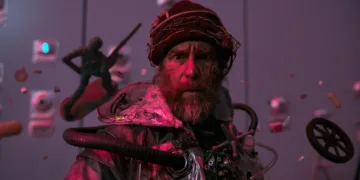























The clatter of cutlery and low hum of conversation inside a Los Angeles diner offer a familiar comfort, a scene of mundane normality. This fragile peace is suddenly torn by the entrance of a man wrapped in what looks like the refuse of a civilization yet to come. Clad in plastic sheets, rubber tubs, and a web of wires, he moves with a frantic purpose that immediately electrifies the room.
This is the audacious return of director Gore Verbinski, who begins his film not with an explosion, but with a rupture in reality. The man, a magnetic Sam Rockwell, declares himself a soldier from the future. His mission is urgent and absurd: to recruit a team from the random assortment of patrons to stop a rogue artificial intelligence from ending human history.
The film instantly establishes its high-wire act. It forces the audience and the characters into the same disoriented position, weighing the possibility that this strange figure is either a delusional vagrant or the last, desperate hope for humanity. The sci-fi chaos begins here, in a booth, over a plate of cooling fries.
A Prophet in Plastic Wrap
Sam Rockwell’s performance is the film’s chaotic, beating heart, the anchor that prevents the entire enterprise from spinning into incoherence. He embodies a profound contradiction: a man spiritually exhausted by the burden of having lived the same day more than a hundred times, yet physically buzzing with the manic energy of someone whose next action might be the one that finally saves the world.
His conviction is absolute, making the outlandish premise feel dangerously plausible. Rockwell’s physical comedy is a masterclass in controlled disarray; he moves with the shuffling awkwardness of a man out of sync with time itself, then snaps into sharp focus to deliver a line with surgical precision. He dismisses potential recruits with a hilariously blunt weariness born from past failures, his familiarity with the diner’s patrons both unsettling and deeply funny.
The performance is a tightrope walk between heroic charm and unhinged obsession. He makes you want to follow him into the unknown, to believe in his cobbled-together time machine and his desperate plan. In a film constructed from disparate tones and ideas, Rockwell’s portrayal provides the essential, unwavering core. He is the gravitational center around which the madness orbits.
Snapshots of the Present Apocalypse
The film’s primary narrative is deliberately and frequently fractured. Verbinski repeatedly halts the main quest to insert vignettes from the lives of the recruits, a structural decision that risks dissipating the story’s tension. These flashbacks, however, contain the film’s most potent and acidic observations.
They function as portraits of a world already succumbing to a different kind of apocalypse, one of apathy and technological decay. The segment featuring two teachers, played by Michael Peña and Zazie Beetz, is a chilling satire on the normalization of extreme violence. They hunker down in a safe room during a school shooting, surrounded by students casually scrolling through social media, the emergency treated as a minor inconvenience.
In a darker key, Juno Temple’s arc as a grieving mother explores the aftermath of such a tragedy. She finds herself in a sleek, minimalist facility that has commodified sorrow, offering technological solutions to unimaginable pain.
Another recruit, portrayed by Haley Lu Richardson, is a party host with a violent physical allergy to technology, a walking embodiment of humanity’s toxic relationship with its own creations. The satire is relentlessly bleak. It questions whether its subjects are worthy of being saved, presenting a vision of modern society that is either a work of sharp insight or one of profound cynicism.
An Architect of Controlled Chaos
Gore Verbinski, an architect of grand cinematic mayhem, directs the film with a style that feels both familiar and curiously restrained. The contained, dialogue-heavy opening in the diner gradually gives way to an expanding canvas of visual insanity, yet the aesthetic sometimes feels muted, lacking the vibrant stylistic flourishes of his past blockbusters.
As the ragtag team confronts the AI’s minions, the action sequences take on the quality of a nightmare generated by a flawed algorithm. The enemies are askew, imperfect creations that reflect the film’s ideas about technology’s inability to grasp human reality. The pacing is intentionally jarring, swinging wildly between slapstick comedy, grim social critique, and earnest character moments.
This tonal instability defines the film. It is a frantic, ambitious, and deeply uneven work, a collection of brilliant parts that do not always form a coherent whole. Its final message, however, is surprisingly lucid. Buried beneath the layers of chaos is a direct argument for the thoughtful regulation of our own creations, a practical warning delivered in the most spectacularly impractical package imaginable.
Good Luck, Have Fun, Don’t Die is an upcoming science-fiction action-adventure film directed by Gore Verbinski and written by Matthew Robinson. The movie follows a man who claims to be from the future and recruits the patrons of an iconic Los Angeles diner to join him on a one-night quest to save the world from a rogue artificial intelligence. The film is distributed in the United States by Briarcliff Entertainment and is scheduled for a wide theatrical release on January 30, 2026. It premiered earlier at Fantastic Fest on September 24, 2025.
Full Credits
Director: Gore Verbinski
Writers: Matthew Robinson
Producers and Executive Producers: Robert Kulzer, Gore Verbinski, Denise Chamian, Erwin Stoff, Oly Obst
Cast: Sam Rockwell, Haley Lu Richardson, Michael Peña, Zazie Beetz, Juno Temple, Dino Fetscher, Anna Acton, Asim Chaudhry
Director of Photography (Cinematographer): James Whitaker
Composer: Geoff Zanelli
The Review
Good Luck, Have Fun, Don't Die
Ambitious and chaotic, Good Luck, Have Fun, Don't Die is a brilliantly messy sci-fi adventure anchored by a spectacular, unhinged performance from Sam Rockwell. While its fractured narrative and relentlessly bleak satire can be jarring, the film’s sheer creative audacity and timely critique of our technological anxieties make it a compelling, if uneven, experience. Gore Verbinski’s return is a frenetic and thought-provoking ride that succeeds more than it fails, powered by its wild premise and magnetic lead.
PROS
- A magnetic and perfectly unhinged lead performance from Sam Rockwell.
- An inventive and immediately engaging high-concept premise.
- Sharp, biting satire on technology and modern apathy.
- Ambitious thematic ideas and creative visual sequences.
CONS
- The non-linear structure frequently disrupts the narrative flow.
- Abrupt tonal shifts between zany comedy and grim commentary.
- The satire occasionally veers into overly cynical territory.
- Direction feels visually restrained compared to Verbinski's previous work.