





![Kingdom Hearts Collection [I-III] Review](https://gazettely.com/wp-content/uploads/2026/10/Kingdom-Hearts-Collection-I-III-1-360x180.webp "Kingdom Hearts Collection [I-III] Review: KHII Holds Steady as Newer Entries Fluctuate 37")





We arrive in a life already in motion. For Grace Pine, a 23-year-old music critic, that life is contained within the year 2011, a time capsule of fading analog hopes. She carries to Montreal an ambition that feels like a shield: to anatomize Alanis Morissette’s Jagged Little Pill for a book, to give structure to a celebrated rage and perhaps find a blueprint for her own.
Barbie Ferreira presents this ambition with a fragile certainty, a belief that a new city can alchemize a new self. The film breathes the city’s humid summer air, thick with the promise of indie rock and artistic becoming. Yet every quest for a voice begins with a period of profound listening, and one wonders what dissonant frequencies will answer when Grace asks the world who she is supposed to be. The search for authenticity is often a pilgrimage toward one’s own contradictions.
Gravity of the Superficial
Montreal does not offer a refuge; it presents a seductive chaos that threatens to dissolve Grace’s singular focus. The city itself becomes a character, a labyrinth of rooftop parties, dingy concert venues, and bagel shops that operate on a timeline separate from worldly ambition.
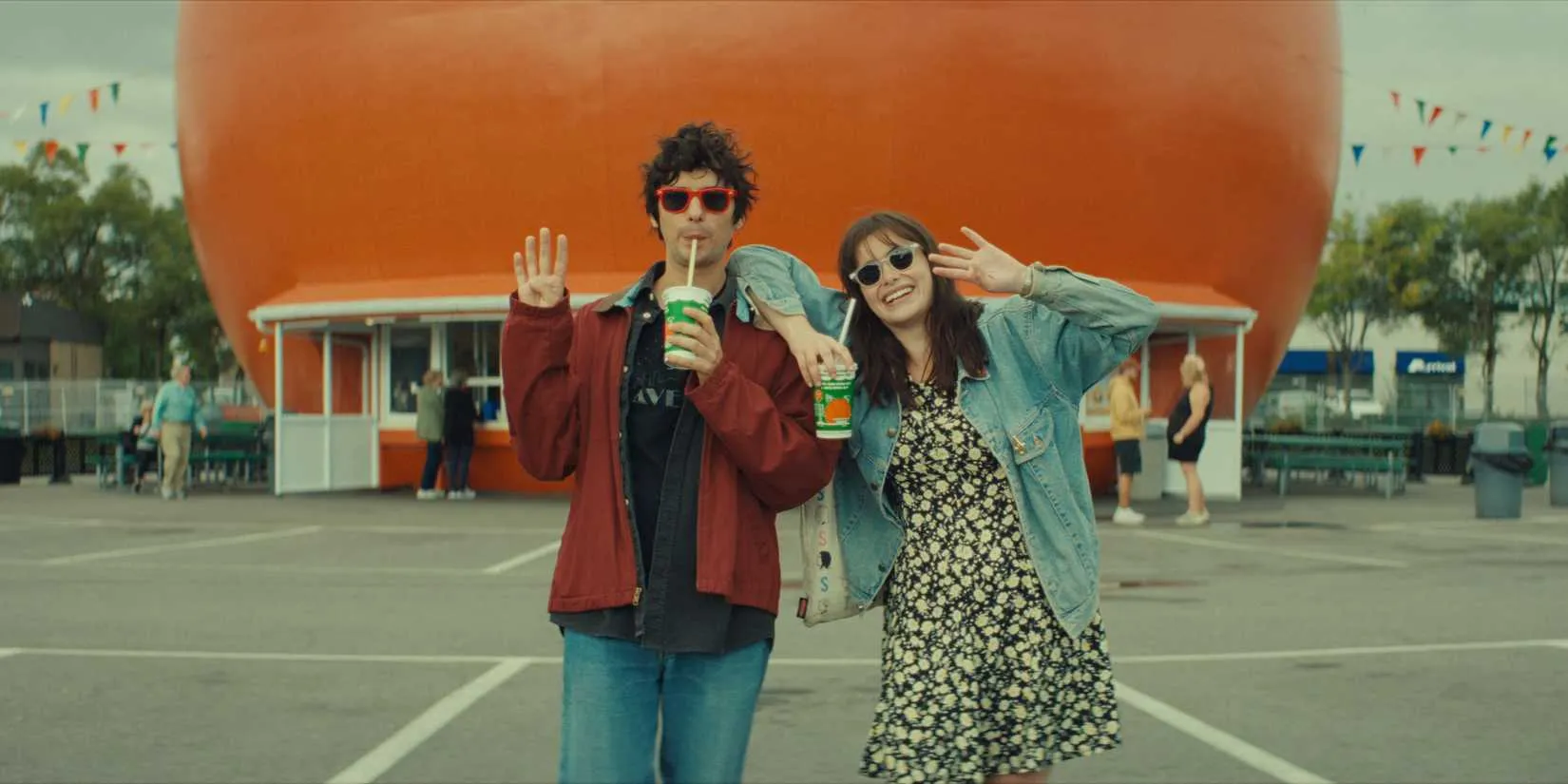
Her Craigslist-found apartment introduces her to Madeleine, a roommate whose life as a DJ is a portrait of effortless immersion in the very scene Grace wishes to document from a critical distance. This new world is given a soundtrack by a local band, Bone Party, whose angular rock music is the perfect anthem for the beautiful apathy Grace finds so alluring.
The band acts as a focal point for her undoing, personified by two opposing forces. There is Archie, the guitarist whose wry humor and quiet intelligence offer a path toward genuine connection. Then there is Chevy, the frontman, a magnetic vacuum of ego and indifference. He is not a person to be known but a phenomenon to be experienced.
Grace, the analyst, immediately abandons analysis and falls into his orbit. The book, her totem of self-definition, languishes. Her descent is a slow, methodical erasure. She begins to pour her professional skills into the band’s ascent, a sacrifice offered at the altar of acceptance. This act is a haunting echo of past compromises, a ritual of self-negation she seems doomed to repeat.
The Anatomy of Self-Sabotage
What is a self but a story we tell ourselves? For Grace Pine, that narrative is fracturing. The film becomes a clinical study of this fragmentation, exploring the chasm between her sharp intellect and her baffling emotional choices. Her quest for external validation is a flight from the terror of self-creation; it is easier to see oneself reflected in another’s gaze, however empty, than to construct an identity from within.
Barbie Ferreira portrays this internal war with breathtaking precision. Her performance is rooted in a physical awkwardness that belies a restless, analytical mind. We see the weight of every bad decision in her posture, the silent calculation in her eyes even as her actions betray all reason. The film examines the bleak mechanics of power.
Grace holds intellectual authority, yet she willingly cedes it to a hollow masculine confidence, exploring the ways we surrender our own power when confronted with its opposite. This surrender is made painfully explicit in scenes of intimacy with Chevy, which are less about desire than about the profound horror of disconnection.
They are hollow physical acts that highlight her existential solitude. A single sequence captures her entire condition: alone in a dark office, she waves her arms frantically to trigger the motion-sensor lights. It is a desperate, silent scream against the void, a primal dance to prove she still exists, to keep the encroaching darkness at bay for just one more moment.
The Artifacts of Becoming
Chandler Levack’s direction is a form of cinematic archaeology, excavating the recent past to unearth something timeless about the human condition. The film’s semi-autobiographical pulse gives every frame the lived-in texture of a personal memory, making it an artifact of a specific consciousness.
The camera is not an objective witness; it is tethered to Grace’s subjective experience. Stylistic choices, like a party sequence shot with the flat, predatory glare of a period fashion photograph, are not mere aesthetics. They are arguments about the ways we were conditioned to see and be seen in that particular moment. The film’s meticulous reconstruction of 2011 is essential, showing a world on the cusp of hyper-connectivity, where loneliness had a different shape.
Levack uses this setting to ask a quiet but persistent question: how does one build a self from the wreckage of one’s own mistakes? The film’s final moments offer no easy answers, no triumphant transformation. Instead, they settle into a state of acceptance. This earned grace is not a destination but a realization: that identity is not a fixed point to be reached but a fluid, often painful, process. We are all just a collection of our own revisions.
Mile End Kicks premiered at the Toronto International Film Festival on September 4, 2025. Information on where to watch the film has not yet been released, as it is not currently available on streaming platforms.
Full Credits
The Review
Mile End Kicks
Mile End Kicks is a deeply honest and unflinching examination of the space between ambition and self-destruction. It trades easy narrative satisfaction for a more profound truth about the messy, often painful, process of becoming. Anchored by a phenomenal lead performance and a sharp directorial vision, the film is a quiet, witty, and compassionate portrait of a young woman learning that finding one's voice sometimes requires first losing one's way. It is a significant work of subjective realism.
PROS
- Barbie Ferreira delivers a layered, authentic, and deeply human lead performance.
- Chandler Levack's direction is confident, with sharp writing that feels specific and lived-in.
- The film offers a realistic and empathetic portrait of a flawed, complex protagonist.
- It successfully captures the specific cultural atmosphere of Montreal's indie music scene in 2011.
- Strong supporting cast, with a particularly charming performance from Devon Bostick.
CONS
- Certain supporting characters feel thinly drawn, serving more as catalysts for the protagonist.
- The narrative sometimes loses momentum, feeling repetitive as the main character circles similar mistakes.
- Occasional shifts in comedic and dramatic tone can feel abrupt.