
























![Kingdom Hearts Collection [I-III] Review](https://gazettely.com/wp-content/uploads/2026/10/Kingdom-Hearts-Collection-I-III-1-360x180.webp "Kingdom Hearts Collection [I-III] Review: KHII Holds Steady as Newer Entries Fluctuate 37")





The television period drama often serves as a form of cultural comfort food, a retreat into a past where the costumes are lavish and the social codes are quaintly rigid. Yet, a more interesting trend sees the genre evolving from nostalgic escape into a tool for social autopsy. By setting a story in a specific historical moment, creators can isolate and dissect contemporary anxieties with a precision that a modern setting might obscure.
Murder Before Evensong places itself squarely in this latter camp. At first glance, it presents all the requisite elements of a cozy British mystery: a tranquil village, a gentle vicar, and a shocking murder to disrupt the peace. But its choice of 1988 as a backdrop is deliberate and incisive. This is not a romanticized past.
It is a time of palpable social friction, a world grappling with the AIDS crisis, entrenched homophobia, and the lingering shadows of war. The series uses the familiar framework of a whodunit to conduct a thoughtful examination of how a community fractures under the weight of fear, prejudice, and long-buried secrets.
The Vicar and His Mother
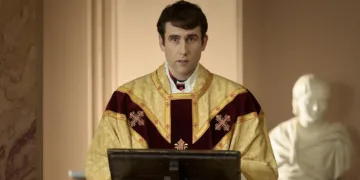
The emotional and moral center of Champton resides in Canon Daniel Clement, a character brought to life with remarkable subtlety by Matthew Lewis. Lewis successfully sheds the skin of his most famous role, offering a portrayal of quiet, intellectual masculinity that stands in stark contrast to the archetypal action hero. Daniel is defined by his empathy; his instinct is not to accuse but to understand, to offer comfort even as he seeks truth.
This compassion is both his greatest strength as a clergyman and his most significant liability as an impromptu detective. His internal landscape, a battleground between his faith in human goodness and the grim realities of the crime, provides the series’s most compelling conflict. He is a man who would much rather be discussing theology or walking his dogs than confronting the darkness that has breached the walls of his church.
This gentle nature is constantly tested by the arrival of his mother, Audrey. Played with a magnificent, scene-stealing gusto by Amanda Redman, Audrey is a whirlwind of sharp opinions and pragmatic action. She is the embodiment of a certain type of postwar British matriarch: unsentimental, fiercely resilient, and armed with a tongue that can slice through pretense with surgical precision.
She is more than mere comic relief; she acts as Daniel’s necessary shadow, the pragmatic force to his spiritual contemplation. Her meddling is not malicious but is born of a deep-seated love and a frustration with her son’s passive nature. The dynamic between them is the series’s strongest asset. Their conversations crackle with the authentic friction of a loving, multi-generational relationship. Audrey’s presence forces Daniel to confront the more worldly aspects of the investigation and, in turn, aspects of himself he prefers to keep submerged.
The wider ensemble of Champton society functions as a cross-section of English village life on the cusp of change. Figures like the rigidly traditionalist Stella Harper, who views a new church lavatory as a sacrilege, or the landed De Floures family, who carry their history like a shroud, are not just background players. They represent the competing social forces—tradition, class, and secrecy—that Daniel must navigate.
Secrets of the Parish
Murder Before Evensong fully utilizes its six-hour runtime to build a narrative of impressive density, where the central murder is but one thread in a complex weave of interlocking secrets. The most significant subplot delves into the victim’s research into the De Floures estate’s history as a covert operations base during World War II.

British crime fiction frequently returns to the Second World War, treating it as a foundational moment of national myth and trauma whose consequences still echo in the present. Here, the war is not a source of heroic nostalgia but a wellspring of secrets and moral compromises that have festered for decades. It suggests that the village’s idyllic peace is a carefully constructed facade, built upon a history far more violent than its inhabitants care to admit. The murder, it seems, may be less about a local squabble and more about silencing a past that refuses to stay buried.
This grand historical mystery is mirrored by the smaller, more intimate dramas of the parish. The fierce debate over the installation of a bathroom in the ancient church is portrayed with a wonderfully straight face, serving as a perfect metaphor for the larger battle between progress and preservation that defines the community. On a more personal level, the series carefully unspools a variety of scandals.
A clandestine romance between two young men is handled with particular sensitivity, highlighting the immense courage required to love in an era of intense social condemnation. Other secrets involving art forgery, a terminal illness kept quiet, and hidden parentage bubble to the surface, each one complicating the investigation and adding another potential motive to the board.
These storylines are not mere diversions; they are thematically linked, each one exploring the corrosive effect of repression. The series argues that the murder is not an isolated act of violence but the inevitable eruption of a community saturated with things left unsaid.
Revisiting the 1980s
The choice to set the series in 1988 is its most potent and politically charged decision. The production goes beyond simple aesthetic recreation of big hair and questionable fashion; it resurrects the era’s social atmosphere with unsettling clarity.

The AIDS crisis is not a footnote but a central, driving theme. The series depicts the moral panic and rampant misinformation of the time through the poison-pen letters Canon Clement receives for his ministry at a local AIDS hospice. These letters, filled with hateful rhetoric about a “gay plague,” transform the abstract threat of the murder investigation into a tangible and immediate danger directed at the protagonist.
This social issue is powerfully framed within a religious context, creating a profound tension between the institutional church’s potential for judgment and Daniel’s personal interpretation of his faith, which calls for unconditional compassion. It is a nuanced exploration of how fear can weaponize faith and how individual conscience can offer a path toward grace.
By tackling this difficult history head-on, the series engages in a form of cultural re-examination, using the lens of a period drama to confront a historical injustice and celebrate the quiet heroism of those who chose kindness in a time of fear. This social commentary is grounded in a meticulously realized world, where the soundtrack and cultural references anchor the story in a specific moment of moral and social anxiety.
The Slow Art of the Sleuth
In an age of frantic binge-watching, Murder Before Evensong makes the bold choice to be slow. Its decision to dedicate a full six episodes to a single story is a move that could only exist in the streaming era, where the pressure of weekly broadcast ratings has vanished. This novelistic pacing allows for a gratifyingly deep immersion into the world of Champton and its inhabitants.

The narrative breathes, giving weight to small character moments and allowing thematic undercurrents to develop organically. The effect is a rich, textured viewing experience, though at times the pace can feel less like a deliberate burn and more like a meandering stroll. The series walks a fine line between immersive depth and narrative padding.
It operates within the “cozy mystery” framework, yet it consistently subverts the genre’s promise of comfort. The warmth of the village community and the humor of Daniel’s domestic life are constantly undercut by a pervasive sense of melancholy and the stark reality of social prejudice. This tonal ambiguity is perhaps the show’s most modern feature.
It reflects a trend in contemporary British crime drama that rejects easy resolutions, suggesting instead that darkness and light are inextricably linked. The “coziness” of Champton is a fragile construct, perpetually threatened by the darkness it tries to keep at bay. The professional side of the investigation, represented by the partnership between Daniel and DS Neil Vanloo, is functional but lacks a certain spark.
Their dynamic seems intentionally muted, perhaps to highlight the chasm between the cold, procedural nature of police work and Daniel’s more holistic, pastoral approach to understanding the human condition. The series is ultimately less concerned with the mechanics of solving a crime and more interested in diagnosing the sickness within the community’s soul.
This six-episode crime drama series, Murder Before Evensong, is an adaptation of the best-selling novel by The Reverend Richard Coles. It centers on Canon Daniel Clement (Matthew Lewis), a witty and empathetic priest in a sleepy English village in the 1980s. When a heated local debate over installing a church lavatory escalates, a body is discovered, pulling Daniel into an unexpected murder investigation. The series premiered on September 29, 2025, and is available for streaming worldwide on Acorn TV. In the UK, it airs on Channel 5.
Full Credits
The Review
Murder Before Evensong
Murder Before Evensong is a thoughtful and patient mystery that succeeds more as a character study and a piece of social commentary than as a conventional thriller. Anchored by the superb dynamic between Matthew Lewis and Amanda Redman, the series uses its 1980s setting to dissect themes of prejudice and compassion with intelligence. While its deliberate pacing may deter some, those who appreciate a slow-burn narrative rich with atmospheric detail and thematic depth will find a rewarding and substantive drama that lingers long after the killer is revealed.
PROS
- Strong, layered performances from leads Matthew Lewis and Amanda Redman.
- The warm and witty mother-son relationship provides the series with its emotional core.
- Intelligent use of its 1988 setting to explore the AIDS crisis and social prejudice.
- Deep, novelistic storytelling that develops a rich world and complex characters.
- Successfully balances multiple subplots, from historical secrets to parish politics.
CONS
- The methodical, slow-burn pacing may feel sluggish to viewers seeking a faster mystery.
- Its tone can occasionally waver between cozy village drama and serious social critique.
- The central police partnership between the vicar and the detective lacks strong chemistry.







