


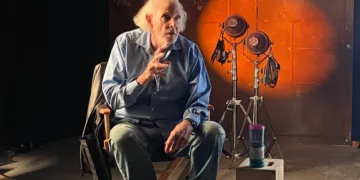












To be named a criminal by the state is a curious honor. It suggests one’s thoughts have achieved a certain material weight, becoming dangerous enough to warrant official condemnation. Alexander Rodnyansky, a filmmaker with a past deep inside the Russian media establishment, now wears this title courtesy of a Moscow court. His documentary, Notes Of A True Criminal, is his response: a cinematic ledger of the historical debts that have come due in Ukraine.
This is no ordinary war report. It is a work of historical pathology, an attempt to diagnose a chronic illness in the body politic by tracing its symptoms across generations. The film posits that the 2022 invasion was not a beginning, but a recurrence.
The acute crisis of the present is understood only through the chronic traumas of the past. The filmmaker’s project, initiated by the sound of missiles sent over the phone from his son in Kyiv, is to listen to the echoes and record their terrible harmony, creating a document that is as much a family memoir as it is a national post-mortem.
The Unforgiving Rhyme of Time
The film’s structure is a deliberate rejection of chronology, opting instead for a kind of historical rhyme scheme where past and present stanzas are set side-by-side. Rodnyansky and his co-director, Andriy Alferov, function as archivists of catastrophe, arranging their evidence not by date, but by resonance.

Footage from 2022 is pointedly devoid of heroic combat; it captures the mundane wreckage of war, the stunned faces of civilians, and the empty, affectless testimony of a captured Russian soldier. This sterile modern horror is then cross-cut with Rodnyansky’s own thirty-year-old footage of the Chernobyl exclusion zone.
The aesthetic here is one of active decay. Shot on older film stock, the images are steeped in sickly, jaundiced browns and washed-out greens, the very emulsion seeming to carry the taint of radiation. It is a landscape engaged in a slow-motion collapse, a visual metaphor for a poison that works not in explosions, but across decades.
This slow violence of fallout is then juxtaposed with the swift brutality of the Babyn Yar massacre of 1941, where Rodnyansky’s own relatives were murdered. The film goes further, showing how a 1966 memorial for the victims became another site of state oppression, with Soviet authorities persecuting those who attended. The film’s editing creates these dissonant chords to build its central thesis: that for Ukraine, history is not a line, but a loop.
A Lineage of Seeing
The film’s intellectual weight is carried by the men who witness these cycles. Rodnyansky himself is a complex narrator, a man whose career once placed him at the center of Russian media power, now viewing it from exile. His family’s three-generation history in Soviet and Ukrainian filmmaking makes their story a microcosm of the nation’s own struggle for a distinct cultural and political voice.

His son, Sasha, an economist who left a Western academic career to serve his country, embodies the burden of this inheritance. He is the generation that was supposed to be free of the past, yet finds itself fighting the same battles. Is his return a choice, or the grim pull of historical gravity?
The most potent intellectual tool in the film is wielded by a ghost: Rodnyansky’s mentor, Felix Sobolev. Through archival clips of his scientific documentaries, Sobolev provides a framework for understanding the madness. The key exhibit is a sequence from his 1971 film, Me And The Others, featuring an experiment with children and a bowl of porridge.
The setup is simple: the porridge is sweet for all but one child, whose portion is saturated with salt. One by one, the children who ate the sweet porridge praise its taste. When it is the final child’s turn, he pauses. He knows from his own senses that the substance is foul, yet confronted with the unanimous verdict of the group, he capitulates. “It’s sweet,” he lies.
This small, heartbreaking moment of conformity is the film’s central metaphor, a perfect illustration of how social pressure can dismantle objective truth. It explains more about the nature of authoritarian compliance than a hundred news reports. While other recent Ukrainian films like the visceral 20 Days in Mariupol document the “what” of war crimes, Notes is interested in the psychological “how”.
The Persistence of Witness
One should not watch this film seeking reassurance. Its conclusion, if one can call it that, is a profound statement of pessimism. It argues that for this part of the world, peace is not the natural state but a fragile intermission. Rodnyansky’s work refutes the myth of linear progress, presenting a history where every hopeful turn is eventually met with a violent correction.
Its cultural function, then, is not to inspire, but to record. It is a cinematic “black box,” preserving a perspective of events that is actively being erased by state-sponsored narratives. The film is a document intended for a future that will need proof of what happened, and why it felt so familiar.
The only whisper of hope is located in the process of its own creation. In a world of chaos, the act of framing a shot, structuring a narrative, and bearing witness becomes a defiant assertion of meaning. It is a small, cold comfort: the belief that a meticulously kept record is its own form of justice.
The film, “Notes of a True Criminal,” premiered at the Venice Film Festival. The documentary explores events in Ukraine’s history and their effect on people and families. The film is not currently available on any major streaming service.
Full Credits
Director: Alexander Rodnyansky, Andriy Alferov
Writers: Alexander Rodnyansky, Andriy Alferov
Producers and Executive Producers: Alexander Rodnyansky, Andriy Alferov
Director of Photography (Cinematographer): Oleksandr Boyko, Vadym Loshak, Denys Melnyk
Editors: Nazim Kadri-Zade
Composer: Evgueni Galperine
The Review
Notes Of A True Criminal
A dense and intellectually formidable work, Notes Of A True Criminal is a demanding cinematic essay. It trades emotional immediacy for a chilling, academic clarity, assembling a powerful argument about the cyclical nature of history and trauma. Rodnyansky has crafted a bleak but essential document, a sober accounting of a nation's pain that finds its power not in shocking images, but in the relentless, intelligent arrangement of its historical evidence. It is a profound, pessimistic, and unforgettable piece of filmmaking.
PROS
- Intellectually rigorous and deeply thought-provoking.
- Masterful non-linear structure creates powerful historical parallels.
- The personal narrative provides a strong emotional anchor.
- Effectively uses archival footage to build a complex argument.
CONS
- Its pessimistic tone can be emotionally draining.
- The essayistic style may feel slow or detached for some viewers.
- Requires a degree of historical knowledge for full appreciation.