







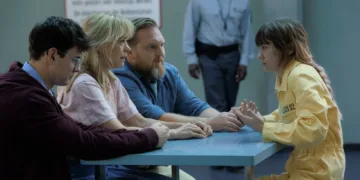









Silence in cinema is rarely an absence. It is a presence, a space charged with unspoken threat and unarticulated rebellion. In Marie-Elsa Sgualdo’s Silent Rebellion, the profound quiet of the Swiss Alps in 1943 becomes a character itself, a placid surface concealing immense pressure. Within this suffocating stillness lives Emma, a young woman whose existence is mapped by duty and piety.
Her life is a straight line drawn toward a prize for virtue and a future of quiet servitude. When a violent act pushes her from this path, she finds herself in a wilderness of impossible choices. The film becomes a forensic study of a single consciousness awakening to its own sovereignty against the crushing weight of a world determined to keep it silent.
The Politics of Silence
The film’s narrative operates on a chilling parallel, setting Emma’s private trauma against the public hypocrisy of Swiss neutrality. Her violation and subsequent forced silence mirror the nation’s own moral abdication, a willed ignorance that allows for profound evil at its borders. The village’s obsession with female purity is revealed as a grotesque performance.
It is a social control mechanism, enacted through the ritual of the Virtue Prize and the constant surveillance of watchful eyes, all while the same community sanctions the delivery of refugees to their executioners. Piety is weaponized to maintain order, creating a society where the greatest sin is not cruelty but indiscretion. Emma’s rebellion must therefore be a thing of whispers and shadows. It is not a loud declaration but an accumulation of small, secret assertions: the stolen knowledge from a forbidden book, the strategic calculation of a loveless marriage.
The local pastor personifies the rot within this system. He is a man drowning in his own conscience, his sermons on morality rendered impotent by his inaction. His private drunkenness is the physical manifestation of his spiritual decay, a portrait of a man trapped in an institution he knows to be hollow. His failure is essential, for it demonstrates the bankruptcy of the established moral order, forcing Emma to invent her own ethical code from scratch.
Anatomy of a Gaze
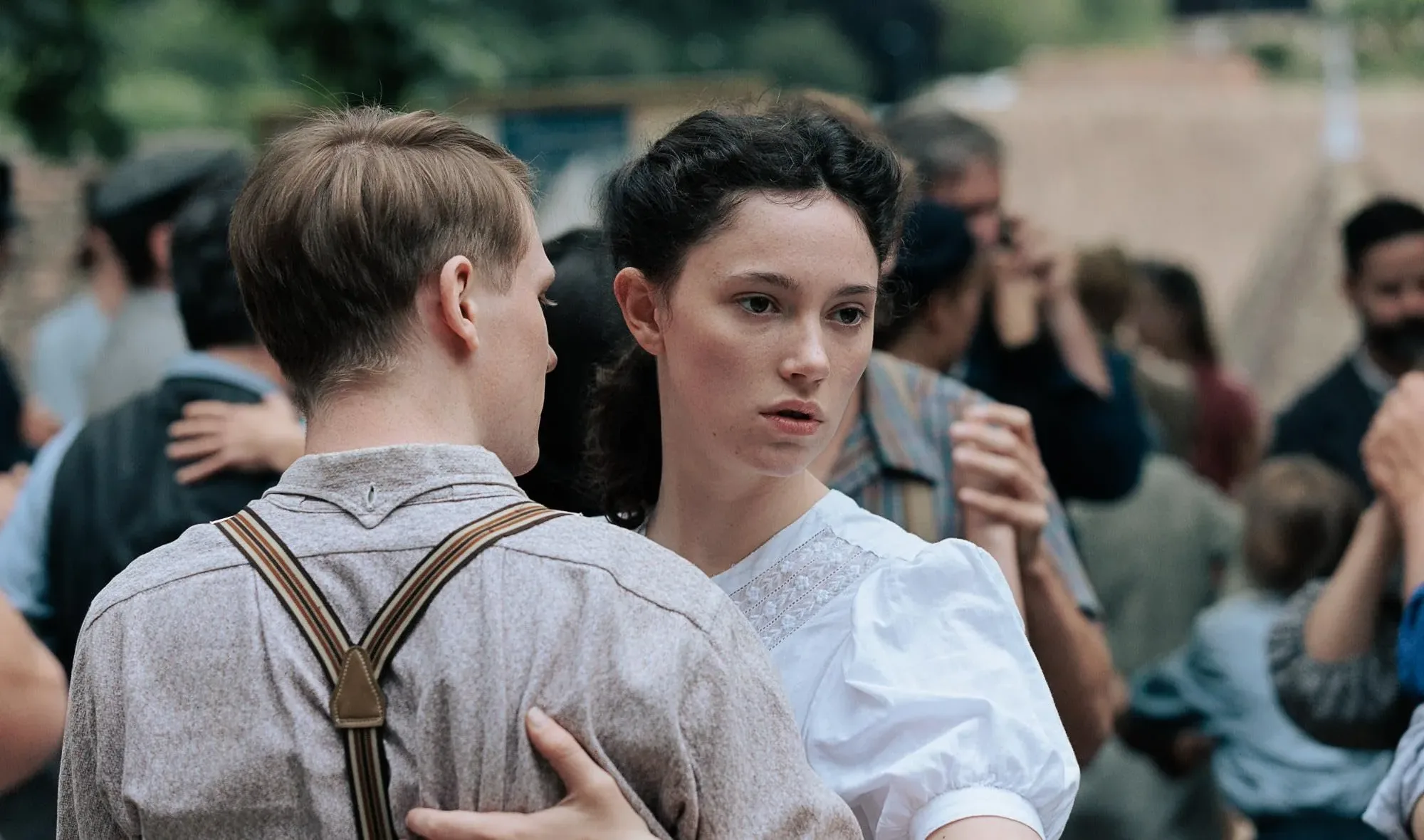
Lila Gueneau’s performance is the film’s ferocious, beating heart. It is a work of immense physical control, where emotion is communicated through the tension in her jaw, the rigid set of her shoulders, the minute flicker of a muscle beneath an eye.
Her body is a landscape of repression. In this context, Gueneau’s Emma becomes a different kind of noir protagonist. She is not navigating rain-slicked city streets but the equally treacherous terrain of religious dogma and social expectation. Her silence is a strategic tool for survival, a way to observe and calculate her next move in a world filled with enemies posing as protectors. Director Marie-Elsa Sgualdo’s camera functions as an interrogator, its lens fixed on Emma in relentless close-up.
This technique creates a powerful, almost unbearable intimacy, forcing the viewer into the claustrophobic space of Emma’s mind. We become conspirators in her secrets, scanning her face for the subtle tells of her internal war.
The camera does not simply observe; it scrutinizes, making Emma’s psychological entrapment a palpable experience for the audience. Her eventual liberation is therefore a profoundly visual event, symbolized by a yellow dress that feels like a rupture in the film’s fabric, a defiant splash of chromatic life against a world of grey.
A Terrible Beauty
Sgualdo’s direction is a study in precise, calculated restraint. The film’s visual language is built on a foundation of cruel irony, with Benoit Dervaux’s cinematography capturing the Swiss countryside in breathtaking, painterly compositions. Sun-drenched pastures and majestic peaks create an image of serene paradise.
This bucolic beauty, however, serves as a beautiful prison, its idyllic surfaces masking the dark moral compromises festering below. The compositions are often static and balanced, the rigid symmetry of the frame reflecting the inflexible social order that entraps Emma. Natural light pours through windows into domestic interiors, but it seems to offer no warmth, instead casting the sharp, deep shadows of a noir film. This is a world of chiaroscuro, where the brightest light only serves to accentuate the darkness. The sound design amplifies the oppressive atmosphere.
The titular silence is filled with the diegetic minutiae of Emma’s existence: the harsh scrape of a brush on a floorboard, the insistent ticking of a clock, the lonely howl of wind. These sounds make her isolation absolute. The film’s quietness is a deliberate challenge, denying the audience easy catharsis. Its subdued aesthetic is not a flaw but its central thesis, suggesting that the most profound rebellions are often the ones that are never heard at all.
The film Silent Rebellion premiered at the Venice Film Festival in the new Spotlight section on September 1, 2025. Set in a rural Swiss village in 1943, the story follows a pregnant teenage girl who defies her community’s rigid social and religious expectations. The film is a co-production between Switzerland, Belgium, and France. It is scheduled for release in Switzerland by Outside the Box in February 2026.
Full Credits
Director: Marie-Elsa Sgualdo
Writers: Marie-Elsa Sgualdo, Nadine Lamari
Producers and Executive Producers: Elena Tatti, Nicolas Wittwer, Julie Esparbes, Emmanuelle Latourrette, Fabrice Préel-Cléach
Cast: Lila Gueneau, Grégoire Colin, Thomas Doret, Aurélia Petit, Sandrine Blancke, Sasha Gravat Harsch, Cyril Metzger, Tamara Semelet, Lievke Bartel, Aurelien Patouillard, Etienne Fague
Director of Photography (Cinematographer): Benoît Dervaux
Editors: Karine Sudan
Composer: Nicolas Rabaeus
The Review
Silent Rebellion
Sgualdo's film is a meticulously crafted, intellectually rigorous study of defiance. Anchored by a breathtakingly subtle lead performance from Lila Gueneau and a visual language that weaponizes beauty against itself, it is a profound, unsettling work. While its extreme restraint may prove too austere for some, Silent Rebellion is a powerful, demanding piece of cinema that lingers long after the screen goes dark.
PROS
- A phenomenal and highly nuanced central performance by Lila Gueneau.
- Intelligent, restrained direction that prioritizes emotional authenticity.
- Stunning cinematography that creates a powerful, ironic contrast between the idyllic setting and the dark themes.
- A deep and thoughtful exploration of hypocrisy, autonomy, and resistance.
CONS
- The deliberate pacing and extreme subtlety may feel emotionally distant to some viewers.
- Its quiet approach risks muting the impact for those seeking more dramatic catharsis.