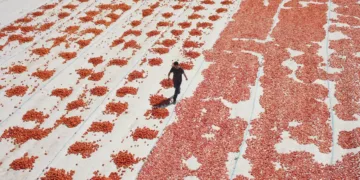


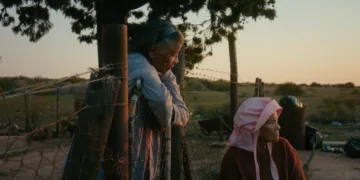














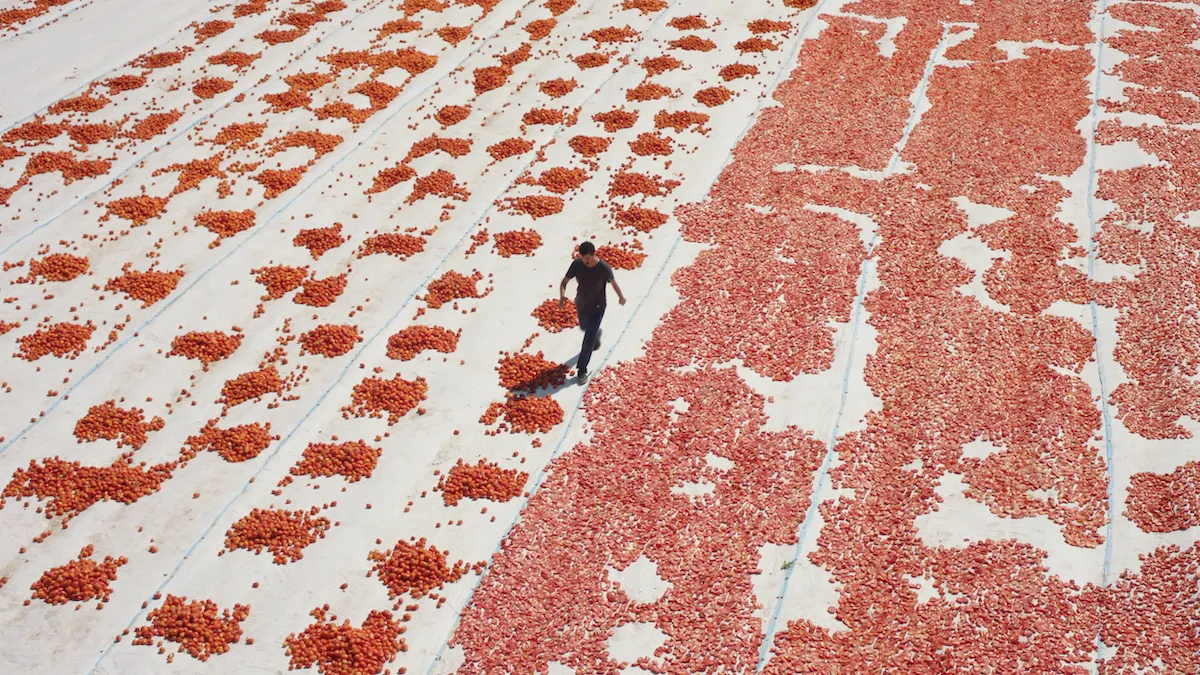

Under a Turkish sun that bleaches the sky to a pale, unforgiving blue, a man’s world can shrink to the size of a single insult. In the vast, crimson fields of harvested tomatoes, Eyüp toils. He is a figure etched by debt and quiet desperation, a laborer whose existence is measured in crates filled and wages withheld. His foreman, Hemme, is the casual architect of his misery.
The breaking point arrives not as a tremor but as a sharp crack: an argument over payment, a public slap, an oath against his mother’s name. From this humiliation, a dark seed is planted. Murat Fıratoğlu’s debut film, One of Those Days When Hemme Dies, follows the shadow of this thought through the course of one day, transforming a simple narrative of potential revenge into a profound meditation on the quiet violence of being.
The Geometry of Suffering
Murat Fıratoğlu, who carries the weight of Eyüp in his own performance, presents a man whose personhood is under constant siege. The film maps the stark geometry of his suffering: the endless rows of tomatoes like crimson wounds on the earth, the relentless sun a physical manifestation of an indifferent universe.
This is a study of a soul under immense pressure, where personal honor is the last currency left in a world that has rendered him economically worthless. The working conditions are a backdrop of brutalist realism. We see children laboring alongside adults, their small forms already bent into the shape of a cyclical, inherited servitude. Their presence suggests that this is not a crisis but a permanent state.
Yet, the film locates a fragile humanity in the spaces between the toil. A brief word with a friend, a moment spent helping an uncle with a heavy watermelon—these are not plot points. They are small acts of existence that defy the dehumanizing logic of Eyüp’s world. They are quiet rebellions, fleeting affirmations of a self that has not yet been entirely erased by hardship or reduced to a mere instrument of labor.
The Uncommitted Murder
The film’s title is a philosophical provocation, a door opened to a dark room that its protagonist chooses not to enter. The narrative is an exercise in subversion, offering the promise of a revenge thriller only to reveal itself as an anti-thriller that questions the very nature of retribution.

Eyüp’s journey from the farm on his sputtering motorcycle is not a flight toward violence but a rattling pilgrimage away from its terrible simplicity. His anger, a fire stoked by humiliation, is slowly cooled by the friction of mundane existence. Each encounter, each trivial task, acts as a tether to the social fabric, pulling him back from the nihilistic abyss of murder.
This retreat is a form of profound resistance. It is a refusal to adopt the brutal logic of his oppressor. The film quietly examines the pressures of masculinity, where an insult to one’s honor demands a violent response. Eyüp’s ultimate inaction is not a failure of will. It is a complex, almost unconscious choice to remain within the difficult, shared sphere of human connection rather than descend into the absolute solitude of a killer.
A Gaze into the Void
Fıratoğlu’s direction is one of patient, philosophical observation. The film’s language is built from long, static shots and a rhythm that mirrors the slow, punishing passage of a laborer’s day. This is not pacing designed for comfort. It is a cinematic meditation that demands the viewer’s stillness, forcing a confrontation with the unadorned reality of Eyüp’s existence and the substance of empty time.
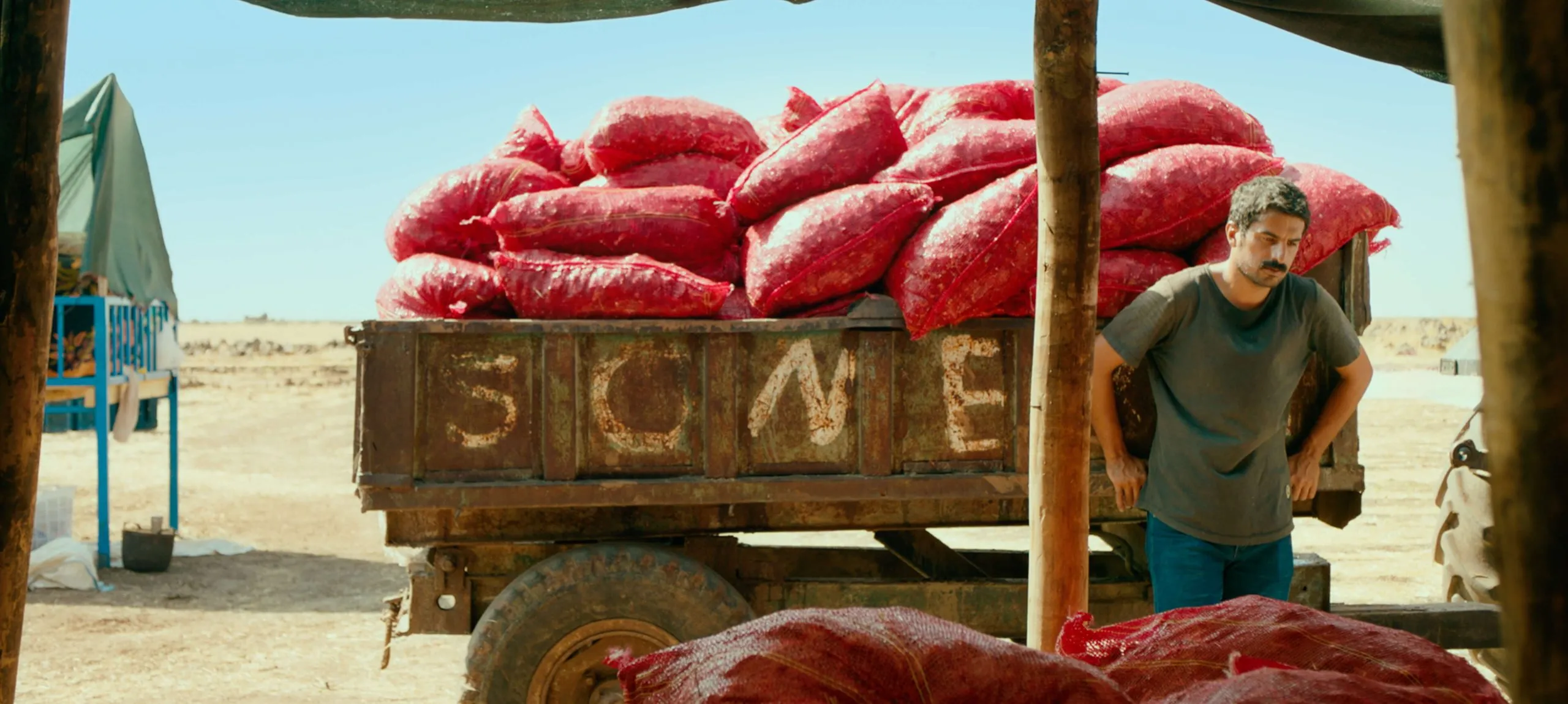
The cinematography maintains a respectful, almost clinical distance, a gaze that refuses the easy intimacy of empathy and instead posits the fundamental isolation of consciousness. The soundscape is sparse, dominated by the ambient noise of wind and work, punctuated by long stretches of deep silence.
Within this quiet, meaning accumulates; the unspoken anxieties and moral calculations become deafening. The visual palette is elemental: the scorching red of the produce, the bleached white of the work tarps, the ochre of the dry earth. These colors paint a world both beautiful and brutal, a landscape whose sublime indifference reflects the cosmic loneliness of its inhabitants.
Choreography of the Soul
The film is bookended by the halay, a traditional folk dance where men link arms and move as one. This ritual is a potent and deeply ambiguous symbol. It is a fleeting performance of the solidarity that is absent from their working lives, a moment of collective effacement where individual burdens are briefly dissolved into a shared rhythm. In the dance, Eyüp and Hemme are equals.
This image of transient unity is a fragile, beautiful illusion. The landscape itself is a silent character, an Eden of pastoral beauty that becomes a site of exploitation the moment human industry intrudes. The earth provides, and man takes until the place is soured with abuse, its beauty a mocking counterpoint to the suffering it hosts.
One of Those Days When Hemme Dies does not offer easy answers or cheap hope. It finds something more durable: the quiet strength of human connection as the only meaningful defense against despair. This solidarity is not a triumphant force, but a fragile, necessary fiction that the characters must sustain to survive.
One of Those Days When Hemme Dies premiered at the 81st Venice International Film Festival on September 5, 2024. The film, a Turkish production, is Murat Fıratoğlu’s directorial debut and was selected as the Turkish entry for the Best International Feature Film at the 98th Academy Awards. As of now, it does not appear to be available on major streaming platforms.
Full Credits
Director: Murat Fıratoğlu
Writers: Murat Fıratoğlu
Producers: Murat Fıratoğlu
Cast: Murat Fıratoğlu, Salih Taşçı, Sefer Fıratoğlu, Güneş Sayın, Ali Barkın, Fırat Bozan, Çetin Fıratoğlu
Director of Photography (Cinematographer): Semih Yıldız, Nedim Dedecan, Abdurrahman Öncü
Editors: Eyyüp Zana Ekinci
Composer: Not available
The Review
One of Those Days When Hemme Dies
A demanding and austere work, One of Those Days When Hemme Dies trades narrative propulsion for a profound existential stillness. Murat Fıratoğlu’s debut is a masterful exercise in slow cinema, a visually arresting meditation on the quiet war for dignity waged within the soul of an ordinary man. It is a stark, challenging, and ultimately unforgettable piece of filmmaking that lingers long after the final, rhythmic dance.
PROS
- A confident and artistically coherent directorial debut.
- Stunning cinematography that powerfully contrasts natural beauty with human hardship.
- Deep and nuanced exploration of complex themes like labor, dignity, and masculinity.
- A masterful, immersive use of meditative pacing and long takes.
CONS
- The deliberate slow pace and thin narrative may alienate some viewers.
- An observational, distant camera style can create a sense of emotional coldness.
- The story's power is more intellectual and philosophical than visceral.