





















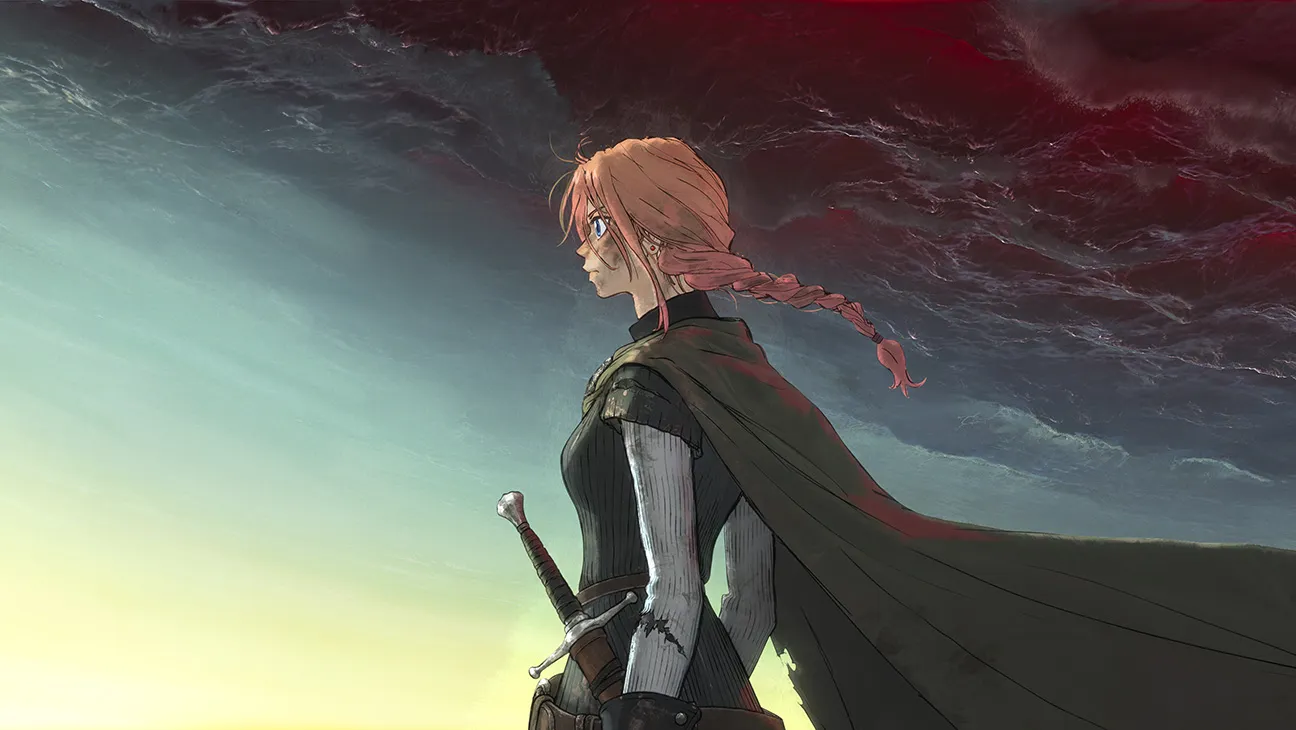

“This is not the afterlife we imagined,” the princess muses. Her soul has been cast into a purgatory of rust-colored plains and endless twilight. Princess Scarlet, heir to a fallen king, arrives in this hellscape not as a peaceful spirit but as an agent of fury.
She has just watched her father’s execution, a spectacle orchestrated by her usurping uncle, Claudius. His ambition did not end at the throne; a cup of poison dispatched Scarlet from the world of the living, sending her to a desolate plane known as the Otherlands. It is a limbo populated by the lost and the wronged, a place where time has no meaning.
Here, among the spectral armies and forgotten souls, Scarlet’s single purpose crystallizes. She is fueled by a burning need to avenge her father’s murder. The film immediately establishes itself as a bold reimagining of a classic tragedy, replacing the melancholic prince with a flame-haired princess armed with righteous anger.
An Afterlife of Discordant Beauty
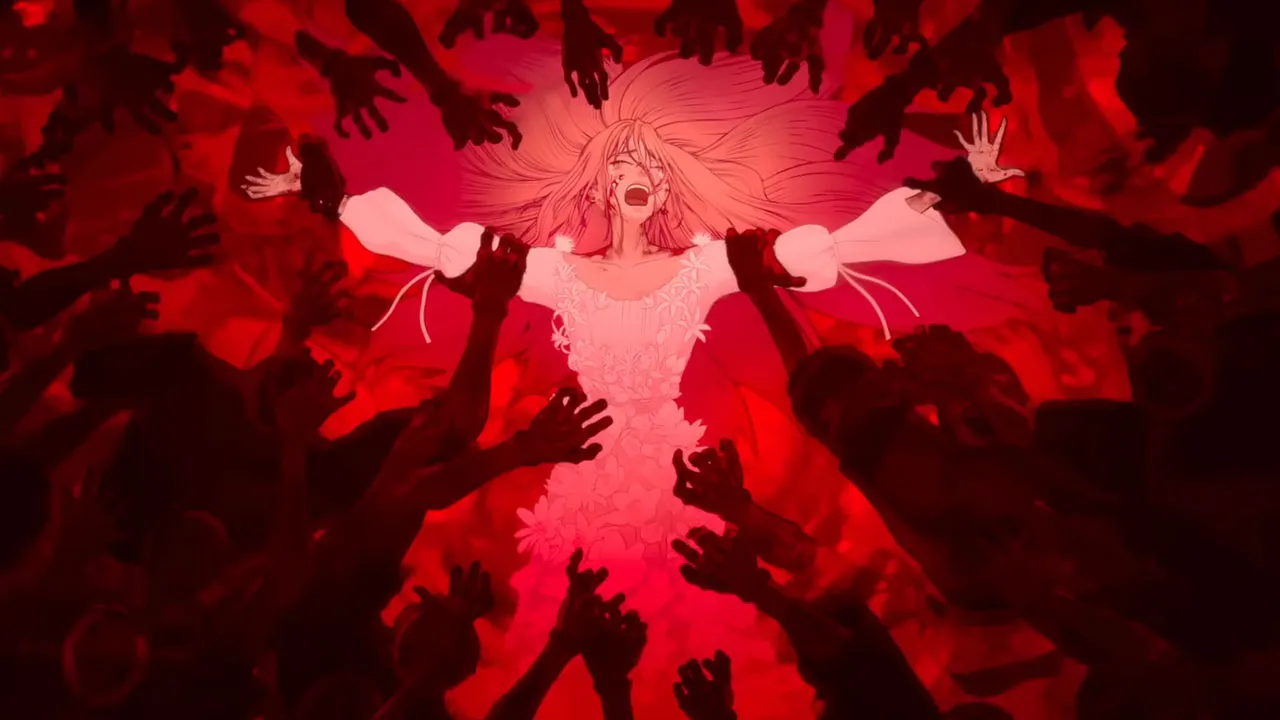
The Otherlands is a realm of breathtaking desolation. A raging ocean churns in the sky above, while below, a colossal dragon pierced by a thousand swords unleashes lightning from its maw. Armies clash for eternity on barren fields, and a sea of blood-red water is thick with the grasping limbs of the damned.
Director Mamoru Hosoda renders this world with a distinct dual aesthetic that separates planes of existence. Flashbacks to Scarlet’s kingdom are presented in traditional, hand-drawn 2D animation, giving them a familiar warmth and a feeling of tangible history. The afterlife, conversely, is constructed with computer-generated imagery that aims for an epic scope.
This choice yields spectacular results in the sweeping, alien landscapes, which possess a painterly grandeur. The effect is less successful when applied to its inhabitants. Character movement can appear stiff and unnatural, and certain dance sequences that use rotoscoping feel detached from the surrounding art style.
This visual friction creates a sense of dislocation that mirrors Scarlet’s own turmoil, though it is likely an unintended side effect of the technical approach. The soundscape amplifies the scale of this world. The deafening crack of the dragon’s lightning and the intense, atmospheric score create a potent sensory experience, grounding the fantastical setting in a physical reality that is both awesome and terrifying.
The Weight of a Crown, The Price of Vengeance
Scarlet enters the Otherlands as a specter of pure hatred, her identity wholly defined by her mission to destroy Claudius. Her violent quest is soon complicated by the appearance of Hijiri, a gentle male nurse displaced from modern-day Japan. He is a paragon of selflessness who has no memory of his death and carries no malice, embodying a philosophy that directly opposes Scarlet’s worldview.
His pacifism and unwavering kindness serve as a constant challenge to her rage. Hijiri is not so much a character as he is a thematic device, a moral compass whose performance is serviceable but lacks deep complexity. His presence forces Scarlet to question her methods, suggesting true strength lies not in destruction but in preservation.
This pivot is accelerated by other encounters, particularly with a little girl who muses that a real princess would use her power to make the world better for others. Scarlet’s perspective begins to shift. She sees that her personal vendetta is a small matter within a realm filled with aimless, forgotten people.
Her journey evolves from a singular pursuit of revenge into a recognition of a greater responsibility, a mission of social justice for the disenfranchised dead. The film attempts to chart this profound internal transformation, though the change can feel abrupt, repositioning its protagonist from an avenger to a savior.
Extravagant Worlds, Elementary Truths
The film’s greatest strength is its boundless imagination. Hosoda builds a spectacular, unforgettable world filled with striking imagery and enormous scale. This artistic ambition stands in sharp contrast to the simplicity of its narrative resolution.

After establishing a complex and violent premise rooted in betrayal and rage, the story retreats to a familiar moral about the futility of revenge. This “feast of sincerity,” as one might call it, feels unearned and tedious, a platitude that sits awkwardly beside the darker, more irreverent tone established earlier.
The screenplay also neglects the potential of its source material, leaving characters like Gertrude underdeveloped. It is a recurring pattern in the director’s work. Films like Belle use their stunning visual artistry to deliver a reductive anti-bullying message.
Here, the extravagant design of the Otherlands and the intensity of Scarlet’s initial quest promise a deep exploration of loss and anger. What the film delivers is a visual feast that leaves one hungry for a more substantive philosophical meal. The dissonance between the extravagant imagination and the elementary morality suggests a failure to trust the audience with ambiguity, ultimately undermining the power of its own creation.
The animated film Scarlet had its world premiere at the Venice International Film Festival and also screened at the Toronto International Film Festival and New York Film Festival. It is scheduled for release in Japan on November 21, 2025, with a subsequent theatrical release in the United States on December 12, 2025, distributed by Sony Pictures Classics.
Full Credits
Director: Mamoru Hosoda
Writers: Mamoru Hosoda
Producers: Yuichiro Saito, Toshimi Tanio, Nozomu Takahashi
Cast: Mana Ashida, Masaki Okada, Koji Yakusho, Masachika Ichimura, Kotaro Yoshida, Munetaka Aoki, Shota Sometani, Noa Shiroyama, Kayoko Shiraishi
Director of Photography (Cinematographer): Ryo Horibe, Yohei Shimozawa, Yasushi Kawamura, Akiko Saito
Editors: Shigeru Nishiyama
Composer: Taisei Iwasaki
The Review
Scarlet
Mamoru Hosoda's Scarlet is a monumental artistic achievement, offering an afterlife rendered with breathtaking imagination. Its visual splendor, however, is tethered to a disappointingly simple narrative. The film trades philosophical depth for a straightforward moral on forgiveness, making for a hollow experience. It is a feast for the eyes that provides little nourishment for the mind, a beautiful spectacle that ultimately feels empty.
PROS
- Visually stunning and imaginative world-building.
- Strong, epic-scale sound design and musical score.
- An engaging and bold initial premise.
CONS
- Thematic resolution is overly simple and sentimental.
- Narrative lacks the complexity of its visual design.
- Inconsistent quality in CGI character animation.