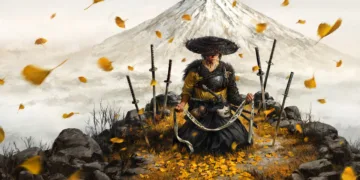
























Sucker Punch returns to feudal Japan with Ghost of Yōtei, trading the island of Tsushima for the wilds of Ezo (modern-day Hokkaido) in the early 1600s. This sequel shifts focus from noble samurai to vengeful mercenary, following Atsu as she hunts the Yotei Six, the outlaws who slaughtered her family. Where Ghost of Tsushima explored the tension between honor and pragmatism, Yōtei embraces a character who has already abandoned such concerns.
The result feels less like revolution and more like careful iteration: tighter combat, expanded weapon systems, and a protagonist whose emotional rawness provides the throughline for a visually stunning revenge tale. Sucker Punch clearly aimed to refine what worked while addressing specific mechanical gaps from their 2020 release. The question becomes whether these adjustments create a meaningfully different experience or simply deliver familiar pleasures with fresh packaging.
The Weight of Blood: Character-Driven Vengeance
Atsu occupies an interesting space compared to her predecessor. Jin Sakai wrestled with ideology, torn between samurai code and survival necessity. Atsu has no such conflict. As a mercenary from a murdered family, she exists outside the structures that defined Jin’s struggle. Her vengeance feels personal rather than philosophical, and this shift changes how the narrative functions. The game opens with you literally writing out the names of the Yotei Six using the DualSense touchpad, establishing immediately that this story prioritizes emotional catharsis over moral complexity.
The onryo identity (vengeful ghost) becomes Atsu’s calling card, but the game handles this legend-building differently than Tsushima’s ghost mythology. Where Jin’s transformation carried thematic weight about identity and sacrifice, Atsu’s fearsome reputation feels more like practical branding. She’s already committed to violence; the legend simply amplifies her effectiveness. Erika Ishii’s performance grounds Atsu in vulnerability beneath the rage. She drinks too much (mechanically encouraged since sake restores spirit), speaks with barely contained fury, and carries her trauma visibly. This creates a protagonist who feels human even when the plot mechanics around her remain predictable.
The family flashbacks integrate seamlessly through playable childhood sequences. Practicing swordplay with your brother or working in your father’s forge establishes what was lost without resorting to exposition dumps. These moments hit hardest when they connect to present gameplay: learning to paint from your father manifests in Sumi-e activities; your mother’s shamisen becomes both a musical connection and a mechanical tool for finding collectibles. The thematic coherence between memory and mechanics strengthens Atsu’s characterization in ways that dialogue alone couldn’t achieve.
Lord Saito and the Yotei Six function as archetypal villains rather than nuanced antagonists. They’re designed to be hated, and the game doesn’t pretend otherwise. Each member controls a region through distinct methods (the Oni’s brutal military occupation versus the Kitsune’s shadowy shinobi tactics), giving the revenge tour some structural variety. The frustration comes from how often targets escape during cutscenes, padding the runtime without advancing the plot meaningfully. These moments undermine player agency in a genre where agency should feel paramount.
Companion characters like Oyuki provide necessary counterbalance to Atsu’s single-minded fury. Their contrasting perspectives on revenge and justice create friction that prevents the narrative from becoming monotonous vengeance porn. The story explores cycles of trauma and violence with more sophistication than the “revenge is bad” clichés common to the genre, even if it never quite transcends its basic structure. Several emotional beats land with surprising effectiveness, particularly the Kitsune sequence that deepens Atsu’s relationship with her mother through parallels rather than preaching.
The 30-hour arc struggles with the inherent challenge of revenge narratives: where do you take a character who begins at peak fury? Atsu’s growth feels incremental rather than transformative, which creates some dissonance by the conclusion. The story works best when viewed as an emotional vehicle for combat encounters rather than a groundbreaking narrative experiment. That’s not necessarily a weakness if you accept the game on those terms, but it does mean the plot rarely surprises.
Arsenal of Vengeance: Combat as Expression
Ghost of Yōtei’s most significant improvement arrives through its expanded combat toolkit. Where Jin cycled through katana stances, Atsu wields five distinct weapon types: katana, odachi, kusarigama, dual katanas, and yari spear. Each weapon handles with noticeable weight and animation differences. The kusarigama swings in wide arcs for crowd control, dual katanas deliver rapid strikes that look and feel desperate, while the massive odachi requires commitment to each devastating blow. Weapon-switching happens quickly without menu navigation, allowing you to flow between tools based on enemy composition rather than getting locked into a single approach.

The rock-paper-scissors dynamic creates both structure and constraint. Shield enemies crumble against kusarigama heavy attacks. Spear-wielders fall to dual katanas’ relentless speed. Giant armored units require the odachi’s raw power. Your katana remains viable against everything but loses efficiency against specialized defenses. This design encourages weapon rotation while occasionally making encounters feel prescriptive. When a shield wall appears, you’re essentially required to switch to kusarigama or accept tedious chip damage. The system rewards mastery of multiple weapons but sometimes at the expense of player expression.
The kusarigama deserves special mention as the standout addition. Beyond shield-breaking, it functions as a ranged assassination tool (yank enemies toward you like Scorpion from Mortal Kombat) and crowd control option that feels genuinely different from anything in Tsushima. Landing a kusarigama kill creates a visceral satisfaction that the other weapons can’t quite match, primarily because it offers utility beyond direct damage. The chained weapon solves spatial problems, pulling distant enemies into lethal range or dragging shielded foes out of formation.
Firearms integrate naturally given the early 1600s setting. The musket requires lengthy reloading but punches through armored enemies with emphatic impact. The flintlock pistol staggers opponents or finishes wounded targets at point-blank range. Neither weapon breaks combat balance; instead, they add tactical options to your rotation. Projectiles like smoke bombs, metsubushi blinding powder, and flame attachments round out a toolkit that provides solutions to most combat puzzles without creating dominant strategies.
Parrying remains the combat system’s centerpiece. That blue glint signals your opportunity to deflect and counter, creating rhythm-based engagements that reward timing over button-mashing. Perfect parries deliver devastating ripostes that can end fights in single strikes. The Bounty Master armor increases perfect parry windows while disabling standard parries, raising stakes through risk-reward balancing. Landing consecutive perfect parries generates the same flow state satisfaction that defines Sekiro or Sifu, minus the punishing difficulty. Dodging provides a secondary defensive option that feels equally responsive, giving you multiple ways to manage incoming attacks.
Duels and boss fights strip away the chaos of group encounters to test your fundamental understanding of defensive timing. These one-on-one battles feel like the combat system’s purest expression: no trash enemies to distract, just you and an opponent reading each other’s patterns. Standoffs return from Tsushima, letting you execute quick-draw kills on one or multiple enemies before engaging the remainder. They function as satisfying combat openers rather than standalone challenges.
The lack of lock-on creates both immersion and occasional frustration. Encounters feel natural as you flow between targets, but off-screen enemies sometimes land cheap hits during intense fights. Camera improvements from Tsushima mitigate this issue compared to the predecessor, and the option to enable lock-on exists if you prefer traditional targeting. Atsu’s fragility raises engagement stakes (you can die quickly if you misread attacks) while her lethality makes you feel dangerous rather than fragile. This balance keeps combat tense without becoming punishing.
Stealth functions as combat’s lighter sibling. Tall grass provides concealment, aerial assassinations chain together satisfyingly, and the kusarigama’s ranged kills add variety. The mechanics never push beyond genre basics, though. Guards have convenient blind spots, lack vertical awareness, and follow predictable patrol routes. Getting caught simply transitions into open combat, which is arguably what you wanted anyway given how satisfying the fighting feels. Mixing stealth kills with loud combat creates the most engaging rhythm: thin enemy numbers quietly, then unleash full aggression on whoever remains.
Wandering Through Memory: Exploration and Discovery
Ghost of Yōtei divides its world into five regions rather than Tsushima’s two-part structure. The opening wetlands area sprawls larger than subsequent zones, which each correspond to a Yotei Six member and their territorial aesthetic. The Oni’s fortress overlooks burned villages and military encampments. The Kitsune’s domain features hidden shinobi hideouts and secret passages. This structural approach provides clearer identity for each region while maintaining the impression of a cohesive landmass rather than disconnected levels.
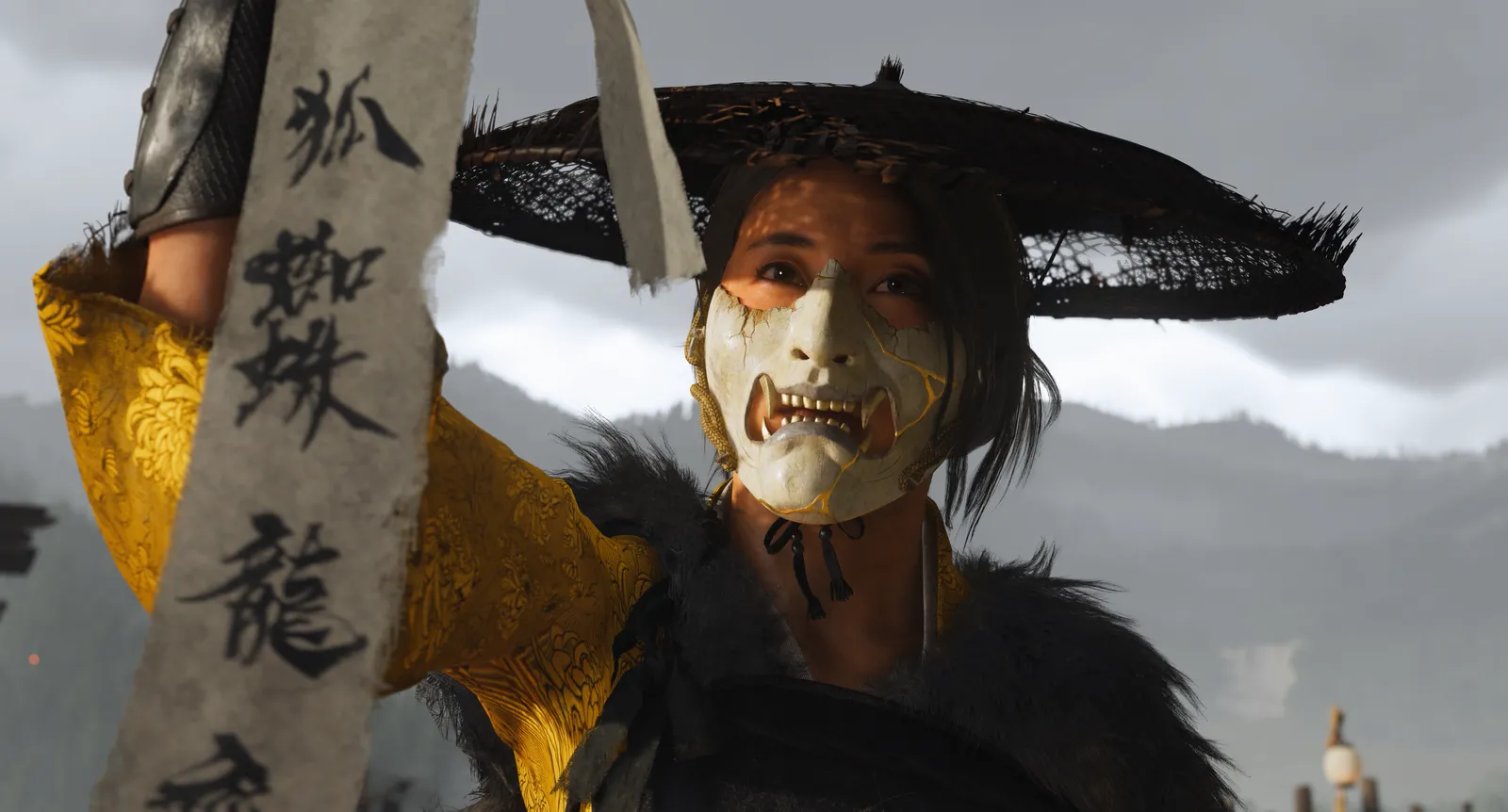
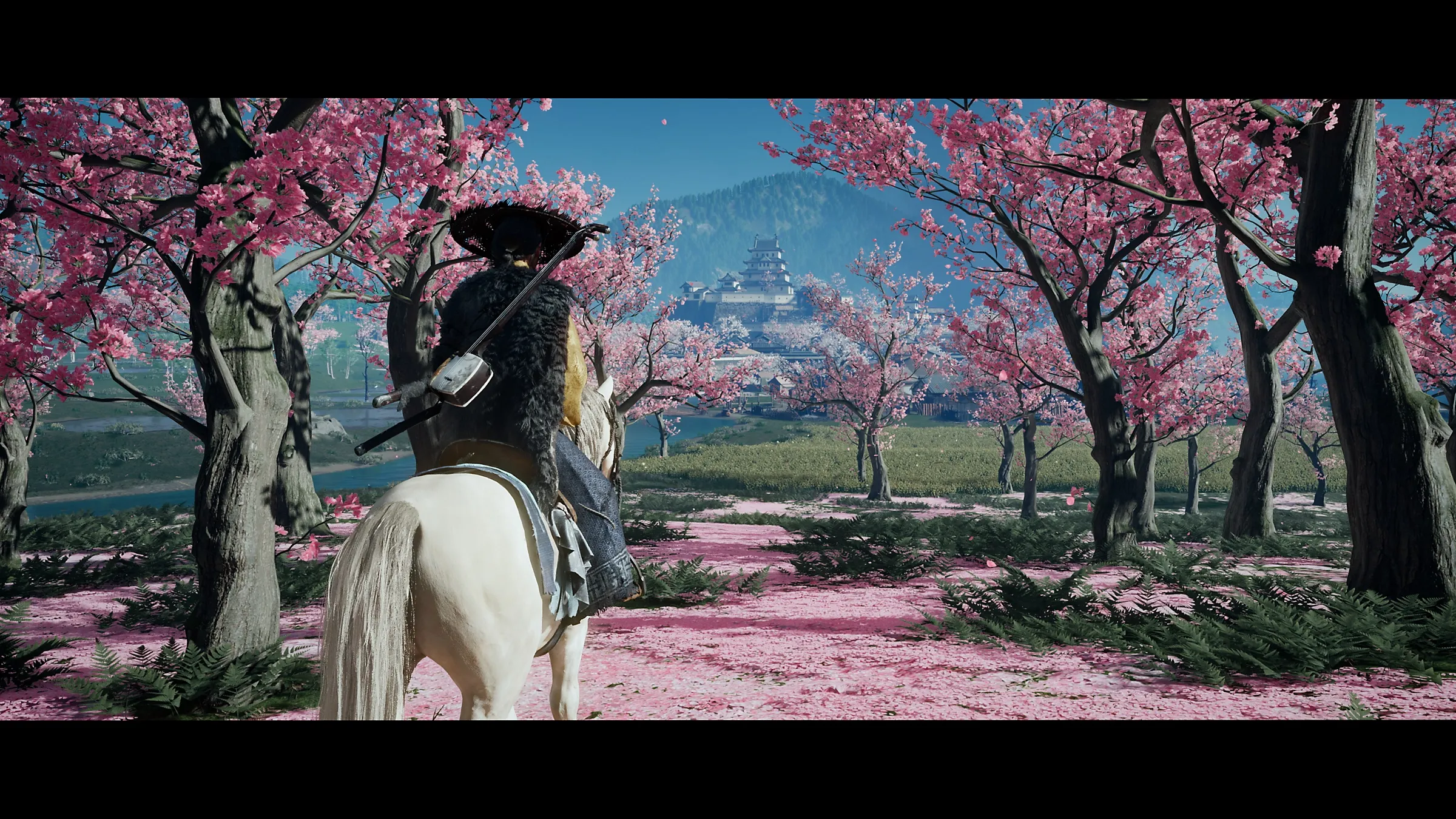
Environmental diversity marks a clear improvement over Tsushima’s more uniform landscape. Ezo shifts between wetland plains, snow-covered mountains, vibrant autumn forests, and coastal cliffs within relatively short distances. The biodiversity feels authentic to Hokkaido’s reputation as Japan’s natural showcase. Cherry blossoms paint southern regions pink while northern areas disappear under freezing snowfall. Duels staged against these backdrops turn routine encounters into screenshot opportunities, with mountains, waterfalls, and ancient trees providing natural framing.
The Guiding Wind system returns as the game’s primary navigation tool. Swipe up on the touchpad and wind gusts visualize your path toward active objectives. It remains one of the smartest open-world navigation solutions: you stay immersed in the environment rather than staring at minimaps or following waypoint markers. Birds and foxes lead you to secondary locations with worthwhile rewards (hot springs, fox dens, hidden gear). These organic discovery mechanics feel respectful of player attention rather than demanding constant UI interaction.
Map sketches represent a new discovery layer. NPCs provide these hand-drawn papers showing landmarks and secret locations. You match the sketch to the actual map, placing it when topographical features align. The system aims for puzzle-solving satisfaction but lands somewhere simpler. Sketches lock to regions and snap into place generously, making most discoveries trivial within seconds. The idea shows promise, but the execution lacks the challenge needed to make discovery feel earned. A more demanding version of this mechanic could have added meaningful exploration depth.
The spyglass functions like Breath of the Wild’s Sheikah Slate, automatically marking discovered locations when viewed through its lens. This encourages environmental observation and landmark memorization rather than icon-chasing. Combined with the Guiding Wind, these systems create navigation that prioritizes spatial awareness over UI management. NPCs provide contextual clues about nearby points of interest (a merchant mentions an onsen, a villager describes a fox den), building a world that communicates through conversations and observation rather than glowing markers.
Hot springs, bamboo strikes, fox dens, and shrines return in reduced quantities compared to Tsushima. The lower count prevents these activities from feeling like exhausting checklists while maintaining their mechanical purpose (shrines unlock skill points, hot springs boost health). Sumi-e painting adds cultural texture through the DualSense touchpad, letting you recreate animals and landscapes in black ink. The shamisen serves double duty: it connects Atsu to her mother’s memory while functioning as a collectible-finding tool through learned songs. These activities feel integrated into Atsu’s characterization rather than generic open-world busywork.
Bounty hunting provides structured combat challenges across Ezo. Some targets present distinct scenarios (a murderous musician, a drowning killer with kappa mythology connections) while others default to basic camp-clearing objectives. The variety swings between memorable encounters and generic filler. Fast travel eliminates loading screens almost entirely, creating seamless movement that prevents downtime from interrupting your momentum. Vendors can be summoned to campsites rather than requiring returns to settlements, respecting player time without breaking immersion through impossible convenience.
Growth Through Action: Progression Systems
Ghost of Yōtei abandons experience-based leveling entirely. Your character growth ties directly to shrine discovery and quest completion rather than killing enemies for XP. This design decision makes exploration feel purposeful: every shrine you find translates into new combat abilities rather than arbitrary stat increases. The skill trees branch based on weapon type and playstyle, encouraging specialization while leaving room for hybrid builds.

Charms function as the primary customization layer. These collectible perks modify specific mechanics (extend assassination chains, boost parry damage, reduce ability cooldowns) without creating obviously dominant combinations. Finding charms through exploration rather than vendor purchases makes discovery meaningful. The system avoids the common open-world trap where side content rewards feel inconsequential compared to main story progression.
Armor sets lean into distinct playstyles rather than serving as pure stat upgrades. The Bounty Master armor mentioned earlier removes standard parries to expand perfect parry windows. Other sets emphasize stealth chains, ranged damage, or defensive resilience. Switching armor changes how you approach encounters without hard-locking you into specific strategies. Cosmetic options provide visual customization separate from mechanical benefits, letting you maintain preferred aesthetics while swapping functional gear.
Weapon upgrades happen through gameplay milestones rather than resource gathering. Teachers scattered across Ezo provide new techniques tied to mastery challenges (clear this camp, defeat this number of enemies with perfect parries). These requirements occasionally feel like padding (fully upgrade a weapon’s skill tree to unlock the next technique) but generally integrate progression with exploration and combat practice. The system reinforces the design philosophy that player skill improvement matters more than character stat inflation.
Side quest quality varies significantly. The strongest missions weave short stories into exploration: tracking supernatural rumors about yokai, investigating a near-invincible bear, learning Ainu cultural practices through platforming sequences. These quests provide narrative context beyond “kill enemies, get reward” while introducing mechanical variety. Teacher questlines feel weaker, essentially asking you to complete activities you’d pursue anyway (upgrade weapons, clear camps) without much narrative payoff.
Bounty missions present specific warrior targets with distinct combat modifiers, culminating in duels that test your defensive mastery. Some bounties subvert expectations with unexpected outcomes rather than straightforward fights. Others simply place named enemies in generic camps, losing the personality that makes the best bounties memorable. The inconsistency prevents bounty hunting from feeling like a cohesive system rather than a collection of unrelated encounters.
The Ainu representation deserves acknowledgment. Including Hokkaido’s indigenous people through cultural activities and questlines shows effort toward historical authenticity beyond samurai mythology. The integration feels natural rather than educational checkbox-filling, treating Ainu traditions as living parts of Ezo’s identity rather than museum pieces.
Mission design demonstrates more variety than Tsushima’s formulaic approach. Infiltration sequences require social stealth (pose as an anonymous bounty hunter), pursuits combine horseback chasing with gunfire, and platforming sections break up combat rhythm. Some activities still follow familiar open-world patterns (follow this NPC, climb to this viewpoint), but the ratio of unique-to-generic feels improved. The issue remains with repeatable activities: petting foxes delights initially but grows stale after the third identical encounter. What would work as one-off moments becomes tedious through repetition.
Visual Spectacle: Art Direction and Technical Execution
Kurosawa’s influence permeates Yōtei’s visual language. The returning black-and-white Kurosawa Mode pairs with Japanese audio to recreate samurai cinema aesthetics directly. New presentation options push further: Takashi Miike Mode amplifies blood and gore to exploitation film levels, while Watanabe Mode adds lo-fi beats in the style of Samurai Champloo. These aren’t mere filters; they represent distinct artistic lenses that reframe the entire experience. The modes acknowledge that samurai cinema encompasses multiple traditions rather than a single definitive style.

Letterboxed framing during horseback riding creates constant cinematic composition. Black bars appear automatically when you mount your horse, drawing attention to environmental artistry through intentional cropping. This transforms travel into visual showcase rather than dead time between objectives. Photo mode integration (mapped to D-pad for quick access) encourages screenshot-taking, which feels appropriate given how often stunning vistas appear organically during exploration.
Environmental effects elevate technical prowess through artistic choices. Particles swirl constantly (leaves, snow, petals, butterflies) creating visual density that makes every frame feel alive. Weather transitions happen dynamically: clear skies give way to storms, sunlight filters through forest canopies, and moonlight reflects off wetland streams. These atmospheric touches prevent the world from feeling static despite using familiar open-world structures.
Color contrasts define regional identity. Autumn trees glow red and gold against green hillsides. Cherry blossom groves burst pink across southern zones. Northern snowfields stretch white to the horizon, making blood splatter during combat particularly stark (that Lady Snowblood influence). Duel backdrops take advantage of these palettes: waterfalls crash behind tense standoffs, ancient trees frame one-on-one battles, mountain peaks provide dramatic silhouettes. The game understands that samurai cinema thrives on composition as much as choreography.
Performance remains stable at 60fps in performance mode on base PS5, with no noticeable frame drops during intensive combat or exploration. Cutscenes lock to 30fps, creating a slight jarring transition between gameplay and narrative beats. Pre-rendered cinematics showcase exceptional facial animation and lighting work, while in-engine cutscenes demonstrate noticeably lower fidelity. The quality gap between these presentation modes becomes obvious enough to distract from narrative moments, particularly during conversations that use static character models in empty environments.
The artistic vision succeeds more consistently than technical execution across all scenarios. When Yōtei leans into stylized presentation (duels, horseback framing, weather effects), it creates memorable visual experiences. When it defaults to functional game cutscenes (standing conversations, basic dialogue exchanges), the seams show. This inconsistency doesn’t undermine the overall aesthetic achievement, but it prevents Yōtei from feeling uniformly cinematic despite its clear aspirations toward that standard.
Refined, Not Reimagined: Final Assessment
Ghost of Yōtei accomplishes what it sets out to achieve: a tighter, more mechanically confident version of the samurai power fantasy established by its predecessor. The expanded weapon systems create combat with genuine tactical depth while maintaining accessibility. Atsu provides a more compelling emotional anchor than Jin through her uncomplicated fury and family-driven motivation. Ezo’s environmental diversity and artistic presentation elevate the visual experience beyond simple technical achievement.
The refinement approach means you’ll recognize the underlying structure immediately if you played Tsushima. Guiding Wind navigation, optional side activities, rhythmic combat encounters, and cinematic presentation all return largely intact. Yōtei improves these systems incrementally rather than reinventing them wholesale. For players seeking familiar pleasures executed with higher confidence, this delivers exactly that. For those hoping Sucker Punch would push into genuinely new mechanical or narrative territory, the conservative iteration may disappoint.
Combat represents the clearest success. Few open-world action games achieve this level of fluidity while maintaining strategic depth through weapon variety and timing-based defense. The satisfaction of perfect parries, weapon-switching mid-combo, and executing stylish kills remains high throughout the 30-hour experience. If Yōtei existed primarily as a combat sandbox with exploration connecting fight sequences, it would excel without reservation.
Exploration and side content demonstrate both improvement and persistent weaknesses. Navigation mechanics respect player intelligence through environmental guidance rather than UI handholding. Activities that tie to Atsu’s characterization (painting, shamisen, family flashbacks) feel purposeful. Generic bounties, repetitive fox dens, and formulaic side quests reveal the same content padding issues that plagued Tsushima. The game never fully solves the tension between wanting a large open world and filling that world with consistently meaningful activities.
The predictable revenge narrative serves its purpose as a combat delivery vehicle without offering surprising twists or thematic complexity. Atsu’s emotional journey works within these constraints, and individual story beats land effectively even when the overall arc follows expected patterns. This represents clear improvement over Jin’s less compelling characterization, though it still leaves room for bolder storytelling in future entries.
Ghost of Yōtei fits comfortably within the PlayStation first-party template: technically impressive, artistically confident, mechanically polished, and structurally conservative. It refines a successful formula rather than challenging open-world conventions. Whether that satisfies depends entirely on your appetite for familiar structures executed with higher quality. The samurai fantasy feels sharper here, the combat more varied, the protagonist more human. That might be enough.
The Review
Ghost of Yōtei
Ghost of Yōtei refines rather than reinvents, delivering exceptional combat depth through varied weaponry and precise timing mechanics. Atsu proves a more compelling lead than Jin, her rage-fueled journey providing emotional weight to predictable revenge plotting. Ezo's environmental diversity and cinematic presentation create stunning backdrops for satisfying swordplay. However, repetitive side activities and conservative open-world design reveal familiar limitations. This is polished iteration for those craving accessible samurai action, though it rarely surprises beyond its combat excellence.
PROS
- Five distinct weapons create tactical depth while maintaining fluid combat flow
- Atsu's character-driven motivation feels more personal and emotionally grounded
- Exceptional visual artistry with diverse environments and cinematic framing
- Guiding Wind navigation keeps players immersed without UI clutter
- Perfect parry mechanics deliver consistent satisfaction throughout
- Seamless fast travel and instant loading eliminate downtime
CONS
- Predictable revenge narrative with targets repeatedly escaping via cutscenes
- Repetitive side activities (fox dens, generic bounties) become tedious
- Rock-paper-scissors weapon system occasionally feels prescriptive
- Some exploration puzzles lack meaningful challenge
- Cutscene quality varies significantly between pre-rendered and in-engine sequences
- Side quest design remains formulaic despite improvements