











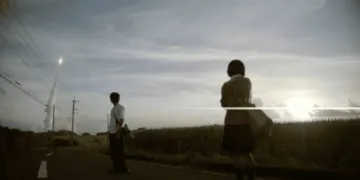















Yoo Jae-in’s accomplished debut feature, En Route To, guides viewers into the closed world of a South Korean high school boarding facility and keeps the focus on two students who must negotiate an unforgiving social order. Yun-ji, withdrawn and reeling after a pregnancy by her married homeroom teacher who has vanished, faces a decision that raises direct questions about female autonomy inside a society in rapid transition.
The story soon brings in Kyung-sun, Yun-ji’s roommate, an abrasive local entrepreneur who sells vape refills to classmates. Their early friction grows out of Yun-ji’s attempt to secure abortion pills and the practical problems that follow. Tension cools into an uneasy alliance that becomes the film’s engine.
Trained at the Korean Academy of Film Arts, Yoo shapes a measured coming-of-age drama that treats teenage pregnancy and sexual exploitation without moral preaching, mixing grave stakes with quick, disarming humor and plainspoken logic. The film’s immediate attention to the girls’ situation creates a clear, lived-in frame.
Bonds Forged in Broken Systems
The relationship between Yun-ji and Kyung-sun forms the structural spine of the film and offers a precise study of contemporary female friendship under pressure. The pair reads as opposites at first. Yun-ji retreats inward, fixated on an absent teacher and missing parents. Kyung-sun moves fast and talks faster, a sharp-witted hustler with an armor built for survival.

Their shift from conflict, sparked when Yun-ji steals Kyung-sun’s savings for an abortion, to a wary solidarity feels earned because it grows from shared knowledge of unreliable support networks. Both carry the weight of fragile family structures. Their bond becomes layered and changeable, framed by petty quarrels, small mercies, and a steady recognition that each offers the other a form of shelter.
Sim Su-bin’s Yun-ji channels a fierce hunger for stability. Her first impulse to keep the baby, a hope to “complete her family” after parental abandonment, lands with ache and clarity. This wish maps onto a cultural value that prizes a conventional household even as circumstances defy it, which gives the character’s choices a recognizable social logic.
Lee Ji-won gives Kyung-sun speed, bite, and a quiet capacity for care. The performance holds both a self-serving streak and a stubborn loyalty to a roommate left to fend for herself. The script stays with the forces that formed these girls and lets those forces explain behavior. Meaning grows from cause and effect, not from verdicts.
Thematic Sprawl and Visual Storytelling
En Route To reaches beyond a single issue. It traces lines that connect abortion, marital infidelity, sexual exploitation of youth, and contested ideas of family. The tone moves with agility. Early passages carry the suspense of a crisis. A funeral home sequence slips into caper-like comedy, then the film settles into a grounded melodrama in its latter half. This play with tone broadens the characters rather than turning them into symbols. Each swerve adds detail to who they are and what they can bear.

The structure divides into two clear halves. The first half concentrates on the immediate emergency and the formation of a friendship. The second half shifts to Yun-ji’s stay in a facility for pregnant teens and presents a less cohesive field of incident. The choice reads as intentional. The film follows the full and messy arc of Yun-ji’s decision rather than shaping events into a neat pattern. Another strand adds fresh complication.
Yun-ji forms an unusual connection with Min-yeong, the wife of the teacher, played by Jang Sun. Victim and “other woman” occupy the same charged space, and the film uses that space to examine expectations of motherhood inside Korean society without heavy-handed signals. Yoo manages this wideness with quiet authority, producing a heated, sometimes chaotic drama that avoids simple moral tales.
This reach invites cross-cultural reading. The film’s observational tenor recalls currents in contemporary European social drama, yet the story remains tied to South Korean youth culture, school life, and family expectations. The connection acts like a prism. It lets viewers see how a particular setting reflects pressures that echo internationally while preserving its own texture. The result speaks to audiences beyond Korea while keeping the local grain of speech, gesture, and institutional routine.
Directional Assurances and Cultural Lens
Yoo Jae-in’s direction favors unobtrusive control and a low-key register. The presentation looks polished without ornamental flourishes. Performances carry the weight, which suits a story about choices made in small rooms and in corridors where rules feel both clear and impossible. Cinematographer Baek Jae-ryung frames still, unfussy images that lend the world a quiet realism.
Calm compositions sit beside characters in turmoil, which sharpens the contrast between surface order and private crisis. The echo of European social dramas appears here as a point of method, yet the texture stays grounded in South Korean spaces and behaviors. That mix clarifies how local details can carry across borders and how global viewers can read the film without losing sight of its origins.
Editing, handled by Yoo, moves with light feet. Scenes connect with steady rhythm, which lets the film pass through sharp emotional turns without stalling. Beats of humor arrive with purpose. Jokes or wry moments relieve pressure and keep the characters human, never flattening the stakes.
The script treats a radical subject with clarity and restraint, which gives the film staying power. En Route To engages a serious topic and resists predictable fallout scenes or punitive arcs. The emphasis rests on choice, consequence, and the social landscape that shapes both.
Yoo Jae-in emerges as a significant new voice among South Korea’s rising female directors. The film reads as culturally specific and globally legible at the same time. It sets a story inside local institutions and values, and it reaches outward to viewers who recognize the shared language of coming-of-age pressure, friendship under strain, and systems that fail those who need them.
The pressure of a modernizing society appears in classroom hierarchies, in dorm rules, in the quiet economies that Kyung-sun navigates for cash, and in Yun-ji’s wish for a standard family that feels just out of reach. The film accepts contradiction as a fact of life. It shows how humor and common sense can live beside fear, how solidarity can grow inside scarcity, and how a single decision can expose the limits of help available to young women who must act now.
The film En Route To is an independent South Korean coming-of-age drama that centers on a teenage high school student’s unintended pregnancy and her subsequent difficult journey. The story explores themes of autonomy, familial abandonment, and female friendship as the protagonist, Yun-ji, attempts to navigate a complex and illegal abortion process with the unexpected help of her rebellious roommate, Kyung-sun. Written and directed by Yoo Jae-in, the film had its world premiere in competition at the 30th Busan International Film Festival on September 19, 2025. It currently holds a running time of 106 minutes. The film’s sales rights were acquired by Hive Filmworks, and it is expected to pursue a festival run and a potential arthouse or curated streamer release, though a general theatrical release may be challenging. Information regarding the official content rating is not widely available.
Credits
Title: En Route To
Distributor: Hive Filmworks (International Sales), Korean Academy of Film Arts (Production Company)
Release date: September 19, 2025 (Busan International Film Festival Premiere)
Running time: 106 minutes
Director: Yoo Jae-in
Writers: Yoo Jae-in
Producers and Executive Producers: Kim Jihyoung, Kim Jih-young
Cast: Sim Su-bin, Lee Ji-won, Jang Sun, Lee Ye-in, Jang Jae-hee, Oh Ha-ni, Yang Hung-joo, Kim So-wan
Director of Photography (Cinematographer): Baek Jae-ryung
Editors: Yoo Jae-in
Composer: Lee Eunjoo
The Review
En Route To
Yoo Jae-in delivers an impressive debut that successfully translates a teenage crisis into a complex cultural text. The film excels in portraying the nuanced, non-judgmental relationship between Yun-ji and Kyung-sun, highlighting their struggles within a modern South Korean framework. While the narrative's second half stumbles slightly as it sprawls into melodrama, the overall vision is clear, confident, and deeply empathetic. The film offers a powerful look at female experience and autonomy. It confirms Yoo Jae-in as a formidable new voice in international cinema.
PROS
- Accomplished, assured directorial debut
- Non-judgmental and empathetic approach to serious subjects
- Complex, layered relationship between the two main characters
- Lee Ji-won delivers an excellent, balanced performance
- Successfully blends serious themes with disarming humor
CONS
- Second half of the narrative is less compelling
- Yun-ji's morose nature can be challenging to connect with
- Ambitious narrative sprawl makes the pacing uneven at times