

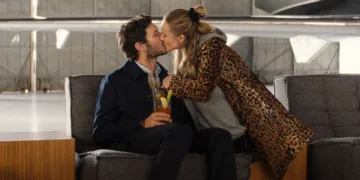


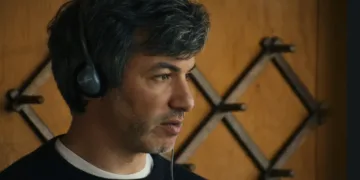













Leave The Cat Alone opens with a teasing title and arrives as Daisuke Shigaya’s confident first feature. There are no actual cats. The film attends to the low hum of adult life, where memory frays, work stalls, and a marriage drifts. Shigaya’s background with shorts like Windows and Spring Like Lovers sits in the rearview as this Busan Competition premiere sets a clear voice.
Three figures hold the frame: Maiko (Ran Taniguchi), a driven photographer; her husband Mori (Soma Fujii), a musician stuck in creative pause; and a marriage that has cooled into careful politeness. Something between them feels cracked and unnamed. Mori stares into a blank space while Maiko keeps climbing. The film watches small domestic currents with the patience of an indie designer who lays out a quiet map and lets a player feel the loss in the terrain.
Echoes of the Past: Narrative Perspective and Malleability
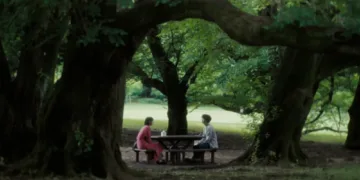
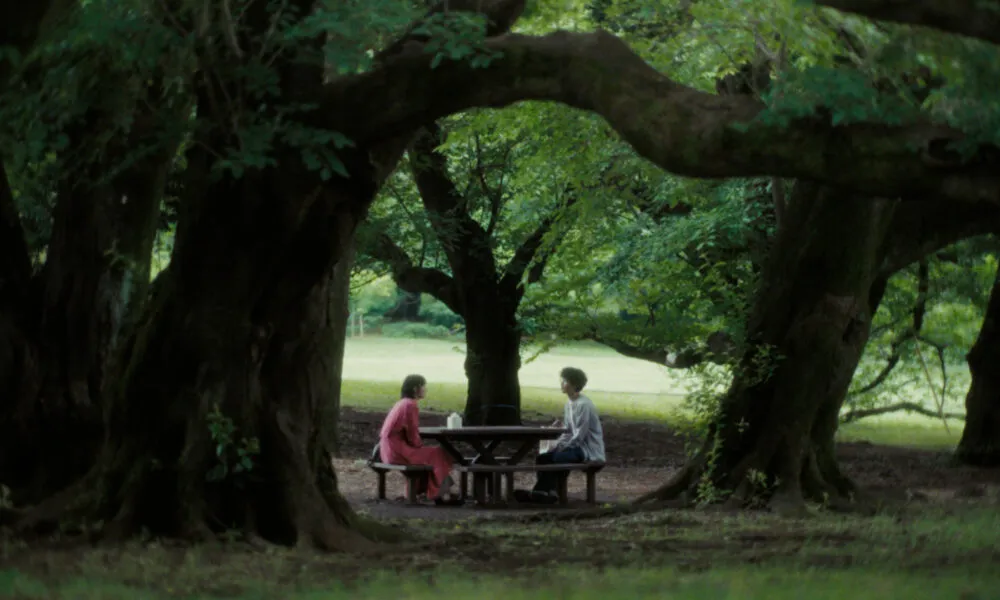
Shigaya builds the story like a mutable save file. A broken union sits at the center, with Mori’s paralysis placing him in Maiko’s shadow. The reason for their strain stays unclear. The film avoids loud confession and uses small gestures to signal damage that already occurred. Movement arrives through an unplanned meeting in a cake shop, where Mori runs into Asako (Yukino Murakami), a former lover. The past reenters the room, and the structure immediately complicates the present.
The encounter appears twice. First we see it as Mori processes it. Then we see it as Asako carries it. Each viewpoint carries its owner’s current state. Flashbacks from their earlier relationship shift shape according to who remembers them. This device feels like a mechanic that tests the elasticity of memory.
It prompts active viewing. Close attention becomes the way to track the branching paths, similar to following two character routes in a choice-heavy narrative. The reunion reads as a reconnection to older versions of themselves. That link offers a way to edit the past just enough to spark movement in the present.
The Geometry of Detachment: Technique and Pace
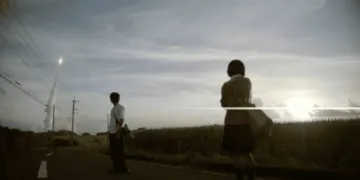
Shigaya directs with care and restraint. That approach sets the film’s look and its tempo. Ryo Hirai’s cinematography finds a spare beauty in small motions and rooms that hold muted light. Reflections, mirror planes, and faint superimpositions build a visual motif that ties memory to split self-perception. Maiko’s slightly skewed photographic compositions repeat across the film and give the emotional balance a visible tilt.
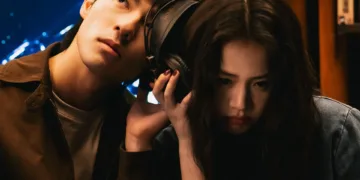
The tempo stays unhurried by design. Shigaya keeps the temperature low and favors micro shifts in feeling. The rhythm asks for patience and gives room for attention. Sound adds to that distance. Soma Fujii’s minimal acoustic score sits in a pensive register. Mori’s listless tinkering with audio gear turns creative block into an audible texture. The craft impresses through control and measure.
The same control can hold the audience at arm’s length from Mori. His passivity reads clearly and can reduce immersion in his pain, which leaves some viewers admiring the mood rather than sharing it. Art-house practice often makes this exchange, trading immediate emotional pull for an atmosphere that settles slowly and stays.
From Paralysis to Purpose: Creativity and Quiet Shifts
The film studies creative stall and the soft despair of routine. Mori’s insomnia and empty sessions with his instruments match Asako’s decision years ago to leave painting behind. Both carry the fatigue that builds inside repetition. They voice the old claim that real art needs suffering. The narrative treats that claim with care and questions the cost.
Time with Asako changes the energy. Their shared history becomes a small power source. Asako returns to her canvas. Mori finally writes a song. The line of motion leads to Maiko’s gallery show, “Collecting Something Alone,” where Mori looks at images that quietly honor their time together. He reads them with his usual sadness and understands that time does not run backward. The viewing still marks a change. The film frames the recovery of earlier selves as fuel for new work and for modest repair. Complexity remains in place. A single step still counts as a step.
What the film does best sits in the coordination between form and feeling. The mirrored structure, the two-perspective encounter, the shifting flashbacks, and the visual motif of reflections create a system that behaves like a narrative mechanic. Each part nudges the viewer to test memory against evidence on screen. Pacing locks that test into place, since the slow roll gives the eye time to notice minor variances in gesture and framing. Sound then colors those variances with an aural pattern that reflects Mori’s inner stasis.
The work makes room for small examples that clarify its method. Mori’s reunion with Asako primes a loop of recollection, and that loop alters how we read earlier scenes without changing the facts within them. Maiko’s off-kilter images recur at key points and replay the couple’s misalignment through composition rather than dialogue. Mori’s quiet fidgeting with cables and dials gives his block a concrete shape. Each example ties execution to theme, which keeps the film coherent even as perspectives shift.
For viewers who favor plot momentum, the measured tempo may feel remote. The film signals its terms early and keeps them. The approach favors resonance that arrives late and holds steady. That late arrival can be worth it, since the last movement of the story repositions past and present with clarity. The gallery visit and the two acts of new creation work like a checkpoint. Progress saves. The road ahead does not change shape, yet the player now carries a small upgrade.
Leave The Cat Alone earns attention for the way it aligns its storytelling technique with the subject of memory’s drift and work’s return. It also points toward the quieter corner of cinema that treats small decisions as decisive. Indie games have long trusted that kind of scale, where a camera angle, a piece of ambient sound, or a route chosen in a dialogue tree tells the real story. Shigaya works in that spirit. The result feels exact in design and honest in emotion, with a final note that listens rather than shouts.
Leave the Cat Alone is a Japanese drama that serves as the feature directorial debut for Daisuke Shigaya. It premiered on September 20, 2025, in the inaugural competition section at the Busan International Film Festival. The film is a subdued, introspective look at the quiet struggles of a modern marriage, creative stagnation, and the subjective nature of memory. It follows Mori, a musician suffering from an artistic block and lethargy, whose distant relationship with his wife, Maiko, is shaken by a chance encounter with his former lover, Asako. The film’s distribution in Japan is handled by Iha Films, and Nikkatsu is handling world sales, which is common for films premiering on the festival circuit. Details on streaming availability or a wider theatrical release are not yet widely available as of its initial festival run.
Credits
Title: Leave the Cat Alone
Distributor: Nikkatsu (World Sales), Iha Films (Japan Distribution)
Release date: September 20, 2025 (Busan International Film Festival)
Running time: 102 minutes
Director: Daisuke Shigaya
Writers: Daisuke Shigaya
Producers and Executive Producers: Hiro Itaya
Cast: Soma Fujii, Ran Taniguchi, Yukino Murakami, Meiry Mochizuki, Naoyuki Miyahara, Daikichi Sugawara, Shinsuke Kato, Kei Sato
Director of Photography (Cinematographer): Ryo Hirai, Fumiya Mishiro
Editors: Takahiro Sakata
Composer: Soma Fujii
The Review
Leave The Cat Alone
Daisuke Shigaya’s debut is a masterclass in cinematic restraint, treating memory and relationship breakdown with intellectual precision. Its unique, mirrored narrative structure effectively captures the quiet devastation of creative and marital stagnation. While the deliberate emotional distance sometimes limits viewer investment in the protagonist, the film's atmospheric control and thematic depth regarding adult disillusionment make it a compelling piece of independent art cinema. It rewards patience and attention.
PROS
- Assured and stylish feature film debut.
- Unique narrative structure and dual perspectives on memory.
- Excellent use of visual motifs (reflections) and sound design.
- Deep thematic exploration of creative block and adult disillusionment.
CONS
- Extreme emotional distance limits empathy.
- Very subdued pace may deter casual viewers.
- Protagonist Mori is difficult to invest in due to passive melancholy.
- Director consistently suppresses potential dramatic high points.