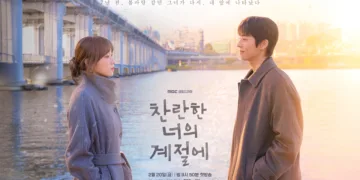





























The modern Korean drama has moved away from the high-voltage melodramas that once defined so much of the form. Its current mode often turns inward, toward mental health, emotional paralysis, and the quiet labor of surviving. In Your Radiant Season enters that shift with a story built around emotional stasis.
The narrative follows Song Ha-ran, a lead designer at the prestigious Nana Atelier fashion house, who has sealed herself off after a series of family tragedies. Seven years earlier, a catastrophic explosion in a Boston research lab killed her partner, or so she accepted. In the present, Seonu Chan arrives in Seoul as a bright animator seeking a professional collaboration with Ha-ran’s company. He seems open, sunny, and almost aggressively warm, the sort of man streaming dramas often position as human vitamin D.
He also carries visible burn scars and the psychological weight of surviving the same blast Ha-ran mourns. The series studies the pressure created when Chan’s brightness enters Ha-ran’s frozen life. It builds a mystery around mistaken identity and a laptop switch from years earlier. During their three-month project, the show studies how two people stranded in separate emotional climates might learn to share the same air.
Climatology of the Soul: The Season Metaphor
The series uses the recurring metaphor of “seasons” to define its protagonists’ psychological states. This reflects a growing television tendency, especially across streaming drama, to treat atmosphere as emotional language. Weather, temperature, light, and texture become tools for discussing trauma with less speechifying, which is useful since nobody in a grief drama needs another motivational wall decal. Song Ha-ran embodies a fixed winter. Her shift from cheerful student to cold professional comes from overwhelming grief. She avoids social contact. She retreats into an attic workspace.
That location makes her desire for distance visible, turning architecture into a protective shell. Her behavior functions as defense. She tries to freeze time before it can take anyone else. Her memory of placing the family’s shoes in a bathtub to stop them from leaving the house captures this impulse with painful clarity. It is a childlike act of control in a world that has become terrifyingly unstable.
Seonu Chan embodies a fixed summer. He presents joy as a daily practice. He greets people with physical warmth. He photographs everyone he meets. The warmth operates as a mask for trauma. Chae Jong-hyeop shapes the role through motion, using buoyancy to cover pain. Chan deals with suicidal ideation. He chose life after reading messages on a laptop.
His smile feels fragile, suggesting a man performing recovery because he needs to believe in it. The burn marks on his arm and his sensitivity to sound keep the past on the surface of his body. Noise triggers disorientation, as the restaurant scene makes clear. His trauma lives in the present tense. The series treats survival as a sensory condition, which gives its mental health portrait a specific force.
Lee Sung-kyung plays Ha-ran with carefully controlled stillness. The character has become emotionally rigid, and the performance finds drama in containment. Against Chan’s restless energy, Ha-ran’s restraint creates the show’s main emotional charge. One key moment arrives when she confronts her grandmother, Kim Na-na. Ha-ran admits that isolation is the sole way she knows how to live.
The confession cracks the frozen exterior and exposes the vulnerability beneath the designer clothes. The show studies the collision between two coping systems. Chan brings heat into Ha-ran’s winter. Ha-ran resists the thaw because feeling again also means hurting again. Their relationship asks if someone can move from one season to another without sacrificing some private part of the self.
The Mechanics of Deception and Recovery
The writing builds much of its romantic mystery from the earlier laptop switch. That incident creates a foundation of deception. Chan communicated with Ha-ran through his friend’s laptop and failed to correct the misunderstanding at the time. The show frames the situation as a romantic puzzle with a catfishing edge, which opens a useful critique of honesty in modern romance dramas.

Chan’s silence creates a power imbalance. He knows who Ha-ran is, while she fails to recognize him. The secret shadows their professional interactions and gives their collaboration a sustained tension. The Boston explosion operates as the event that reshaped both lives. It changed their identities and sent them along separate routes before Seoul placed them back in each other’s path.
The story uses a stalker subplot for immediate conflict. Ha-ran suspects Chan of following her after receiving envelopes of photographs taken without her knowledge. The threat creates danger and pulls the characters into closer contact. The arc resolves with the revelation of a jealous former colleague.
Its function is clear: it brings the leads together and gives Chan a chance to protect Ha-ran. The pacing remains deliberate. The script favors a slow burn and spends time with quiet grief. Some viewers may find that rhythm sluggish. The measured pace lets the emotional weight settle, which fits a streaming-era drama culture increasingly willing to let silence do narrative work.
The middle episodes struggle with repetition. Ha-ran pushes Chan away several times. Chan continues with his relentless cheer, a mode of persistence that can become tiring. The later episodes then move too quickly through several plot points. The lab explosion mystery stays central.
Chan’s recovering memories introduce fresh details. He hears sounds he missed at the time, suggesting the blast may have been planned. These fragments sustain curiosity and keep the romance tied to a darker unresolved past. The structure keeps the audience alert to the true nature of the event that shaped both characters.
Visual Language and the Fashion of Grief
The production values underline the leads’ emotional states. The lighting choices have a clear logic. Warm tones surround Chan’s scenes. Colder environments define Ha-ran’s office. These visual cues carry meaning before dialogue arrives. Nana Atelier gives the drama a high-fashion setting, and the clothes reveal character psychology. The animated character “Won” is based on Ha-ran. The outfits designed for Won reflect a version of Ha-ran she keeps hidden. They point toward her lost cheerfulness and connect her past self to her present one.
The locations keep the narrative grounded. Shim Cafe serves as neutral territory, a gathering place where emotional pressure can ease. Mr. Park, the owner, supplies steady guidance without overstepping. The palace scene stands out visually.
Traditional architecture becomes the setting for an emotional breakthrough, with colors and wall patterns placed against the characters’ modern pain. The quiet gazebo gives them room to share secrets. The scene shifts their relationship as Ha-ran begins to apologize for her behavior and admits she feels trapped behind her own walls.
Metaphorical imagery appears across the series. A withering plant mirrors Chan’s effort to help Ha-ran. He moves it to a pot of soil and watches it grow roots. The gesture represents his hope for her recovery. The winter landscape painting carries similar weight.
Ha-ran stands before frozen scenes and recognizes herself in the ice. The audio design sustains a melancholic mood. A soft soundtrack follows the emotional beats. Sound effects express Chan’s trauma, with ringing in his ears signaling distress. These technical choices create a reflective atmosphere and invite viewers to experience the world through the characters’ senses.
Familial Trauma and the Savior Narrative
The Song sisters show separate responses to family loss. Ha-ran, the eldest, carries the heaviest guilt. Ha-young works as the emotional regulator, caring for the family’s needs while neglecting her own desires. This role is familiar in grieving households. She becomes the family therapist, managing everyone else’s moods. Ha-dam, the youngest, seeks independence. Her relationship with a baseball player represents an attempt to begin a new life and leave the past behind. Their paths show grief as uneven and deeply personal. Each sister invents a survival method.
The dynamic between Yeon Tae-suk and Ha-young brings a lighter personality clash. Tae-suk is robotic and efficient. Ha-young is sprightly and dramatic. Their connection rests on mutual support and gives the series a softer register. Some viewers may see the teenage romance subplot as unnecessary.
It provides levity, yet it can feel like filler. The younger couple’s story stays near the surface and lacks the depth granted to the main leads. Kim Na-na, the grandmother, remains a powerful force. As matriarch, she pushes Ha-ran toward movement and uses her position to arrange meetings. Her motives combine love with a desire to see her granddaughter live again.
The main theme concerns healing, and the show often presents recovery through the arrival of a savior figure. Chan enters Ha-ran’s life to help her escape winter, which raises questions about agency. Ha-ran often waits for Chan to solve problems, tying her growth to his presence. The story frames healing as collaborative while also leaning on a familiar genre trope in which a woman’s happiness depends on a man’s intervention.
That choice narrows the female lead’s transformation. The character arcs remain partly unresolved. Ha-ran still wrestles with avoidant behavior. Ha-young continues to manage everyone’s emotions. The series gives romantic connection greater emphasis than individual resolution, reflecting a television trend that prizes aesthetic comfort. Its heartfelt portrait of grief leaves space for the long-term reality of living with loss.
The South Korean television series In Your Radiant Season premiered on February 20, 2026, and concluded its 12-episode run on April 3, 2026. Originally airing on MBC TV in a prominent weekend timeslot, the show gained significant domestic and international traction, also streaming globally on platforms like Disney+ and Hulu. Centered on a poignant romance between a high-end fashion designer and a character animator, the narrative masterfully weaves together themes of emotional healing, sensory trauma, and the slow uncovering of past secrets.
Where to Watch In Your Radiant Season Online


Full Credits
Title: In Your Radiant Season (찬란한 너의 계절에)
Distributor: MBC TV, Disney+, Hulu
Release date: February 20, 2026 – April 3, 2026
Rating: 15+ (South Korea), TV-14 (International)
Running time: 64–71 minutes per episode
Director: Jeong Sang-hee, Kim Young-jae, Park Seon-ho
Writers: Jo Sung-hee
Producers and Executive Producers: Namgoong Sung-woo, Park Sang-hyun, Kim Hee-yeol, Hong Soo-hwan, Lee Wol-yeon, Moon Joo-hee, Ahn Jae-hong
Cast: Lee Sung-kyung, Chae Jong-hyeop, Lee Mi-sook, Kang Seok-woo, Han Ji-hyun, Kwon Hyuk, Oh Ye-ju, Kim Tae-young, Firas A. Naji
Director of Photography (Cinematographer): Technical credits via Pan Entertainment
Editors: Technical credits via MBC Production
Composer: Moon Sung-nam
The Review
In Your Radiant Season
In Your Radiant Season offers a visually poetic exploration of grief through its seasonal metaphors. While the lead performances create a palpable friction, the narrative relies heavily on a savior dynamic that obscures the individual growth of its female lead. The slow pacing and rushed resolution might test patience. It remains a sincere attempt to map the geography of loss within the limits of a traditional romance.
PROS
- Atmospheric lighting and color palettes
- Thoughtful metaphor of emotional seasons
- Chae Jong-hyeop’s physical and expressive performance
- Realistic portrayal of sisterly dynamics
CONS
- Uneven pacing with a sluggish middle and hurried finish
- Dubious "catfishing" foundation of the romance
- Limited character development for the female lead outside the relationship
- Excessive screen time for the teenage subplot