

























![Kingdom Hearts Collection [I-III] Review](https://gazettely.com/wp-content/uploads/2026/10/Kingdom-Hearts-Collection-I-III-1-360x180.webp "Kingdom Hearts Collection [I-III] Review: KHII Holds Steady as Newer Entries Fluctuate 37")



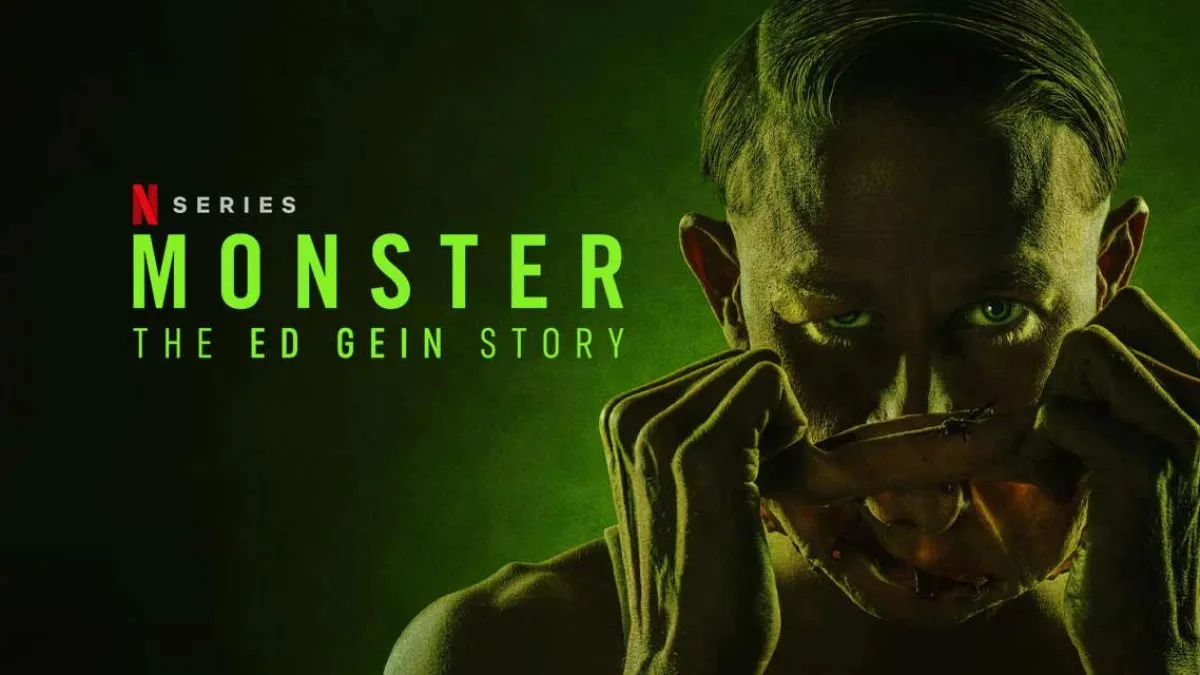

Certain horrors do not simply occur; they are birthed into myth, becoming a kind of cultural source code for all the terrors that follow. Before the slasher film, before the profiler, before the primetime procedural, there was the quiet farmhouse in Plainfield, Wisconsin. With Monster: The Ed Gein Story, the anthology series turns its gaze from the well-documented psychopaths of the modern era to exhume this foundational bogeyman, a man whose quiet atrocities provided the template for a uniquely American brand of grotesquerie.
The series presents itself as a psychological excavation, tracing the path from a tormented son to a grave robber and murderer. Yet, it also has grander, perhaps foolhardy, ambitions. It aims to be a cultural analysis, positioning Gein as the macabre muse for cinema’s most unforgettable monsters. What unfolds is a strange hybrid: part biopic, part academic thesis, and part self-loathing critique of its own existence. This is a story not about the man, but about the monstrous shadow he cast, a shadow the series itself seems desperate to both inhabit and escape.
A Portrait of the Killer: Performance and Psychology
Charlie Hunnam’s interpretation of Ed Gein is a dissertation on affectation, a performance so committed to its external tics that it forgets to build an interior. He adopts a soft-spoken, high-pitched delivery, a vocal choice that lands somewhere between a whisper and a whimper, paired with a physical hesitancy meant to convey a man terminally ill at ease in his own skin.
The sheer effort is visible in every swallowed word and downcast glance, but the result is less a chilling embodiment of madness and more a distracting, circus side show of methodical weirdness. The performance fails to answer the actor’s primary challenge: how to portray a psychological black box. Instead of suggesting a roiling inner life, Hunnam’s choices create a vacuum.
The script compounds this failure, offering no coherent map of Gein’s motivations. He remains an opaque vessel for rumored atrocities, a collection of Freudian triggers without a psyche. We are asked to spend eight hours with a man who, late in the series, admits, “I don’t know who I am,” and the most damning critique is that we are forced to agree. Neither, it seems, do the writers.
This central void is made more apparent by the towering, fleeting presence of Laurie Metcalf as his mother, Augusta. In the first episode, she is a tour de force, a scripture-spewing matriarch who conjures hellfire with a single glare, carving out the twisted Oedipal space in which Ed’s pathology will fester. Her pronouncements on the sinfulness of women are delivered with the force of a physical blow.
Then, after this stunning overture, she largely disappears from the narrative, reduced to a spectral voiceover or a decaying prop. This is a criminal underuse of Metcalf’s talent, a baffling decision that abandons the central psychological conflict that supposedly defined Gein’s entire existence. The pressure cooker is left without its heat source.
The supporting figures are similarly adrift. Suzanna Son’s Adeline Watkins, a heavily fictionalized character who acts as Ed’s ghoulish encourager, is played with an effective, enigmatic subtlety that the rest of the show lacks. She is a fascinating catalyst, though one entirely invented for narrative convenience.
Other portrayals, like Tom Hollander’s one-dimensional Alfred Hitchcock and the bizarre fantasy sequences featuring Vicky Krieps as Nazi war criminal Ilse Koch, feel like phantoms from a different, less interesting series, existing only to serve a thematic argument rather than to live as characters.
Gein’s Legacy: From Farmhouse to Film Set
The series stakes its entire intellectual claim on a primary meta-narrative: tracing Gein’s bloody fingerprints across the landscape of horror cinema. It explicitly and repeatedly connects his desecrations to the creation of Norman Bates in Psycho, Leatherface in The Texas Chain Saw Massacre, and Buffalo Bill in The Silence of the Lambs.

This thesis, while historically sound, is executed with all the nuance of a sledgehammer. The show isn’t offering sharp cultural analysis; it is connecting historical dots with a bloody crayon, pointing out well-known trivia without providing any profound insight into what these connections truly mean. It fails to ask the more interesting questions.
Why did Hitchcock distill Gein’s story into a study of maternal obsession and voyeurism? Why did Tobe Hooper refract it through the lens of cannibalistic capitalism and the decay of the American family? The series is content to show the what, but never dares to explore the why. The project feels less like an investigation and more like a macabre, multimedia book report.
Its method involves recreating moments from these landmark films, including stiffly written interludes with Hitchcock and actor Anthony Perkins. The most telling, and perhaps most artistically bankrupt, of these is a reshot version of the Psycho shower scene, rendered with the graphic, adults-only sensibility of modern streaming.
The sequence begs the question of purpose. Is this a meaningful commentary on how cinematic horror has evolved, a statement on the power of suggestion versus the bluntness of depiction? Or is it simply an act of empty provocation, a way to shock an audience it assumes is already desensitized? It feels entirely like the latter, a misunderstanding of what made the original a masterpiece.
This impulse extends to the show’s Grand Unified Theory of Violence, a clumsy attempt to link Gein’s crimes to the Holocaust and the barbarism of the Vietnam War. These connections feel unearned and intellectually facile. The bizarre, tonally jarring fantasies of Nazi atrocities, inspired by a pulp comic book, are particularly egregious. They use the systemic horror of a genocide as shallow psychological window dressing for one man’s psychosis, an ethical and artistic miscalculation of stunning proportions.
A Narrative of Contempt: The Show vs. Its Audience
Herein lies the show’s most fascinating and fatal flaw: its simultaneous condemnation and gleeful indulgence of the public’s appetite for true crime. It is a strange, self-hating ouroboros of a television series, devouring its own premise. Characters like Alfred Hitchcock are made to bemoan the audience’s base demand for “sex-horror,” a speech that functions as a direct scolding of the viewer for the very act of watching.

This moral high ground is immediately, and spectacularly, abdicated by the show’s own methods. It relentlessly depicts graphic violence, nudity, and Gein’s ghoulish handiwork (the skin suits, the chair upholstery, the collection of vulvas) with a repetitive, lingering gaze that borders on the pornographic.
This creates a kind of “didactic gore,” where the series is both titillating and shaming its audience for being titillated. The series is profoundly guilty of the very sensationalism it claims to critique, wagging its finger at you while forcing you to look closer.
The show’s central thesis appears to be that the real monsters are manifold: the killer, yes, but also the storytellers who exploit his legend and, most pointedly, the ghoulish audiences who consume these stories. This creates a staggering, almost unprecedented sense of contempt between a piece of entertainment and its consumer.
There is a deep, structural irony in a Netflix production, a platform whose algorithms have perfected the art of feeding our true crime addictions, criticizing other storytellers (including those from its own catalog, like Mindhunter) for doing the same thing. The viewer is positioned as the final villain in a transaction they were explicitly invited to participate in.
As a messenger, the show is fatally compromised. It cannot function as a definitive, clear-eyed public service when its own hands are so deep in the narrative gore it purports to find so distasteful. It is an arsonist delivering a lecture on fire safety while holding a lit match. Its authority to pass judgment is not just undermined; it is nonexistent.
An Unfocused Autopsy: Structure, Pacing, and Fact
As a piece of storytelling, the series is a structural disaster. The chronology is mangled, jumping through time with a carelessness that annihilates any sense of narrative momentum or psychological development. The eight episodes feel punishingly overlong, a seemingly endless loop of Gein’s repetitive “hobbies” padded with redundant scenes and subplots that go nowhere.

Only a couple of installments, like the introductory “Mother!” and the discovery-focused “Bombshell,” manage to find a sharp, effective pace. The rest is a formless slog through misery. This narrative chaos is mirrored by a severe case of tonal whiplash. The aesthetic lurches from austere Midwestern Gothic to garish Grand Guignol theater, especially in the later episodes, as if the show grew bored of its own seriousness and decided to lean into the absurdity of a man in a mental facility joyfully singing “I Enjoy Being a Girl.” It cannot decide if it wants to be a somber meditation or a campy spectacle.
Its relationship with historical fact is equally undisciplined, which is a critical failure for a show that claims to be setting the record straight. Every salacious rumor about Gein is treated as canonical truth. He is definitively responsible for his brother’s death and a string of local disappearances, assertions that remain speculative in reality.
The creation of pseudo-composite characters and entirely fabricated subplots (like a bizarre, nonsensical connection to Ted Bundy) further muddies the water. By cementing the most lurid rumors as fact, the show actually contributes to the very mythologizing it pretends to deconstruct. Amid this mess, there are technical merits.
The cinematography is handsome, capturing the bleak beauty of the Wisconsin landscape and cleverly mimicking the visual language of the horror films it references. Mac Quayle’s score is unsettling and effective. Yet these qualities only make the thematic failures more frustrating. They are the cosmetic polish on a rotting narrative corpse, a beautifully crafted empty box that is technically impressive but intellectually and morally bankrupt.
Monster: The Ed Gein Story is the third installment in the true crime anthology series Monster, created by Ryan Murphy and Ian Brennan. The limited series, starring Charlie Hunnam as the notorious serial killer and grave robber Ed Gein, premiered on October 3, 2025. It explores Gein’s horrific crimes in the 1950s and his profound, lasting influence on modern horror films such as Psycho and The Texas Chain Saw Massacre. The series is available to watch exclusively on the streaming platform Netflix.
Full Credits
Director: Max Winkler, Ian Brennan
Writers: Ian Brennan, Ryan Murphy
Producers and Executive Producers: Ryan Murphy, Ian Brennan, Alexis Martin Woodall, Eric Kovtun, Scott Robertson
Cast: Charlie Hunnam, Laurie Metcalf, Tom Hollander, Suzanna Son, Vicky Krieps, Olivia Williams, Joey Pollari, Lesley Manville, Addison Rae, Will Brill
Director of Photography (Cinematographer): C. Kim Miles, Tarin Anderson
Editors: Peggy Tachdjian, Stephanie Gorin
Composer: Thomas Newman, Julia Newman
The Review
Monster: The Ed Gein Story
Monster: The Ed Gein Story is a handsome, occasionally well-acted failure. It positions itself as a profound critique of our obsession with true crime, yet revels in the same graphic exploitation it condemns, creating a staggering hypocrisy. Anchored by a fleeting, brilliant performance from Laurie Metcalf but undone by a hollow central portrayal and a chaotic narrative, the series is a punishingly long, thematically bankrupt exercise. It has nothing new to say about Gein or his monstrous legacy, content to wear the skin of a serious drama without possessing a heartbeat.
PROS
- Laurie Metcalf delivers a powerhouse performance as Augusta Gein, dominating her limited screen time.
- The series features handsome cinematography and a strong, atmospheric production design that captures the bleakness of mid-century Wisconsin.
- Mac Quayle’s score is effectively unsettling and complements the noir tone.
- Suzanna Son provides a subtle and enigmatic supporting performance.
CONS
- Thematic hypocrisy is its fatal flaw; it scolds its audience for consuming the very sensationalism it enthusiastically provides.
- A chaotic and unfocused narrative structure with severe pacing issues makes it a tedious watch.
- Charlie Hunnam’s central performance as Gein is a distracting collection of affectations that fails to convey any psychological depth.
- It is intellectually shallow, failing to offer any new insight into Gein’s legacy or the cultural impact of his crimes.
- The series indulges in repetitive, gratuitous, and often pointless graphic violence and gore.







