




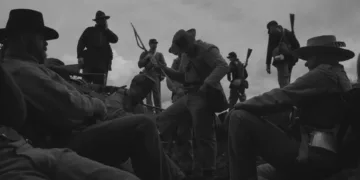

















Some family names are just words on a birth certificate. Others are institutions, entities of their own, carrying the weight of history and the expectation of influence. The Murdaugh name, in the Lowcountry of South Carolina, was the latter. It was a brand of power built over a century, a legal dynasty that treated the local justice system as a family business.
Their name was a key that unlocked doors, silenced accusers, and guaranteed a certain kind of untouchable status. Murdaugh: Death in the Family chronicles the violent, messy dissolution of that institution. The series frames its story with two brutal events. The first is a 2019 boat crash, a night of youthful recklessness piloted by the family’s younger son, Paul, that ends in a young woman’s death.
The second, two years later, is the shocking double homicide of Paul and his mother, Maggie, at the family’s hunting lodge. These twin tragedies pry open a world of secrets, exposing the rot beneath the veneer of Southern gentility and placing the patriarch, Alex Murdaugh, at the center of a spectacular downfall involving stolen money, deep-seated corruption, and profound betrayal.
Reenacting the Inevitable
Creating a scripted series from a true-crime saga that has already been dissected across countless podcasts and documentaries presents a unique narrative challenge. The audience arrives knowing the destination; the show’s task is to make the journey worthwhile. Suspense, in the traditional sense, is off the table. Murdaugh: Death in the Family wisely exchanges the question of what happened for a deeper exploration of how a family so insulated by power could so completely implode.
It is less a whodunit and more a meticulous study of systemic moral failure. The drama shifts from plot twists to the dread of inevitability, turning the viewer into a witness to a slow-motion catastrophe. The tension comes from watching characters make fatal choices, oblivious to the future we already know awaits them.
To fill the unrecorded moments, the series employs a healthy dose of artistic license, a fact it admits upfront. These speculative scenes, mostly quiet, loaded conversations between family members, attempt to map the psychological terrain of the Murdaughs. At their best, they offer chillingly plausible insights into a family dynamic built on denial and transactional affection.
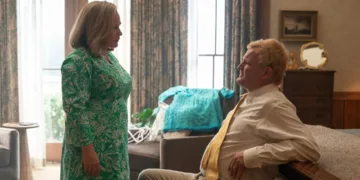
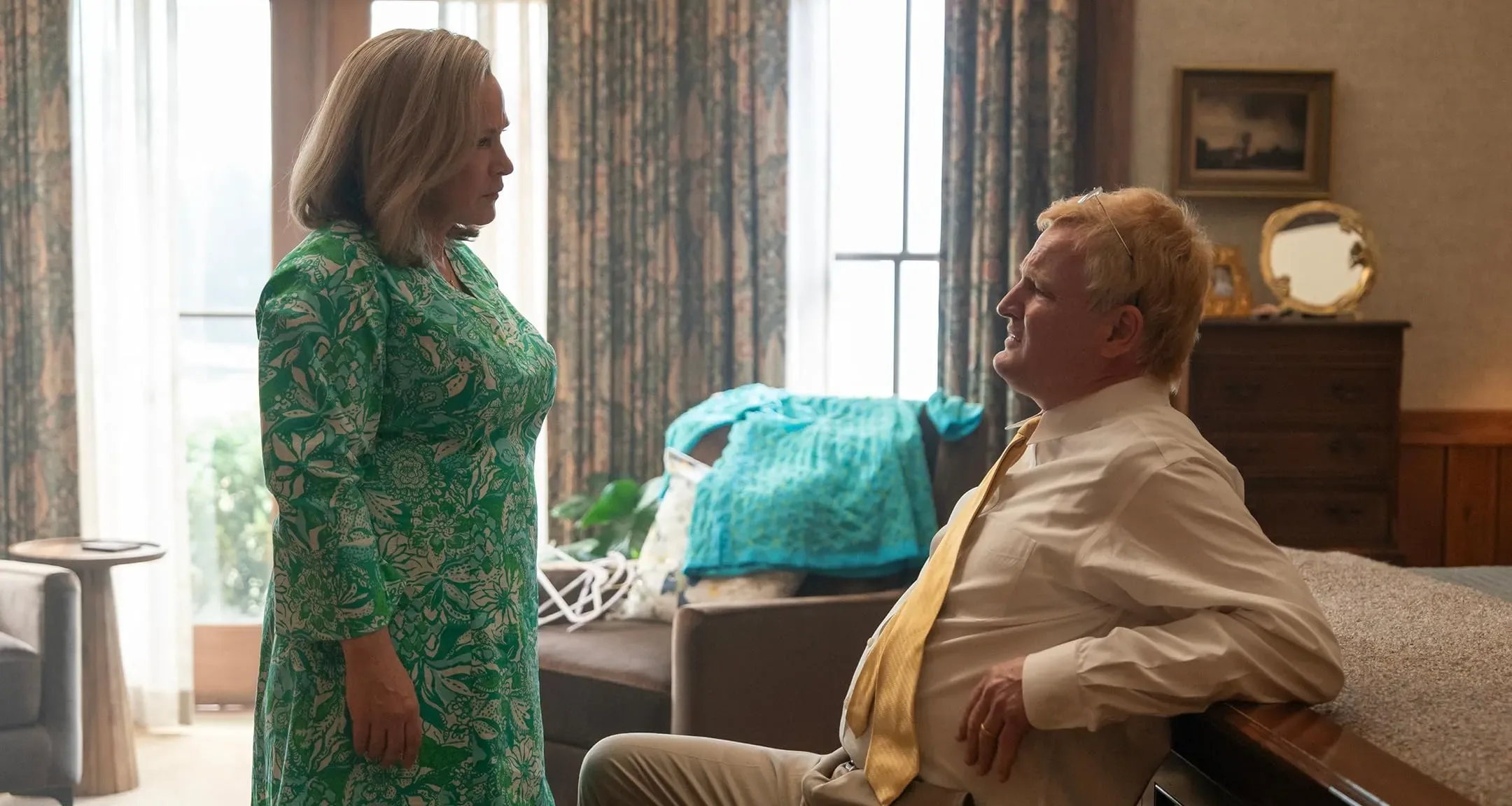
A tense exchange between Alex and Maggie feels authentic in its depiction of a marriage held together by shared interests rather than genuine intimacy. In other moments, however, the writing veers into broad melodrama, turning subtext into spoken text and sacrificing nuance for emotional signposting. The decision to script the final conversations of murder victims is the show’s riskiest gambit.
It walks a fine line between empathetic storytelling and what some might see as exploitation, raising persistent questions about the ethics of dramatizing real suffering. This makes for a bifurcated viewing experience. For a newcomer, the show is a sprawling, self-contained tragedy. For those already steeped in the case, it becomes an exercise in adaptation and performance, a test of whether this fictionalized version can uncover a truth that the documentaries missed.
The Faces of a Fallen House
A story this dependent on character requires a cast capable of inhabiting immense complexity, and the series is largely successful in its portrayals. Jason Clarke’s transformation into Alex Murdaugh is a feat of both physical disguise and nuanced performance. Hidden beneath prosthetics and a syrupy drawl, Clarke perfectly embodies the chilling duality of a man whose folksy charm is a weapon. He nails the performative affability of a small-town power broker, the easy laughter and back-slapping that have long concealed a deeply manipulative nature.

The performance finds its greatest power when the cracks in this facade begin to show. Watching Clarke’s Alex juggle frantic phone calls to clean up his sons’ messes while discreetly feeding his own opioid addiction is to see a master manipulator losing his grip. The panic in his eyes feels real, a terrifying glimpse of a man whose entire identity is predicated on control.
As his wife, Maggie, Patricia Arquette delivers a masterclass in subtlety. Her performance is a quiet portrait of complicity and dawning horror. She presents Maggie not as a simple victim, but as a woman who long ago accepted the Faustian bargain of her marriage.
Arquette communicates volumes without a word. The slight tightening of her smile at a society party, the weary resignation in her posture during a fight, the flicker of fear when she realizes the family’s problems are beyond fixing—it is all there in her restrained physicality. She makes Maggie a tragic figure, a person whose comfort was purchased with a willful blindness she could no longer afford.
The younger generation is just as compelling. Johnny Berchtold plays Paul not merely as a spoiled brat but as a volatile storm of inherited arrogance and profound insecurity. His swagger is a brittle shield, and Berchtold expertly reveals the frightened child beneath the aggressive posturing. In contrast, Will Harrison’s Buster is a figure of watchful silence, the heir apparent to a kingdom already crumbling.
The supporting cast ably fills out this world, with Noah Emmerich as Alex’s conflicted brother and Gerald McRaney as the once-powerful patriarch. The show’s most awkward structural element is the character of journalist Mandy Matney, played by Brittany Snow. While Matney’s real-world reporting was vital, her storyline in the show feels detached, an obligatory nod to the source material that repeatedly pulls focus from the central, claustrophobic family drama. Her scenes feel like they belong to a different, more conventional procedural.
A Narrative Stretched Thin
For all its performance strengths, Murdaugh: Death in the Family suffers from a significant structural ailment: the bloat endemic to the modern streaming model. The story is stretched across eight hour-long episodes when it would have been far more potent as a taut five-part thriller.

The primary culprit is a dual timeline that jumps between the years leading up to the murders and the investigation that follows. Instead of creating a compelling interplay between past and present, the structure often feels disjointed, dissipating tension rather than building it. The constant chronological shifts prevent either storyline from developing a sustained momentum, leaving the viewer perpetually trying to regain their footing.
The pacing is profoundly uneven. The early episodes are almost entirely consumed by the boat crash investigation, a narrative choice that front-loads the series with legal wrangling and delays the arrival of the story’s true dramatic core. An entire hour can pass with the plot advancing only incrementally. This deliberate, almost laborious pace feels designed to fill the episode order, resulting in scenes that repeat information or belabor points about the family’s influence that were clear from the opening minutes.
The exposition can be particularly clunky, with characters sometimes speaking in lines that sound more like reminders to the audience than natural dialogue. The show often chooses to tell us about the Murdaughs’ power through conversation when a single, subtle visual cue would have been more effective. This reliance on drawn-out exposition and narrative padding ultimately saps the story of its inherent urgency, turning a shocking tale of violence and corruption into a long, sometimes tedious, legal deposition.
The Aesthetics of Rot
Visually, the series makes a disciplined choice to reject sensationalism. The aesthetic is one of realism, capturing the humid, sun-drenched world of the Lowcountry with a muted, almost dreary palette. The direction favors a steady, observational style, finding horror not in graphic violence but in the oppressive quiet of the Murdaugh estate or the forced cheerfulness of a charity event.

The cinematography frames the characters in their natural habitats—wood-paneled offices, sprawling porches, exclusive boat clubs—making the environment itself a symbol of their insulated power. The sound design amplifies this, contrasting the chirping crickets of the rural landscape with the tense, whispered conversations happening behind closed doors. This creates a palpable sense of claustrophobia, suggesting that this family’s gilded cage was also its prison.
Ultimately, the show is an autopsy of a uniquely American form of power, one rooted in legacy, land, and the tacit consent of a community. It methodically demonstrates how generations of unchecked influence can erode the foundations of justice, creating a system designed to protect its most powerful members at all costs.
The story of the Murdaughs is presented not as an aberration, but as the grimly logical conclusion of a world where a name serves as a shield against consequence. It poses a chilling question about the nature of impunity: when the people in charge of the rules believe they are exempt from them, how long can the center possibly hold?
Murdaugh: Death in the Family is an upcoming true crime drama miniseries for Hulu, based on the real-life events surrounding the Murdaugh family in South Carolina. The story centers on Alex Murdaugh, an attorney whose life and family legacy unravel following a deadly boat crash involving his son, Paul, which ultimately exposes the family’s connections to multiple mysterious deaths. The limited series is scheduled to premiere on October 15, 2025, with the first three episodes dropping on that day, and subsequent episodes released weekly. You can watch the series exclusively on Hulu in the United States and on Disney+ in some international regions.
Full Credits
The Review
Murdaugh: Death in the Family
Anchored by commanding performances from Jason Clarke and Patricia Arquette, the series succeeds as a chilling portrait of moral decay. Its disciplined, realistic tone effectively captures the rot beneath a veneer of Southern respectability. However, the compelling character work is frequently undermined by sluggish pacing and a bloated narrative structure that stretches a taut tragedy to its breaking point. For those unfamiliar with the case, it is a detailed study of corruption. For others, it may feel like a well-acted but ultimately superfluous retelling of a story already told with more urgency elsewhere.
PROS
- Transformative and powerful lead performances that capture the complexity of the central figures.
- A restrained, realistic aesthetic that avoids true-crime sensationalism, building a palpable sense of dread.
- Succeeds as an effective psychological study of a family’s internal collapse and the corrupting nature of influence.
- Provides a comprehensive introduction for viewers new to the Murdaugh saga.
CONS
- The eight-episode runtime feels excessive, leading to significant pacing issues and narrative bloat.
- A disjointed dual timeline often dissipates dramatic tension instead of building it.
- Can feel redundant for audiences already familiar with the case from extensive documentary and podcast coverage.
- Some subplots feel disconnected from the main narrative, detracting from the central family drama.