











Every archive is a mausoleum. It preserves what is already dead, offering flickering images that only accentuate the finality of the past. To watch Robert Gordon’s Newport & the Great Folk Dream is to engage in a kind of séance with a ghost that refuses to speak plainly. The film is built from the bones of a lost time, meticulously assembled from over eighty hours of Murray Lerner’s unseen 16mm footage from 1963 to 1966. It performs an autopsy on a moment, examining the vibrant life that once animated the Newport Folk Festival before locating the precise point of spiritual death.
This is not a celebration. It is a document of a brief, incandescent illusion, the period when a collective ideal felt not just possible but preordained. The film’s narrative is a slow, methodical tracing of a fracture line, from a point of impossible unity to its inevitable dissolution into the static of a new era. It is a work of profound melancholy, a study for anyone who finds a strange beauty in the architecture of failed utopias and the cold mechanics of historical change. It asks what it means to believe in something, and what is left when that belief is gone.
A Fragile Covenant
The “folk dream,” as the film’s title suggests, was less a musical genre and more a philosophical proposition, a fragile covenant against the atomization of modern life. In 1963, this idea achieved a precarious physical form on the fields of Newport. It was a belief in a kind of spiritual alchemy, the notion that the disparate songs of a fractured nation, from Appalachian laments to the hollers of the Mississippi Delta, could be fused into a single, unified expression of political and moral conscience.

This vision belonged, in large part, to Pete Seeger, a figure whose quiet refusal to bend before the House Un-American Activities Committee gave him the saintly authority to attempt such a radical experiment. His ethos is captured in a single, profound gesture: his insistence that every musician, from the most obscure to the most revered, receive the same payment of fifty dollars. It was a spiritual directive, an attempt to exorcise the ego and subordinate the individual to the collective song.
The music from that year is the sound of this principle made manifest. It is a sound that feels elemental, drawn from the earth itself. When Clarence Ashley & Doc Watson perform “The Coo Coo Bird,” their voices are like worn leather and dry soil, carrying a truth that predates any stage. The performance of the Moving Star Hall Singers possesses an ancient, oceanic quality, a sound that feels less like a performance and more like the opening of a channel to a forgotten past.
The fire of the era is present in the Freedom Singers’ rendition of “Woke Up This Morning,” a performance that weaponizes harmony and turns a simple melody into an instrument of profound defiance. The 1963 festival existed as a spiritual staging ground, a gathering of a tribe preparing for the battles to come. One month later, many of these same voices would be heard at the March on Washington, their songs serving as the liturgy for a revolution.
The Inevitable Unraveling
By 1964, the covenant was beginning to fray. The air at Newport had grown thicker, charged with a new spirit that was more personal, more anarchic, and seductively unruly. The world beyond the festival grounds was hemorrhaging certainty. The arrival of The Beatles in America was not a musical event but a cultural contagion, introducing a new kind of mass consciousness built on manufactured desire, a force entirely alien to the handcrafted soul of the folk ideal.

This shift toward a different kind of existence was mirrored on the Newport stages. The expanding musical palette began to dilute the singular focus of the original project. The raw, nerve-ending confession of Buffy Sainte-Marie’s “Co’dine,” a song of private addiction, stood in stark opposition to the public hymns of the previous year. It signaled a turn inward, an exploration of the self that the collectivist dream had sought to transcend.
The clearest omen of the coming schism, however, was already humming through an amplifier. Howlin’ Wolf stood on stage with an electric guitar and unleashed a sound that was jagged, profane, and thrillingly impure. The serpent was not just in the garden; it was being given a microphone. This internal transformation was made visible in the crowd itself. The orderly, attentive rows of lawn chairs, which gave the early festival the feel of an outdoor church, had begun to dissolve into a looser, more chaotic swarm of bodies.
Young people were dancing with a new abandon, their movements speaking of a desire for personal release, not communal uplift. The atmosphere was shifting from a congregation to something closer to a revel. The stunning 1965 performance by Mimi and Richard Fariña, with its modern, intoxicating groove that set even the folk purist Joan Baez to dancing, was the final, beautiful proof that the old world had already died. The center could not hold.
Apostasy in Six Strings
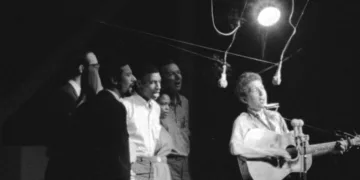
Bob Dylan’s electric set in 1965 was not an act of betrayal; it was an act of revelation. He arrived on a stage that was already wired for its own demise. The Paul Butterfield Blues Band and the Chambers Brothers were already there, their amplified instruments serving as the heralds of a new sonic age.
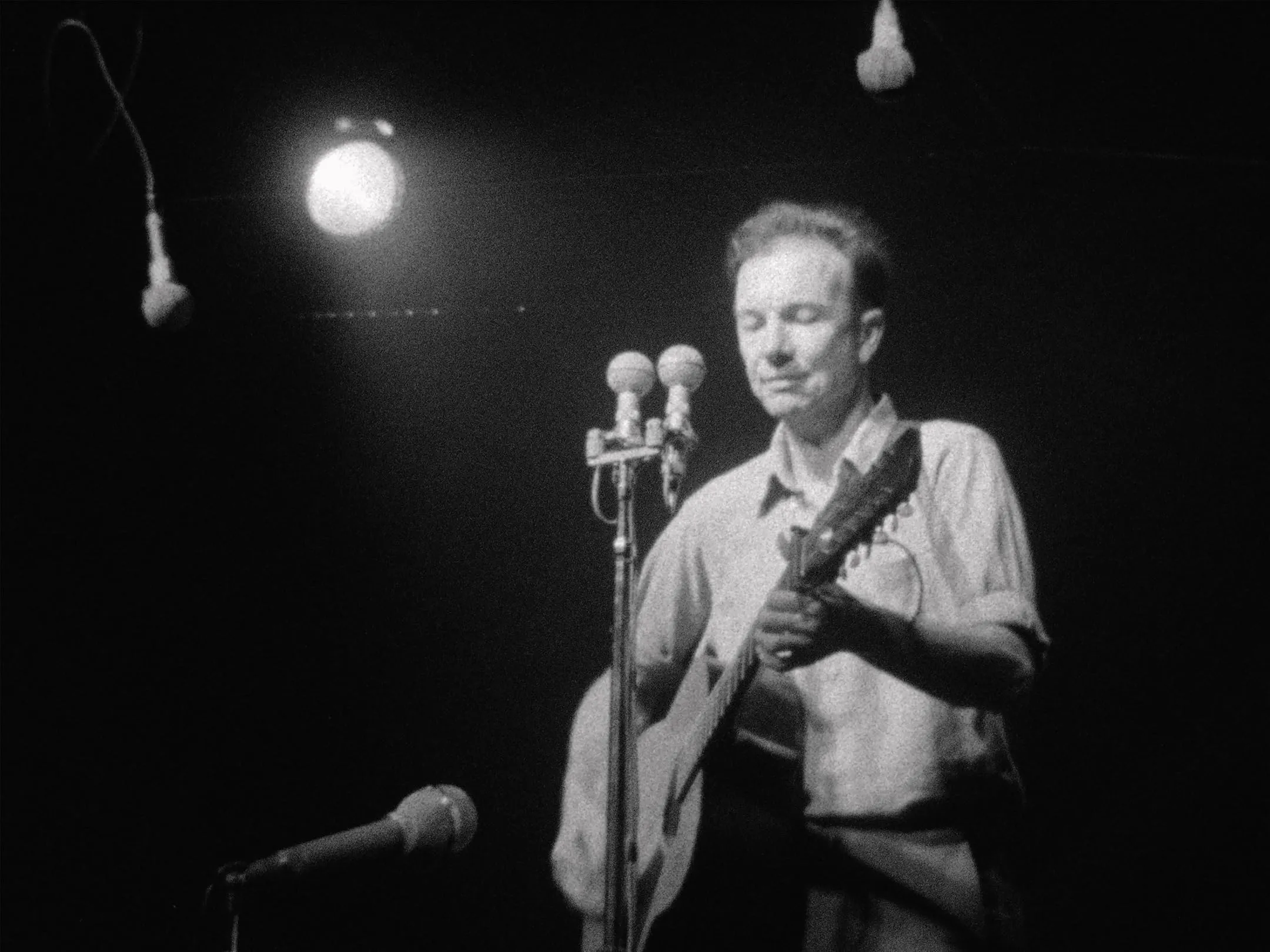
Dylan did not cause the schism. He simply gave it a name and a face, forcing the faithful to confront the apostasy that had been growing within their own ranks. His performance of “Maggie’s Farm” was the flashpoint, a sonic assault that shattered the festival’s pastoral illusion. It was loud, confrontational, and utterly indifferent to the ideals of acoustic purity. As Loudon Wainwright III states with brutal clarity, “That night, Dylan fucked with it.” He broke the covenant.
The boos that erupted from the crowd were a complex human sound, a wail of confusion and loss. It was the cry of an audience watching its messiah reject his own divinity, choosing to be a man instead of a symbol. They were booing the sound, the artist, and the terrifying, unknown future he represented. The folk dream did not die because a Fender Stratocaster was plugged into an amplifier.
It ended because the gravitational center of the culture was shifting away from the selfless communion of the “we” and toward the liberated, and terrifying, sovereignty of the “I.” The song of the self was replacing the song of the people. The film stands as a monument to that moment of fracture, a haunting record of a beautiful, perhaps always impossible, ideal. It captures both the purity that was lost and the cold, unsparing creative power of what came next. The dream was over, and the world began.
Newport & the Great Folk Dream is a feature documentary that chronicles the pivotal years of the Newport Folk Festival, specifically from 1963 to 1966. Using newly remastered 4K archival footage shot by Murray Lerner and his crew, the film captures the collision of traditional folk music with the emergent youth counterculture and the Civil Rights movement, including key performances by legends like Bob Dylan, Johnny Cash, and Joan Baez. The documentary notably features Dylan’s controversial 1965 electric set, which signaled a major shift in the musical landscape. The film had its World Premiere at the Venice Film Festival on September 5, 2025, and its North American Premiere at the Hamptons International Film Festival on October 3, 2025. As of its premiere, it does not yet have a wide theatrical or streaming release platform announced.
Full Credits
Director: Robert Gordon
Writers: Robert Gordon
Producers and Executive Producers: Joe Lauro, Robert Gordon, Laura Jean Hocking, Bruce Feldbaum, Dan Braun, Josh Braun
Cast: Bob Dylan, Johnny Cash, Joan Baez, Howlin’ Wolf, Mississippi John Hurt, Judy Collins, Pete Seeger, Odetta
Director of Photography (Cinematographer): Murray Lerner, George Pickow, Stanley Meredith, Francis Grumman
Editors: Laura Jean Hocking
The Review
Newport & the Great Folk Dream
This is less a documentary and more a haunting piece of cinematic archaeology. Newport & the Great Folk Dream performs a beautiful, melancholic autopsy on a moment when a collective soul seemed possible, only to document its inevitable fracture. It is an essential, disquieting film, not about the birth of a new sound, but about the profound and permanent loss of an ideal. It watches a ghost come into being, capturing the beautiful tragedy of a dream ending and a new, colder world beginning.
PROS
- Exquisite, ghostly archival footage that transports the viewer completely into a lost era.
- An intelligent, structured narrative that builds a powerful philosophical argument about cultural change.
- A profound and melancholic exploration of idealism and the shift from community to individualism.
- Features incandescent, historically vital musical performances captured with stunning clarity.
CONS
- Its contemplative, melancholic pace may feel slow for viewers seeking a more conventional music documentary.
- The tight focus on a specific four-year period of the folk movement might feel esoteric to those unfamiliar with the era.
- Lacks some traditional documentary exposition, requiring the viewer to engage with its ideas on a more abstract level.