

























![Kingdom Hearts Collection [I-III] Review](https://gazettely.com/wp-content/uploads/2026/10/Kingdom-Hearts-Collection-I-III-1-360x180.webp "Kingdom Hearts Collection [I-III] Review: KHII Holds Steady as Newer Entries Fluctuate 37")



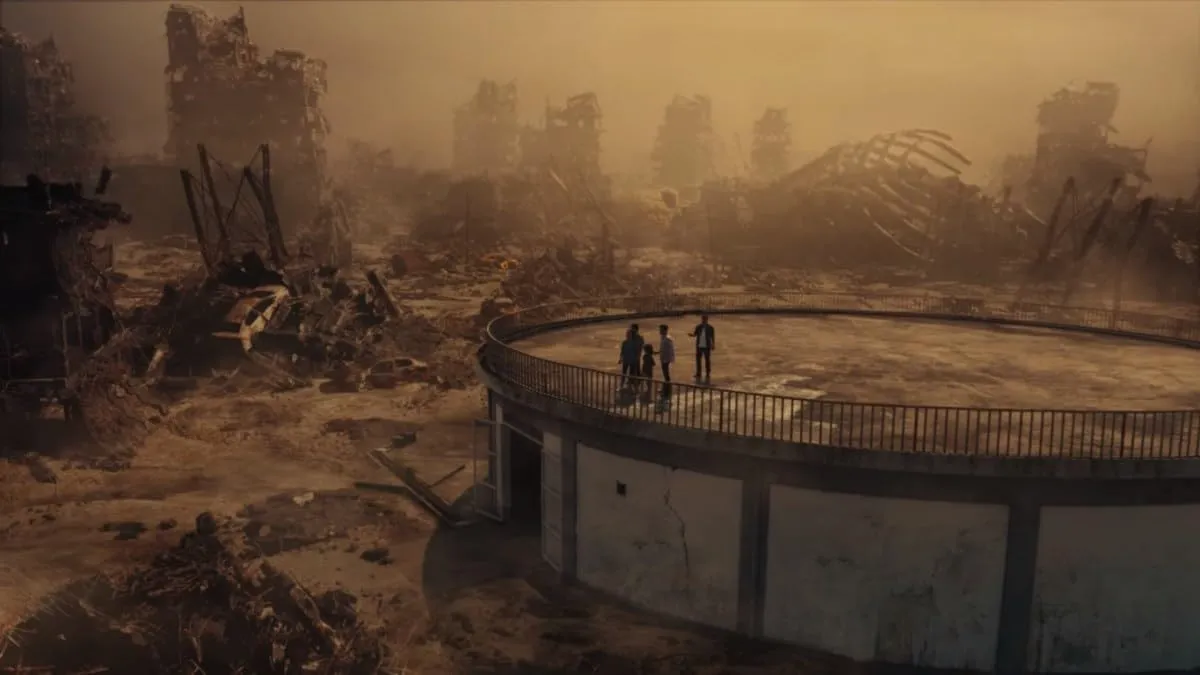

Chookiat Sakveerakul’s Project Genesis is an ambitious undertaking that announces itself as a landmark effort for Thai cinema. This time-travel sci-fi spectacle weaves together prehistoric set pieces, dystopian futures, and kaiju-scale surprises with the scope and audacity of a world-spanning blockbuster.
The central engine runs on direct, clean emotion. We follow Stella (Paula Taylor), a mother jolted by a radio call that hints her long-vanished father might be reachable through the abandoned Genesis Machine. Her drive to power up that device and find him sets off the chaos.
Beneath the high-concept fireworks, the charge comes from a human bond: the strained yet unbreakable connection between Stella and her daughter, Valen (Nutthacha Jessica Padovan). That relationship serves as the steady anchor for a film that loves to spill beyond its frame.
Genre Cocktail and Technical Ambition
Project Genesis swings wide with scale. It begs for the biggest screen available; large-format projection pays off with a showpiece presentation. What caught me most was the texture of the worldbuilding. The spaces feel used and specific: decommissioned Cold War sites read as rusted and tangible, and the future corridors carry scuffs and wear that avoid sterile sci-fi gloss.
Director Sakveerakul shows real technical curiosity in the way he stages the temporal shifts. The narrative moves like a relay across eras, and those leaps land as chapters of one continuous line. Production design threads shared visual motifs through each time period, so ancient ruins and futuristic bases register as parts of the same wounded history.
For the creatures and threats, the mix of practical effects and CGI aims for weight and touch, giving bodies and surfaces presence. The film can get unruly; it keeps stacking ideas, from dinosaurs to zombies to mutants. That arms-race energy leads to uneven spots, and some passages, including the Ban Chiang civilization and the future material, wobble in execution. I still respect the commitment to imagination and the choice to lead with vision over pristine polish.
Time, Memory, and National Wounds
The film uses sci-fi to carry a story about time and memory. Its layered, epic shape balances Stella’s intimate current of grief and hope with wider concerns that include pointed political notes. The film explores the refusal to release the past while trying to protect the present, a question about what we owe to the people who are gone yet still shape our days.
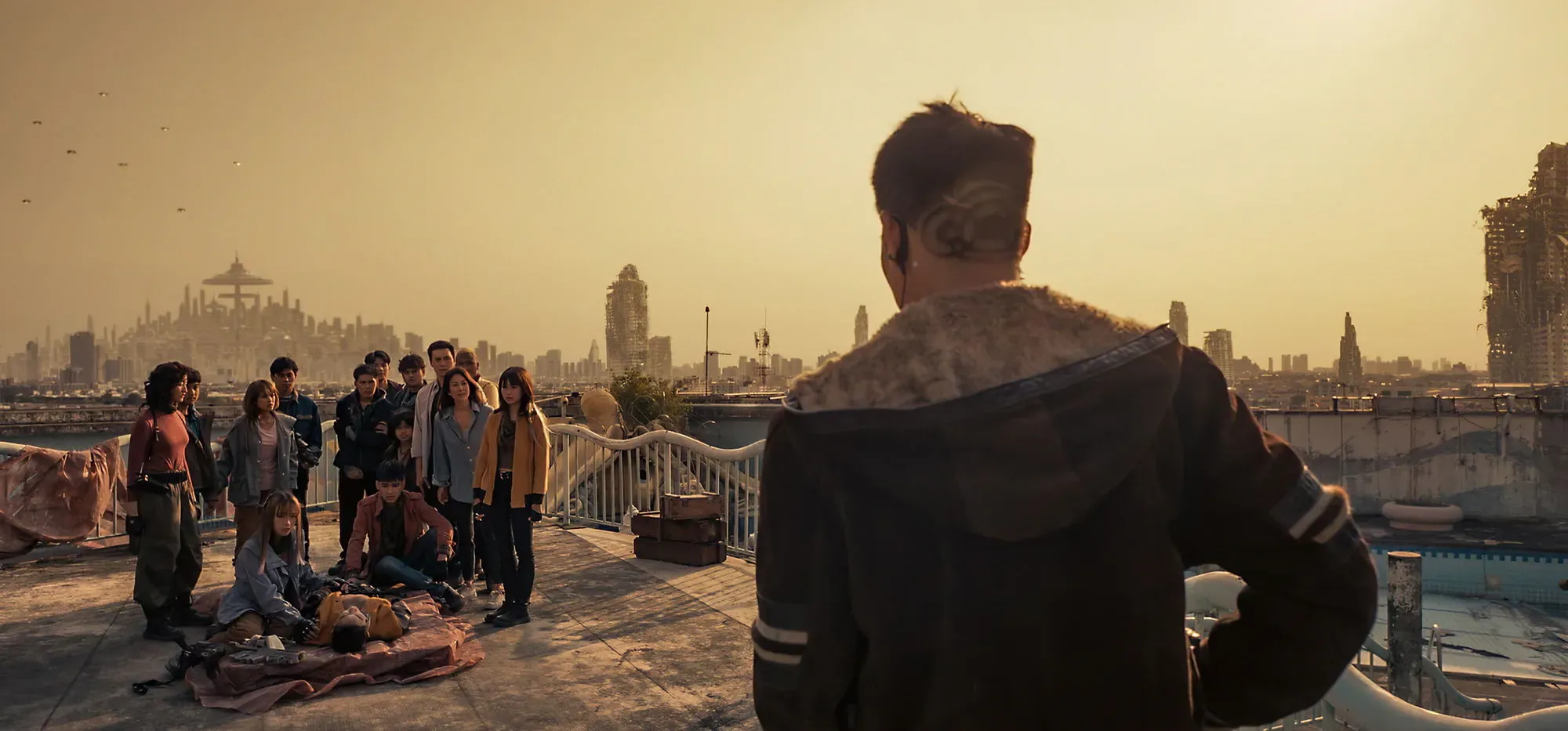
The script sets its priorities clearly. Dramatic logic and emotional momentum take precedence over intricate scientific scaffolding. The time-travel rules provide enough structure to set stakes, and the emphasis stays on thrills and payoff. That approach frames the movie as an ambitious crowd-pleaser; viewers seeking hard-science rigor will spot a convenient transition here and there.
For me, the cultural charge gives the film extra voltage. Thai history enters the frame in a meaningful way, with a student-massacre sequence that lands with power and pain. The moment ties the spectacle to national wounds and shows how genre cinema can speak to difficult truths.
An Ensemble Grounded in Grit
The fantasy framework needs human ballast, and the cast largely supplies it. Paula Taylor centers the film as Stella, playing a realist who must expand her sense of the possible. Determination, sharpened by maternal force, gives her the grip needed to face each new era.
Nutthacha Jessica Padovan’s Valen holds the quiet emotional core of the piece. Many of the most resonant scenes circle her. Wanarat Ratsameerat’s Kong carries a heavy burden and channels it through wary restraint, delivering some of the film’s most weighty passages.
Within the ensemble, Peter Corp Dyrendal brings lively “mad scientist” charge to Ith, and Jenjira Pongpat’s Aunt Jane adds a grounded, earthy note. There are rough patches, including stiff dialogue in spots and shifts in performance style across such a large company, and at times the formality sounds like an audio novel instead of loose conversation. The core family dynamic still carries the load. When the spectacle threatens to swallow the frame, the drive for connection keeps the stakes clear.
As a viewer who cares about how films shape and reflect culture, I found Project Genesis exciting for its ambition and its sense of lived texture. The movie celebrates scale, but the confidence comes from structure, design echoes across time, and a willingness to tie genre thrills to memory and national hurt. I kept thinking about how those shared motifs stitch the eras together, the way a favorite riff links movements in a long piece of music. That throughline turns the film’s many timelines into one story that keeps beating forward.
Project Genesis is an ambitious Thai-language science fiction and adventure film from writer and director Chookiat Sakveerakul. The movie tells the story of Stella, a scientist and single mother who returns to her hometown only to receive a cryptic radio transmission from her father, who vanished decades ago and is now trapped in a different time configuration. To rescue him, Stella must find and activate a relic of a classified CIA project known as the Genesis Machine. The movie first saw a release in Thailand in 2024 and is scheduled for a 4K Blu-ray and DVD release in international markets, with the UK home video release set for October 20, 2025. It has a running time of approximately 129 to 134 minutes, depending on the release cut.
Credits
Title: Project Genesis
Distributor: Capelight Pictures, Altitude Film Distribution, Neramitnung Film
Release date: 2024 (Original Thai release), October 20, 2025 (UK Home Video Release), September 25, 2025 (German 4K Blu-ray Release)
Rating: FSK-16 (German rating, equivalent to a mature rating like R or 15), 15 (UK DVD rating)
Running time: 129 minutes (4K Blu-ray), 134 minutes (UK DVD)
Director: Chookiat Sakveerakul
Writers: Chookiat Sakveerakul
Producers and Executive Producers: Neramitnung Film (Production Company), Titan Capital Group Holding (Production Company)
Cast: Paula Taylor, Nutthacha Jessica Padovan, Peter Corp Dyrendal, War Wanarat Ratsameerat, Jenjira Pongpat, Phutharit Prombandan, Intira Charoenpura
Director of Photography (Cinematographer): Monthon Pongpab
The Review
Project Genesis
Project Genesis is a film of extraordinary ambition that stretches the limits of its genre and budget. While the maximalist approach results in some unevenness—the technical execution is inconsistent, and the narrative sometimes fractures under the weight of too many ideas—its vision is undeniable. It is saved by a powerful, human anchor in the story of a mother and daughter, using time travel to explore enduring themes of memory, hope, and national resilience. This is an unruly, essential cinematic event that sets a daring new standard for local spectacle.
PROS
- Sets a massive scope that challenges typical conventions of national cinema.
- The mother-daughter relationship provides a sturdy, heartfelt anchor amidst the chaos.
- Integrates painful and politically charged local history into the sci-fi plot in a powerful sequence.
- Settings feel lived-in and textured across various timelines.
- Delivers large-scale, tactile creature and action sequences.
CONS
- Some sequences (e.g., Ban Chiang, future scenes) feel cheap or inconsistent in their design.
- The genre pile-up (dinosaurs, kaiju, zombies) sometimes dilutes the impact of individual elements.
- Favoring dramatic momentum over scientific detail leads to occasional, convenient plot jumps.
- Acting and dialogue delivery is uneven across the large supporting cast.







