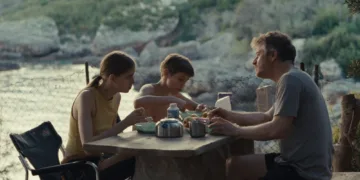
























The sunlight on the Croatian coast feels intentionally misleading. In Ungrateful Beings, a film that patiently dismantles its own serene facade, we open on a family holiday that is anything but relaxing. David, a father grasping at the frayed ends of his paternal authority, has brought his two children camping. The tent is pitched, the portable stove is lit, but the emotional landscape is barren.
His seventeen-year-old daughter, Klara, is withering away from an eating disorder, her silence a dense, heavy object at the center of their temporary camp. Her younger brother, Theo, watches from the sidelines, an anxious ghost in his own family. The film’s initial movements are quiet and observational, setting up what appears to be an intimate portrait of a family succumbing to an internal crisis.
Yet director Olmo Omerzu uses this familiar dramatic territory as a staging ground for a much stranger and more disquieting narrative. This is a story that begins in a world of quiet suffering and ends somewhere far more treacherous, using the illusion of a simple family drama to explore the unsettling logic of desperation.
The Architecture of a Family’s Pain
Before the plot takes its sharp turn, the film invests heavily in establishing the psychological terrain of its characters. This is a family unit defined by its dysfunctions, a collection of individuals orbiting a shared trauma without ever truly connecting. David’s parenting is a study in futility. He tries to be the fun dad, the concerned dad, and the stern dad, but each approach shatters against Klara’s impenetrable wall of adolescent misery.

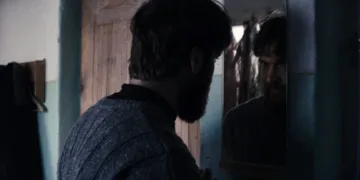
His anxiety is palpable, a constant hum beneath the surface of his forced cheerfulness. He is a man who has lost control and knows it. Klara’s anorexia is depicted with a chilling precision, not just as an illness but as a source of immense power. The film’s camera often frames her in isolation, meticulously measuring parts of her body with her hands or checking her reflection. These moments portray her search for control in a life where everything, especially her parents’ marriage, has fallen apart. Her refusal to eat becomes her only form of agency.
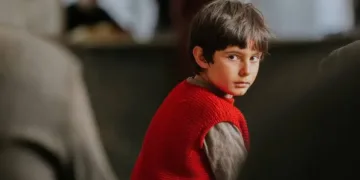
The sound design in these early scenes is critical, amplifying the uncomfortable silences that fill the spaces between clipped, tense lines of dialogue. We hear the crickets, the gentle waves, but rarely a genuine conversation. The younger son Theo is a casualty of this dynamic, rendered almost invisible by the gravity of his sister’s condition.
He drifts through scenes, his presence a quiet reminder that in a family crisis, the loudest problem often consumes all the available emotional resources. The mother, Laura, exists as a disembodied voice over the phone, her distance a symbol of the family’s complete communication breakdown. The film masterfully builds a sense of claustrophobia within the wide-open Croatian landscape, suggesting that for this family, there is no escape from themselves.
A Fleeting Romance, A Violent Intrusion
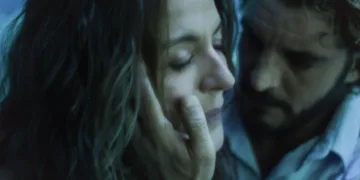
The narrative’s suffocating stasis is broken by the arrival of Denis, a local fisherman whose easy charm offers an unexpected disruption. Their meeting shifts the film’s tone, introducing the warm, familiar visual language of a teenage summer romance. The lighting softens, the pacing relaxes, and for a brief, hopeful interlude, Klara begins to emerge from her self-imposed exile.
At Denis’s encouragement, she starts eating. It’s a simple, powerful sequence that feels like a release of long-held tension. The film allows the audience to believe in this simple solution, presenting their relationship as a potential cure. This narrative choice is a deliberate and effective piece of misdirection, a cinematic sleight of hand that makes the story’s subsequent pivot all the more shocking.
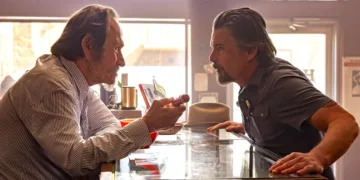
The romantic idyll is violently shattered when Denis’s estranged father is murdered, and Denis, as the primary suspect, is forced to disappear. The event is a brutal intrusion of external chaos into the family’s contained world of emotional turmoil. The generic conventions of the romance are discarded, and the film snaps back into a mode of high anxiety. This structural shift is the story’s most significant move.
It argues that personal healing cannot happen in a vacuum and that the world’s harsh realities will always find a way to break in. David, seeing his fragile hope for Klara’s recovery vanish, makes a panicked decision. He packs up the children, fleeing the Croatian coast and the crime scene. They are not returning to normalcy, but are instead retreating into a new, more dangerous phase of their crisis, one that will demand far more than they realize.
The Perverse Logic of Parental Love
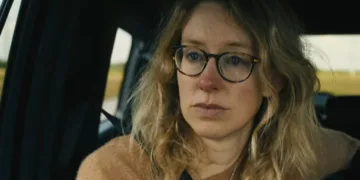
Back home, away from the deceptive Croatian sun, the film completes its transformation into a dark, morally complex thriller. Klara’s condition worsens dramatically, and she is hospitalized, once again using starvation as her only means of expression. Laura, the mother, returns as a physical presence, her distress matching David’s. It is here that their shared desperation leads them to a disturbing and ethically fraught decision.
Convinced that Klara’s survival is tied to Denis, they conspire to resurrect him as a digital ghost. David takes the fugitive boy’s phone and begins a covert text message relationship with his own daughter, carefully crafting a fantasy to keep her emotionally tethered to life. This act of deception is the film’s unsettling centerpiece.
The narrative explores this bizarre gambit with a clinical, almost deadpan tone, forcing the audience to confront uncomfortable questions about the boundaries of parental care. Is this an act of profound love or a horrifying violation? In a darkly ironic twist, the shared conspiracy to manipulate their daughter begins to repair the broken bond between the parents. They find a renewed sense of purpose and partnership in their joint deception.
The film offers no easy answers, presenting their actions as a product of a perverse but understandable logic. It pushes the idea of parental sacrifice to its most extreme conclusion, suggesting that sometimes the desire to protect can become its own form of destruction. It is a provocative and challenging examination of a family willing to sacrifice truth for a fragile, manufactured hope.
Ungrateful Beings is a drama directed by Olmo Omerzu, which had its world premiere at the 73rd San Sebastián International Film Festival in September 2025 as part of the Official Selection. The story follows David, a recently divorced father, whose family beach holiday in the Adriatic turns dark when his 17-year-old daughter, who is struggling with an eating disorder, falls in love with a local boy who then becomes a murder suspect. As the daughter’s condition worsens, her parents are forced to take desperate measures to save her, highlighting the complexity of their fractured, bilingual family. The film is a co-production between the Czech Republic, Slovenia, Poland, Slovakia, Croatia, and France, with the main production company being endorfilm. As of now, specific general release dates and streaming platforms for widespread viewing are not yet available, as the film is set to begin its festival run.
Full Credits
Director: Olmo Omerzu
Writers: Olmo Omerzu, Nebojša Pop-Tasić, Kasha Jandáčková
Producers and Executive Producers: Jiří Konečný, Olmo Omerzu (Note: Jiří Konečný is the producer for endorfilm, the main production company.)
Cast: Barry Ward, Barbora Bobulová, Dexter Franc, Antonín Chmela, Timon Šturbej
Director of Photography (Cinematographer): Kryštof Melka
Editors: Jarosław Kamiński
Composer: Monika Omerzu Midriaková
The Review
Ungrateful Beings
Ungrateful Beings is a challenging and audacious film that begins as a quiet family drama before methodically descending into a dark psychological thriller. Its strength lies in its confident tonal control and its willingness to explore the perverse logic of parental desperation without offering easy moral judgments. While its unsettling subject matter and deliberately unlikable characters may alienate some, the film's bold narrative choices and commitment to its grim premise make it a provocative and unforgettable piece of cinema that lingers long after the credits roll.
PROS
- A compelling narrative structure that masterfully shifts from intimate drama to unsettling thriller.
- Deeply explores complex and morally ambiguous themes of parental love, control, and manipulation.
- Features strong, nuanced performances that ground the bizarre plot developments in emotional reality.
- An unpredictable and provocative story that defies easy categorization.
CONS
- The central characters are intentionally difficult and unsympathetic, which can make it hard for viewers to connect.
- Its subject matter is deeply unsettling and may be too disturbing for some audiences.
- The deliberate, slow-burn pacing of the first act might test the patience of some viewers.