






























ILA: A Frosty Glide positions itself within the growing movement of indie 3D platformers that celebrate the aesthetic and design philosophy of early polygon-based games. Developed by Magic Rain Studios and born from a comic series before receiving Kickstarter funding in December 2023, this cozy platformer follows young witch-in-training Ila as she searches for her escaped black cat, Coco, across a mysterious snowy island.
The skatebroom serves as your primary tool here, a witch’s broom reimagined as a skateboard that you’ll use to glide, jump, and dash through this magical landscape. Released on October 20th, 2025 for PlayStation 5, Xbox Series X|S, Nintendo Switch, and PC, the game makes clear from its opening moments that speed and difficulty take a backseat to exploration and emotional storytelling. The polygonal art style harkens back to the PlayStation 1 era while maintaining a crisp, modern polish that works particularly well on handheld devices.
Stories Written in Snow and Scattered Collectibles
The premise wastes no time establishing its emotional stakes. A falling star cuts through the night sky, and inside is Ila, desperately chasing after Coco who slipped through an open window during what should have been an ordinary evening.
She crashes onto a snowy island dock with her father Bryn’s hand-crafted skatebroom, and the goal becomes immediately clear: follow the trail of pawprints and fish bones to the pillar of light at the mountain summit. The setup mirrors the straightforward emotional hooks found in games like Journey or ABZÛ, where a simple objective masks deeper thematic concerns.
What distinguishes ILA from many contemporary platformers is its commitment to environmental storytelling over scripted sequences. The narrative unfolds through fragments you discover while exploring rather than through cutscenes or dialogue trees. Letters from Ila’s father Bryn appear at key moments, offering both practical guidance about traversing the island and glimpses into their family dynamic. The collectible system serves the narrative directly.
“Stories of the Island” segments reveal the history of this abandoned place, while “Coco’s Memories” show the bond between witch and familiar through illustrated scenes. Fish bones scattered across platforms work as physical evidence of your cat’s passage, turning what could be generic collectibles into story-relevant breadcrumbs.
The game asks you to piece together answers to questions like why this world sits empty, what happened to the other inhabitants, and what witches and wizards represent in this setting. This approach recalls the lore delivery system From Software uses in their Souls games, where curiosity gets rewarded with understanding rather than explicit exposition.
The tonal balance impresses throughout. Notes and statues you discover inject absurdist humor into the world, giving locations personality without undermining the sincere emotional core. Art scenes depicting Ila’s family relationships appear at measured intervals, reminding you why this search matters so deeply to her. The game trusts you to engage with these quieter moments rather than forcing melodrama.
Skatebroom Physics and Vertical Challenges
The skatebroom mechanic forms the foundation of everything you do in ILA, and the developers clearly spent considerable time making it feel responsive and satisfying. Basic movement combines jumping, gliding (activated by holding a button while airborne), ground pounding, and dashing in ways that recall Tony Hawk’s Pro Skater filtered through the traversal systems of games like Celeste.

You collect Stardust Charges throughout your journey, and these determine how far you can glide before gravity reclaims you. More charges mean more distance, creating a clear progression path that opens up previously inaccessible areas.
The control scheme stays intuitive from the start. Ground pounding serves double duty, letting you smash open the 70 Magic Fortune Chests while also providing downward momentum for navigating platforming challenges. Green-swirling areas function as ability tutorials, teaching you techniques like catching wind currents with the left trigger for speed boosts.
Wall-jumping allows you to scale icy surfaces, expanding your vertical mobility options. Permanent upgrades to your boost count arrive at key moments, transforming what was once a single air jump into a multi-jump combo system. Recharge rings float in the air like the crystal refills in Celeste, letting you extend glides mid-flight if you plot your route carefully.
The absence of fall damage or death penalties means experimentation carries no risk. Fail a jump, and Ila simply respawns at your launch point, ready to try again. The camera system handles most situations competently, following Ila automatically with enough intelligence that you rarely need manual adjustments.
Fixed camera angles appear at certain story beats, while other sections allow free rotation. An interesting touch: if you stand still long enough at any location, the game shifts into first-person perspective, letting you survey your immediate surroundings for hidden paths.
Hopshrooms introduce vertical traversal puzzles into the mix. These bouncy mushroom platforms launch Ila upward, and chaining multiple hopshrooms together while maintaining momentum becomes key to reaching higher elevations. The challenge escalates when some platforms start disappearing after you land on them, forcing quick decision-making.
The final mountain descent sequence strings together all these mechanics, asking you to skate downhill while jumping between land masses using strategically placed recharge rings. The absence of checkpoints in this climactic sequence means any failure sends you back to the summit to start over, a design choice that feels at odds with the game’s otherwise forgiving philosophy.
A World Designed for Wanderers
ILA structures its world as a small open environment rather than a series of linear levels, inviting exploration from multiple angles. Coins serve as visual guides along main paths, and they remain visible in areas you haven’t yet discovered, providing a subtle navigation system.

You can wander freely and approach many sections in whatever order feels natural, though certain platforms will be too high to reach until you’ve acquired the necessary upgrades. This design philosophy resembles the structure of 3D Zelda games, where your growing toolkit gradually unlocks previously tantalized secrets.
The collectible variety gives you numerous reasons to poke around every corner. Those 70 Magic Fortune Chests demand ground pounds to open, while the 30+ “Stories of the Island” segments require you to venture off the beaten path. Coco’s Memories, Mysterious Shards, Fish Bones, crystal balls, and trendy glasses all hide in different locations.
Hidden secrets behind waterfalls and on precarious ledges follow genre conventions while still feeling earned when discovered. The game avoids the N64-era trap of hiding collectibles in absurdly obscure locations. Most sit just slightly off the main route, visible if you’re paying attention.
The real reward for exploration comes through understanding rather than mechanical progression. Learning about the island’s history and discovering why Ila travels alone through this empty landscape provides satisfaction that transcends simple completion metrics. Navigation proves less elegant, however.
The absence of any map system means you’ll often retrace your steps through identical-looking areas, searching for the one path you missed. Games like Hollow Knight recognized this issue and provided map systems that respected player time while still encouraging exploration. Here, you’re left to mental mapping, which works fine initially but becomes tedious when hunting for collectibles.
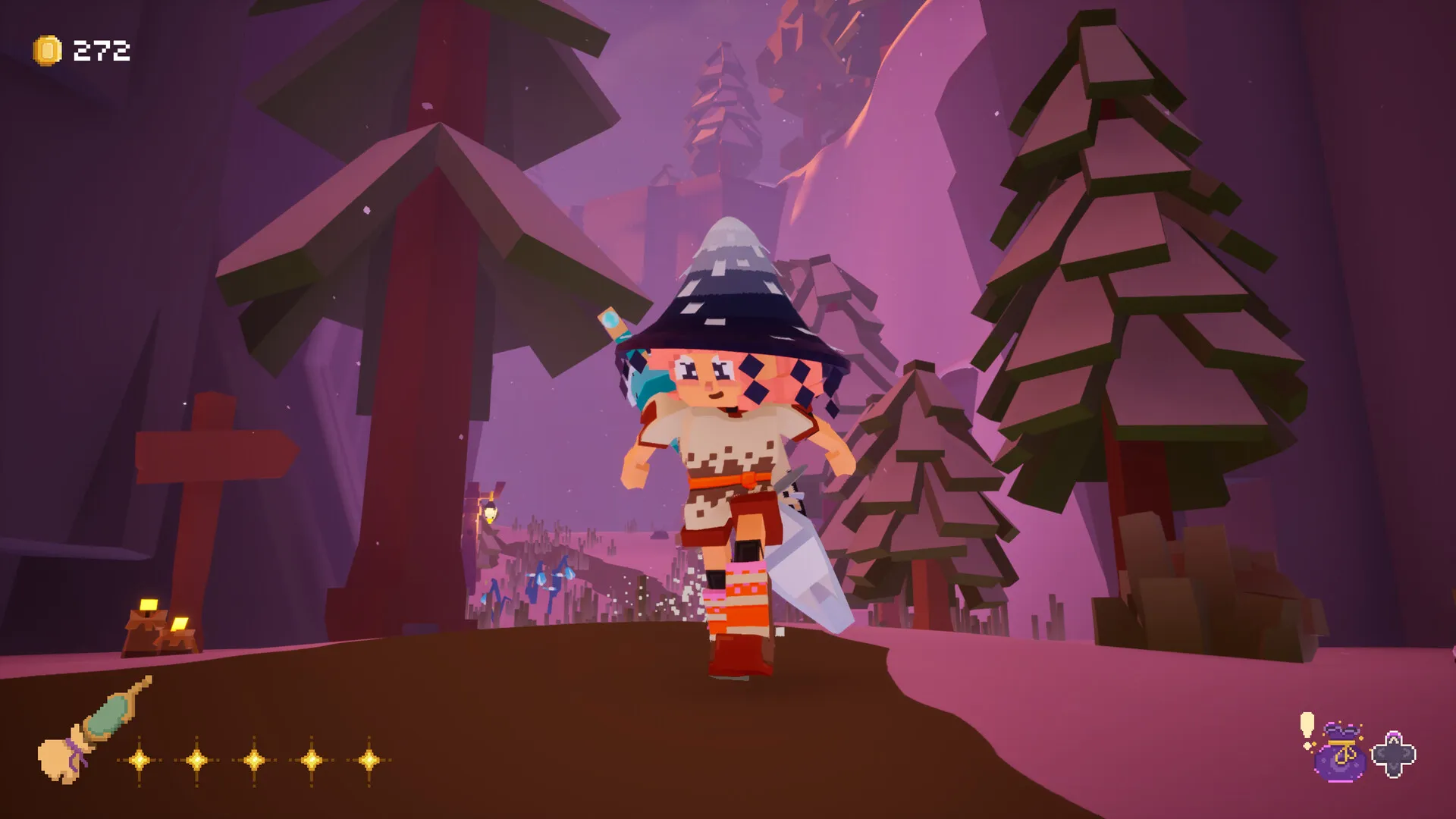
The Swept Market introduces a spending system for your collected coins, offering new clothes, hats, capes, and alternative skatebrooms. Finding Ila’s red witch hat early gives you the choice to wear it or let her hair blow freely, a small touch that adds personal expression. Watching Ila bundle up in cold weather (jacket, sweater, scarf wrapped so only her eyes peek out above visible breath) adds charm to the presentation.
Low-Poly Aesthetics and Technical Realities
The polygonal art direction deliberately evokes the PlayStation 1 era, a time when technical limitations created distinctive visual styles. Low-poly character models and environmental geometry define the aesthetic here, though the presentation maintains a crispness that early 3D games couldn’t achieve. This puts ILA in conversation with other recent indie titles like Anodyne 2, games that mine nostalgia for early 3D while leveraging modern rendering techniques.

The muted color palette reinforces the magical, subdued atmosphere. Snow-covered landscapes dominate, punctuated by warmer tones in inhabited structures. Brumevale stands as the visual highlight, where the lighting system truly shines. Watching light play across building facades and reflect off snowy surfaces creates moments of genuine beauty within the simplified geometry.
Environmental variety prevents visual monotony across the six-hour journey. Some areas feel bright and welcoming, while others lean into darker, gloomier atmospheres. Ila’s animations communicate personality through simple movements, whether she’s adjusting her clothing against the cold or maintaining balance on her skatebroom.
Technical performance stays solid across platforms. The Steam Deck handles the game well in performance mode, maintaining 60 FPS throughout. Graphics mode locks to 40 FPS on the same hardware. No crashes or game-breaking bugs appeared during testing. The Switch Lite version renders text at readable sizes, barely, though the lack of touchscreen functionality feels like a missed opportunity.
The art style creates its own challenges. Muted colors make spotting secrets difficult at times, requiring you to sweep the camera slowly across areas to identify interactive elements. The polygonal aesthetic, while charming and nostalgic, can make depth perception tricky during precision platforming. Judging exactly where you’ll land during a ground pound becomes harder when simplified geometry removes visual reference points.
Soundscapes for Contemplation
The musical score reinforces ILA’s relaxed pacing and contemplative mood. Calm, ambient tracks play throughout your journey, never accelerating into urgency or tension. This scoring philosophy resembles what games like Abzû and GRIS achieved, where music creates atmosphere without demanding attention. You can take your time examining environments without feeling rushed by frantic instrumentation.

Sound effects support the satisfying gameplay feedback loop. The ground pound delivers a weighty thump when you connect with a chest or platform. Collectible pickups provide pleasant audio confirmation. Environmental sounds fill spaces between musical phrases.
None of these effects call excessive attention to themselves, but their absence would be immediately noticeable. The audio design creates space for reflection rather than filling every moment with stimulation, allowing narrative beats to land with proper weight. For players seeking weekend relaxation or gentle gaming experiences, this audio philosophy proves ideal.
When Cozy Meets Challenging
ILA explicitly positions itself as a cozy exploration game rather than a demanding platformer. No life limits exist, death penalties amount to simple respawning, and no time pressure forces quick decisions (unless you enable the optional speedrun timer).
Most puzzles present intuitive solutions, and the game clearly wants you to appreciate environments rather than repeatedly fail at difficult challenges. This philosophy aligns with other cozy games like A Short Hike, where exploration and atmosphere matter more than mechanical mastery.
The difficulty philosophy breaks down during specific sections that demand precision and dexterity. Disappearing hopshroom sequences require timing and execution that feel out of step with the surrounding gameplay. Ground pounding specific shapes while maintaining aerial momentum takes practice that casual players may lack.
The final mountain descent crystallizes these issues. You must skate downhill, judge distances for jumping between land masses, and use recharge rings properly to gain necessary height. No checkpoints exist in this extended sequence, meaning any failure teleports you back to the summit. After multiple failed attempts, the repetition transforms from challenging to frustrating.
The absence of difficulty settings or accessibility options feels like a significant oversight. Games like Celeste demonstrated how thoughtful assist modes can make challenging platformers accessible without diminishing the experience for skilled players. ILA could benefit from options like larger ground pound zones, longer timers before platforms disappear, or boosted glide distances. As designed, some players will hit walls that prevent them from reaching the conclusion.
Camera and perspective issues compound the difficulty spikes. Problems intensify in tight spaces where the camera struggles to find good angles, making precision jumps harder than intended. Judging distances for aerial maneuvers becomes deceptive when the side perspective doesn’t accurately communicate spatial relationships.
The shadow system helps when present, showing where ground pounds will land, but many sections lack shadows entirely. These issues plagued many N64-era 3D platformers, and while ILA never reaches those depths, it replicates enough of the problems to occasionally frustrate.
Game length sits around six hours for completing the main story while collecting roughly 85% of available items. Three save slots with six autosave points each provide flexibility. Optional content extends playtime for completionists, and the speedrun timer offers replayability for players seeking time-based challenges. The linear structure limits long-term replay value once you’ve discovered all secrets and experienced the story.
The Review
ILA: A Frosty Glide
ILA: A Frosty Glide delivers a charming, heartfelt adventure that succeeds through environmental storytelling and satisfying skatebroom mechanics. The polygonal aesthetic looks gorgeous, particularly in Brumevale, and the relaxing soundtrack perfectly complements the cozy exploration. However, difficulty spikes feel jarring against the gentle philosophy, and the absence of a map or accessibility options creates unnecessary frustration. Camera issues during precision platforming and the punishing checkpoint-free finale mar an otherwise delightful experience. For patient explorers willing to overlook these rough edges, Ila's search for Coco offers a rewarding weekend journey.
PROS
- Satisfying skatebroom movement and controls
- Beautiful environmental storytelling through collectibles
- Charming polygonal art style with excellent lighting
- Relaxing soundtrack and cozy atmosphere
- No death penalties encourage experimentation
CONS
- Jarring difficulty spikes contradict cozy design
- No map system leads to repetitive backtracking
- Camera struggles in tight spaces
- Final sequence lacks checkpoints
- No accessibility or difficulty options