



















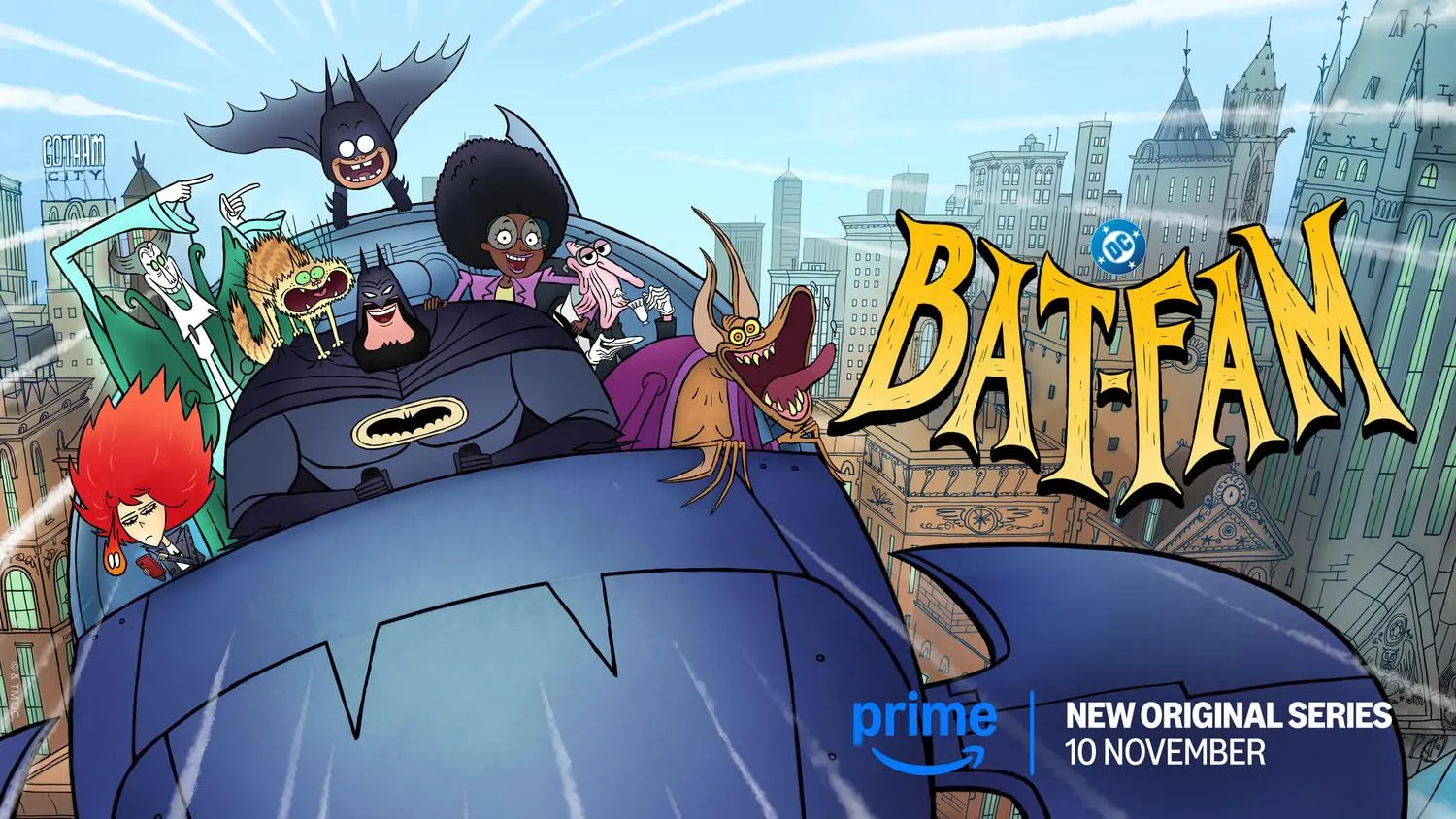

Bat-Fam arrives as an animated DC series, a playful spin-off of the film Merry Little Batman. From the start, it plants the flag in the Bat-Family dynamic and sets aside the usual fixation on the solitary, gothic crusader. The cowl yields to the couch, which becomes a thesis statement about where meaning lives in this version of Gotham: the living room, not the gargoyle.
The tone stays light, funny, and warm, which functions like a mood-correction to the era of grim superhero realism (think the somber ceremony of The Batman). The choice reads as careful craft: bright color inside a mythology famous for shadow. The series aims young, yet the wit and emotional pitch play cleanly for older viewers. Age becomes a variable, not a gate.
Wayne Manor fills quickly. Batman/Bruce Wayne, his son Little Batman/Damian Wayne, and a growing oddball household create a domestic stage. The series reframes home life inside the superhero canon and treats it as the core story engine. The welcome feels sincere and the humor carries the room, which refreshes the long-worn map of Gotham and points it toward laughter without dismissing care.
The Found-Family “Para-Social” State
Bat-Fam’s central idea comes through a bold re-casting of the Bat-Family. The roster differs from the familiar comic-book lineup and reads like a commentary on contemporary “found family” ideals (call it the domestic commons). Wayne Manor becomes a para-social state, a miniature polity where affection, rules, and provisional trust hold the place that capes once occupied. Heart supplies ballast here.
Bruce Wayne (voiced by Luke Wilson) shifts into “Dad-Bat,” a parent managing new anxieties instead of existential doom. The famously closed-off affect gives way to clumsy kindness. He speaks in his natural voice, a quiet refusal of performative Bat-gravitas. Vulnerability appears in the ordinary trials of raising a teenager, which yields a portrait of fatherhood that sits closer to the kitchen table than the cathedral.
Damian Wayne/Little Batman (Yonas Kibreab) acts as the emotional hinge. He runs on open-eyed enthusiasm, the classic younger-sibling frequency, and keeps auditioning for his place. Alfred Pennyworth (James Cromwell) anchors the space with a deep, steadying voice that gives the Manor its gravity well.
The “New Residents” turn the house into a social lab. Volcana/Claire Selton stands as a reformed ex-villain testing the possibility of trust and belonging in a halfway-house-adjacent arrangement. Man-Bat/Kurt Langstrom (Bobby Moynihan) delivers absurdist relief, a monstrous, olive-loving uncle archetype. Ra’s al Ghul lingers like a vexed grandparent, a comic haunt who literalizes the recurring villain that refuses to move on. The crowded rooms surface familiar family pressures: house rules, attempts at redemption, the hard work of believing one another. The vocal ensemble clicks; Wilson’s warmer Batman feels especially sharp.
The 20th Century’s Animated Ghost
Bat-Fam’s look and pacing signal a studied aesthetic turn, a strategic step backward to move forward. The animation favors a retro, hand-drawn energy that recalls Saturday mornings from the 1970s through the 1990s. Bright palettes and exaggerated shapes reject the crepuscular mood associated with The Animated Series and claim a different lineage. Nostalgia becomes a method, not a crutch.
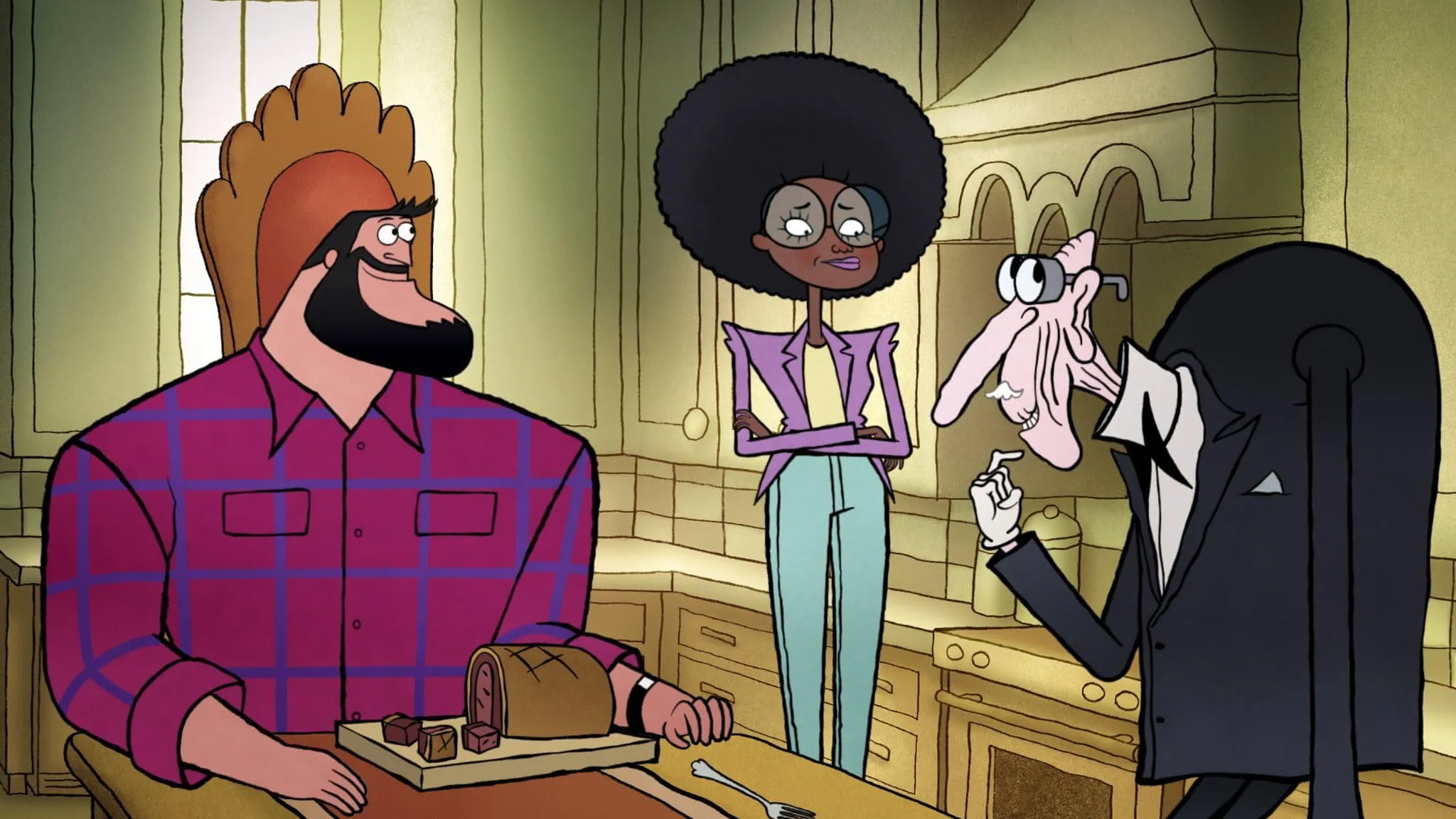
Mike Roth’s background (SpongeBob SquarePants, Regular Show) yields a synthesis of vintage flavor and present-day polish. Think of it as the “20th Century’s Animated Ghost,” a guiding spirit that lets the show mark its lane while keeping the machinery crisp.
The humor runs self-aware and irreverent, built from kinetic slapstick and well-timed visual buttons. The gags often land with the clockwork precision of classic Looney Tunes structure. The series salutes superhero traditions while adding a knowing wink that neither sneers nor panders.
Narratively, episodes pair a “case of the week” rhythm (with classic, recognizable Gotham foes) and a softer long-arc. The combination supports quick engagement and still plants clues toward a broader reveal. The theme song by Patrick Stump leans into pop-punk bounce and dispels any expectation of orchestral solemnity. It fits the package: high energy meeting high polish.
The Refusal of the Cape’s Burden
Action appears, yet the home front keeps the spotlight, which marks a break from Bat-lore’s emphasis on elaborate combat. Set pieces move with invention and ride the errors of an eager, occasionally bumbling Damian. Momentum flows from character first and punchlines second, then circles back to character again.
Fight beats fold into jokes and family business. The clashes feel like outward signs of inward tensions, which keeps the show’s thesis intact. Force exists, but the meaning sits with the people choosing when and why to use it.
The show commits to its own line of originality and does not chase the darker, self-serious blueprint. The mood favors levity and a positive charge. The approach reads as fresh oxygen. Character interpretations take advantage of the room; Bruce’s greater vulnerability, in particular, pays off across scenes and softens the hero into a neighbor.
Bat-Fam reframes Gotham as a place where fluorescent kitchen light pushes back at existential night. Dinner crowds the frame, and conversation shares the job once reserved for brooding. The result is a superhero series keyed to heart, one that leaves the viewer ready for another round. For a franchise often weighted by its mythology, that appetite feels rare and welcome.
Bat-Fam is a new animated superhero comedy series from DC and Warner Bros. Animation. It serves as a follow-up to the 2023 film Merry Little Batman. The show focuses on Bruce Wayne, his son Damian, and their growing, chaotic household in Wayne Manor as they balance superhero duties with family life. The entire first season, consisting of 10 episodes, premiered globally on November 10, 2025, and is available to stream exclusively on Prime Video (Amazon’s streaming service) and Amazon Kids+.
Credits
Distributor: Prime Video, Amazon MGM Studios, Warner Bros. Animation
Release date: November 10, 2025
Rating: TV-Y7
Episode Length: Approximately 22 minutes (per episode, 10 episodes total)
Director: Sam Spina, Kat Morris, Aleks Sennwald
Writers (Developed By/Showrunner): Mike Roth, Jase Ricci, Han-Yee Ling, Moujan Zolfaghari, Shakira Pressley, Libby Doyne, Matt Price
Producers and Executive Producers: Mike Roth, Jase Ricci, Sam Register, Bradley Gake
Cast (Voice Actors): Luke Wilson, Yonas Kibreab, James Cromwell, Haley Tju, London Hughes, Michael Benyaer, Bobby Moynihan, Reid Scott, Kevin Michael Richardson, Diedrich Bader, Natasha Leggero
Composer: Patrick Stump
The Review
Bat-Fam
Bat-Fam succeeds by embracing a vibrant, light-hearted tone and redefining the domestic superhero experience. The series sacrifices gothic severity for genuine heart, focusing on the chaos and warmth of a bizarre found family in Wayne Manor. It is a visually distinct and well-acted entry that provides a necessary counterpoint to darker DC adaptations. This blend of humor, imaginative action, and emotional depth makes it a truly welcome diversion.
PROS
- A refreshing, warm, and nuanced portrayal of the hero as a father ("Dad-Bat").
- Strong emotional core derived from the unconventional, ragtag household dynamics.
- Unique, retro, and colorful animation style that breaks from Batman tradition.
- Stellar cast ensemble, notably Luke Wilson, James Cromwell, and Bobby Moynihan.
- Successfully merges episodic, comedic capers with a satisfying season-long arc.
CONS
- Can lean toward the immature given its primary target demographic.
- Not as meta-textual or thematically deep as some other modern adult animation.
- The highly distinct aesthetic and exaggerated proportions may initially be polarizing for some long-time fans.
- Its complete commitment to levity will disappoint viewers seeking faithfulness to the character's darker origins.