

























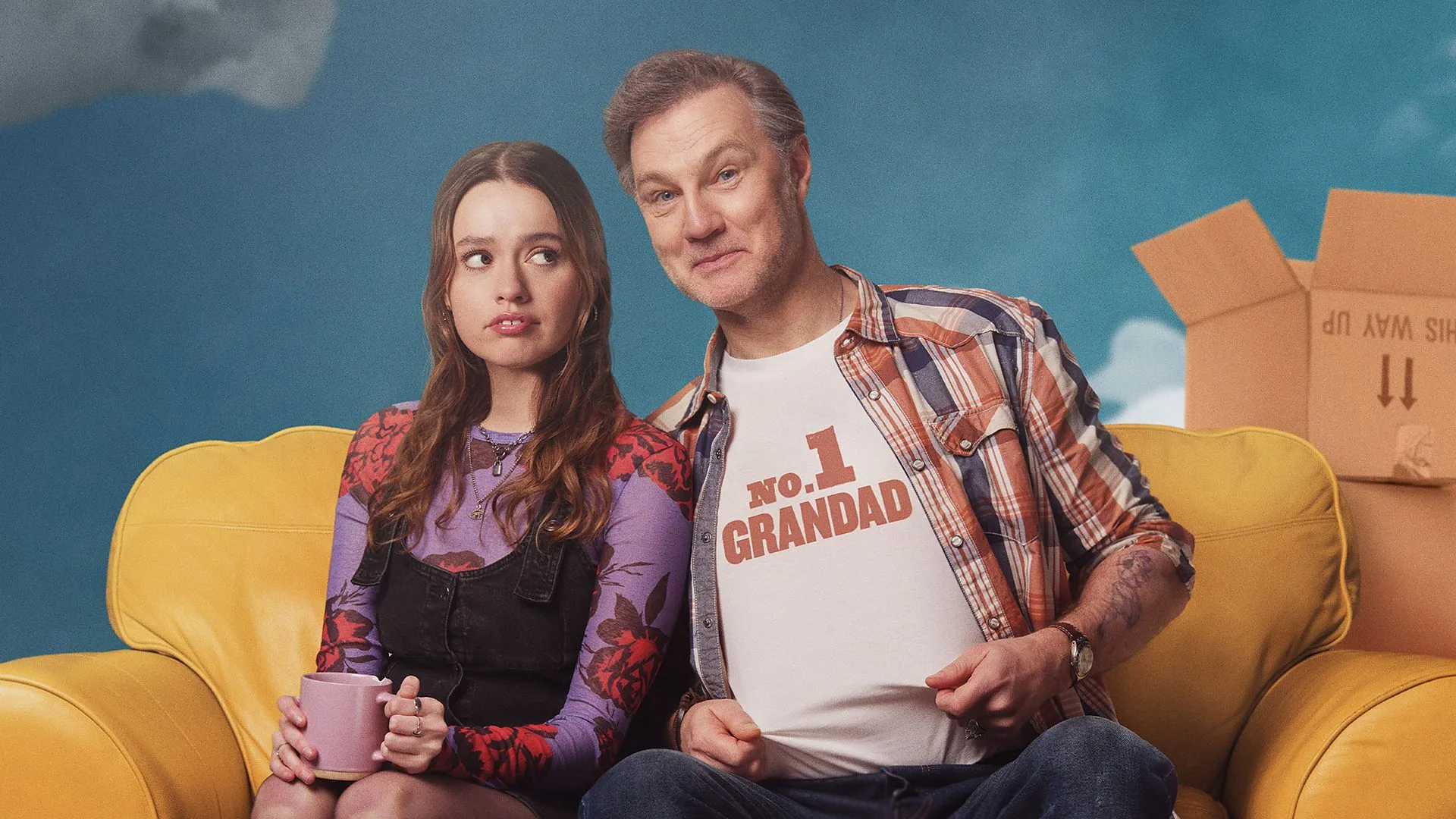

Daddy Issues opens its second season by pitching the audience straight into the fallout of domestic chaos. The story begins three months after the birth, and it stays locked on the grim, unromantic rhythms of that time. Gemma (Aimee Lou Wood) is deep in the isolating exhaustion of single motherhood, learning how small tasks become endurance tests when sleep is a memory. Malcolm (David Morrissey), her father, remains cheerfully optimistic and deeply unreliable, a man who wants to be present but keeps floating at a practical distance from the home.
Season two comes in with a firmer sense of shape than the first run. The storytelling splits into two distinct tracks that keep circling the same family wound: Gemma’s bruising immersion in early “mumdom,” and Malcolm’s parallel hunt for purpose and stability after he’s pushed out of her flat and into a new connection.
That division gives the show room to play out generational friction in separate comic spaces without losing the thread that binds them. The humor springs from the messy, bodily reality of everyday life, where love and fear sit beside regret, and physical limitations are part of the punchline. The result is a season that lands with sharper intent and steadier control than its predecessor.
The Unvarnished Reality of Domesticity
Gemma’s storyline supplies the series with its gravity, keeping the comedy tethered to painful, specific truth. The narrative is built around the physical toll of C-section recovery and lactation, all under the constant pressure of sleep deprivation. The scripts don’t soften these realities. They use them as the ground the jokes have to grow from. Early on, the pointed exchange with Gemma’s boss about her “upstairs” and “downstairs” problems sets the tone in one go: acerbic, darkly observant, and unafraid to sit in discomfort long enough to find the laugh.
The strain inside Gemma’s flat spikes with the return of Davina (Jill Halfpenny), Malcolm’s ex-wife and Gemma’s mother. Davina arrives like a glittery wrecking ball, self-absorbed and casually cruel, scattering passive-aggressive comments that cut deeper than she seems to notice.
Her remarks about Gemma’s weight, topped by the horrific story of a comatose cousin, don’t read as harmless ribbing. They function as small acts of domestic sabotage that chip away at Gemma’s already thin margin. The show uses Davina, plus the disruption caused by her new partner “the sausage man,” as an external force that pushes Gemma closer to the edge. Each visit tightens the vise, turning the flat into a battlefield of exhaustion, wounded pride, and forced politeness.
Aimee Lou Wood is the hinge that makes this track work. Her Gemma is grounded, articulate, and smart, a person who can still fire off a sharp line while her body is begging for rest. Wood threads raw fatigue into the performance without losing comedic timing, and that balance keeps Gemma from slipping into caricature. You feel the weight of someone trying to do the impossible on a daily loop. The season’s portrait of young parenthood stays unsentimental and plain-spoken, refusing to pretty up the sheer volume of work and the way it rewires a person’s sense of self.
The Dynamics of Midlife Male Loneliness
Malcolm’s arc expands the show’s remit by shifting attention to male loneliness and the need to matter as you drift into middle age. Having been removed from Gemma’s flat, he starts the season displaced, living in the derelict bedsit of his perpetually divorced friend Derek (David Fynn). Malcolm’s defining trait is His desperate wish to be useful, and the show lets that urge play out in ways that are both funny and quietly painful. His attempt to construct a “cat flap for fellas” is the season in miniature: a misguided idea born from sincere longing.
The Malcolm-Derek pairing gives the season its second engine. Malcolm comes off as anxiously kind and chronically deflating, a man who tries to help and almost always undercuts himself in the attempt. Derek is angry, sad, and fixed in cynicism, the sort of friend who uses bitterness as a shelter.
David Fynn fully commits to that bleak humor. He makes Derek’s stubborn irredeemability feel lived-in, especially in scenes like the grabber machine addiction, where self-destruction becomes a grim set piece. Their dynamic creates an effective frame for exploring middle-aged masculinity, showing two men locked in different forms of failure who keep meeting in the same lonely place.
This track keeps returning to purpose. Malcolm’s sweetness and eagerness never translate into real competence, and Derek’s resignation feels like an old scar he has stopped tending. The scripts let those states coexist without forcing a clean lesson. Redemption stays possible in theory, and the season keeps reminding you that life doesn’t always hand it out. The late arrival of Grandad Jackie (Philip Jackson), Malcolm’s own conman father, folds another generation into the story. His presence widens the theme of parental failure and makes clear that this family’s dysfunction didn’t start with Gemma. It was waiting in the walls long before she brought a child home.
Tone, Ensemble, and Story Resolution
Season two shows a clear stylistic step forward. It plays as an acerbic, confident comedy with pacing that feels far more controlled than the debut. The humor leans into dry observation and uneasy chuckles, with fewer lunges for oversized laughs. What makes that approach land is the show’s affection for its people. The characters can be ridiculous, selfish, or pathetic, and they still register as human beings you recognize.
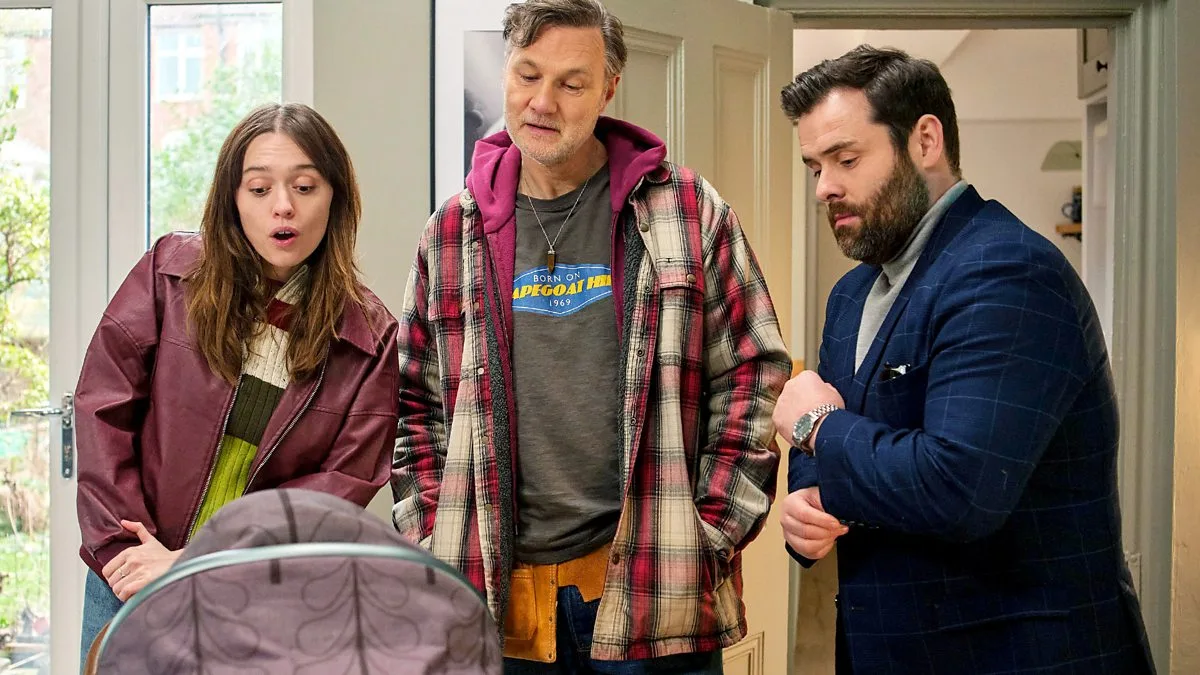
Serious themes like fractured family ties and the grind of new motherhood slide into the daily flow without tipping into syrupy melodrama. The emotional turns come from character and circumstance, so they feel earned instead of engineered. Morrissey settles into Malcolm’s comic rhythm this time.
He plays him as endearing while his failures keep stacking up, a man whose good intentions are real even as his follow-through keeps collapsing. The ensemble chemistry is a major asset. Wood, Morrissey, Fynn, and Halfpenny form a tight core that drives the season’s momentum in every direction it needs to go.
The narrative closes out its primary conflict with Gemma choosing to invite Malcolm back into her life. The gesture provides closure, and the show refuses to pretend it solves everything. The final mood stays bittersweet, pointing toward a steadier future that still carries doubt, love, and the continuing mess of shared family life. Daddy Issues understands that real family stories don’t end with a bow. Season two earns its laughs and its bruises by keeping faith with that truth.
The second season of the British comedy series Daddy Issues premiered on Friday, November 21, 2025, on BBC One and BBC Three, with all episodes immediately available for streaming on BBC iPlayer. Set primarily in Stockport, the show follows the newly expanded, chaotic family life of Gemma (Aimee Lou Wood) three months after the birth of her daughter, Sadie. The series chronicles Gemma’s struggles with new motherhood and sleep deprivation, while her hapless, well-meaning father Malcolm (David Morrissey) tries to redefine his role as a grandad, all while navigating the intrusion of Gemma’s self-absorbed mother, Davina (Jill Halfpenny). The production is overseen by Fudge Park.
Full Credits
Title: Daddy Issues Season 2
Distributor: BBC Three, BBC One, BBC iPlayer
Release date: November 21, 2025
Running time: 30 minutes per episode (6 episodes total)
Director: Damon Beesley, Danielle Ward
Writers: Danielle Ward
Producers and Executive Producers: Lynn Roberts (Producer), Phil Gilbert, Aimee Lou Wood, David Morrissey, Danielle Ward, Damon Beesley (Executive Producers)
Cast: Aimee Lou Wood, David Morrissey, David Fynn, Taj Atwal, Sarah Hadland, Sharon Rooney, Jill Halfpenny, Philip Jackson
The Review
Daddy Issues Season 2
Daddy Issues Season 2 refines its scope and sharpens its comedic voice, delivering a mature exploration of generational conflict and domestic exhaustion. The dual narrative structure effectively balances the specific pressures of new motherhood with the existential search for purpose in middle age. Excellent performances, particularly from Aimee Lou Wood and the expanded ensemble, ground the acerbic humor in genuine, messy human emotion. It is a smart, confident comedy that succeeds by refusing to sanitize the difficulty of modern family life.
PROS
- Confident dual storyline allows for expanded thematic exploration.
- Acerbic, dry humor grounded in realistic, messy detail.
- Strong ensemble chemistry; Aimee Lou Wood and David Fynn are standouts.
- Unsentimental look at single motherhood and middle-aged male loneliness.
CONS
- The split structure, while effective, sometimes emphasizes the two tracks (Gemma vs. Malcolm) as distinct narratives.
- Humor relies heavily on character flaws and relentless exhaustion, which may be too dry for some viewers.
- Some characters' stubborn irredeemability limits the potential for emotional growth arcs.