





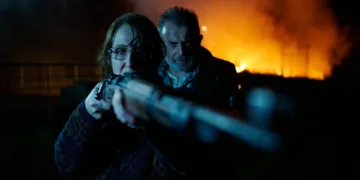
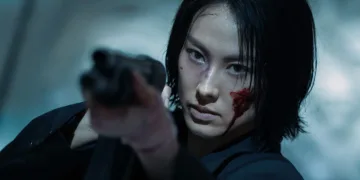








The modern action picture often reads like an argument about identity’s permanence and the genre’s refusal to allow its protagonists a genuine exit. James Nunn’s Wildcat sits squarely in that lineage. Kate Beckinsale plays Ada, a former operative of the blackest stripe who tried to negotiate a private treaty with the world and live under the quiet of ordinary life.
The treaty breaks. A crisis, brought on by the misjudgment of her brother Edward, shatters eight years of peace and returns Ada to a state of instrumentality. Her daughter Charlotte becomes the leverage that forces her back into the field. Ada must re-engage completely, assemble a hastily recruited mercenary trio, and carry out a high-risk heist while East London simmers in a gang war that turns the city into a continuous zone of kinetic friction. The picture announces its priorities at once: speed and survival. It treats the present as a rushing imperative. The film frames events as forced regression; there is little room for deliberate choice.
Chronological Friction and The Genre’s Artifacts
At its narrative core Wildcat operates as a transaction in extremis. Crime lord Frasier Mahoney (Charles Dance) pushes Ada to secure a large sum, which requires stealing from his rival Christina Vine (Alice Krige). That setup reduces action to a zero-sum equation and powers a plot driven by necessity. Dee Dee (Dominic Burns), credited for the script, assembles the usual British crime archetypes. The bumbling relative appears as liability, the underworld bristles with eccentrically dangerous figures. These people function frequently as artifacts of the caper tradition rather than as fully lived persons.
Structurally the film proves inefficient. It drops the viewer into the middle of things but then interrupts the momentum with a string of temporal inserts. The time jumps—ten years prior, ten days past, ten hours ago—aim to supply context but end up resembling an overcomplicated map for what is, at base, a straight course. The exposition feels needlessly diagrammatic; the immediacy of the present emergency is traded for a historical accounting that could have been handled with more subtlety. A fast-moving hostage deadline keeps the mechanism running, so the film’s engine rarely stalls. The audience is hustled from incident to incident, which preserves a feverish sense of motion.
That velocity carries a dramatic price. Perpetual forward motion bars any deep excavation of emotional ground. Attempts to develop tragic backstories or lingering attachments register as data points, not as experiences the viewer can feel. The script introduces foundational traumas and residual affections and then moves on. As a result the action remains busy to the point of emotional flatness.
The citywide riot that frames the story functions mainly as urban camouflage, a useful cover for the team’s operation. Its scale and implied political resonance are abandoned in favor of immediate street-level conflict. The riot remains an atmospheric filter over the heist, a large event reduced to a small, local variable.
The Director’s Gaze and the Kinetic Body
Nunn shows technical competence and an ability to stretch a mid-tier action budget into effective set pieces. The action sequences mount the film’s strongest case for existence. They are engineered with rigorous attention to timing and motion, producing a tangible kinetic charge. Nunn favors what might be called professional cinematic violence, often using clean, over-the-shoulder tracking shots that mimic the immersive first-person feel common to certain video game aesthetics. The camera navigates cramped, ruined interiors and urban decay, treating the environment as a continuous obstacle course.
Inside that apparatus the difference between performers’ physical contributions becomes clear. Lewis Tan’s Roman is a visible martial artist who performs difficult stunts; his grounded athleticism lends authenticity to his scenes. Sequences such as a tense fight in a carpentry workshop stand as exemplary close-quarters combat direction.
Beckinsale supplies emotional heft but often cedes the most demanding physical moments to a double; her face is obscured or angled away during complex choreography. That visual split creates a minor but persistent dissonance: the branded star presence sits alongside an unexposed bodily performance. The film thus exposes a contemporary split in action practice between mythic celebrity and genuine physical authorship.
Production values suit the film’s class. Wildcat looks polished without suggesting cheapness. At times the production leans on computer-generated blood effects that undermine attempts at gritty realism; those digital splashes read as shorthand and detract from the physical violence that the staging otherwise pursues. The direction renders the whole as a smoothly functioning machine. The machine privileges forward motion and leaves little space for reflection.
Trauma, Tropes, and the Disposable Star
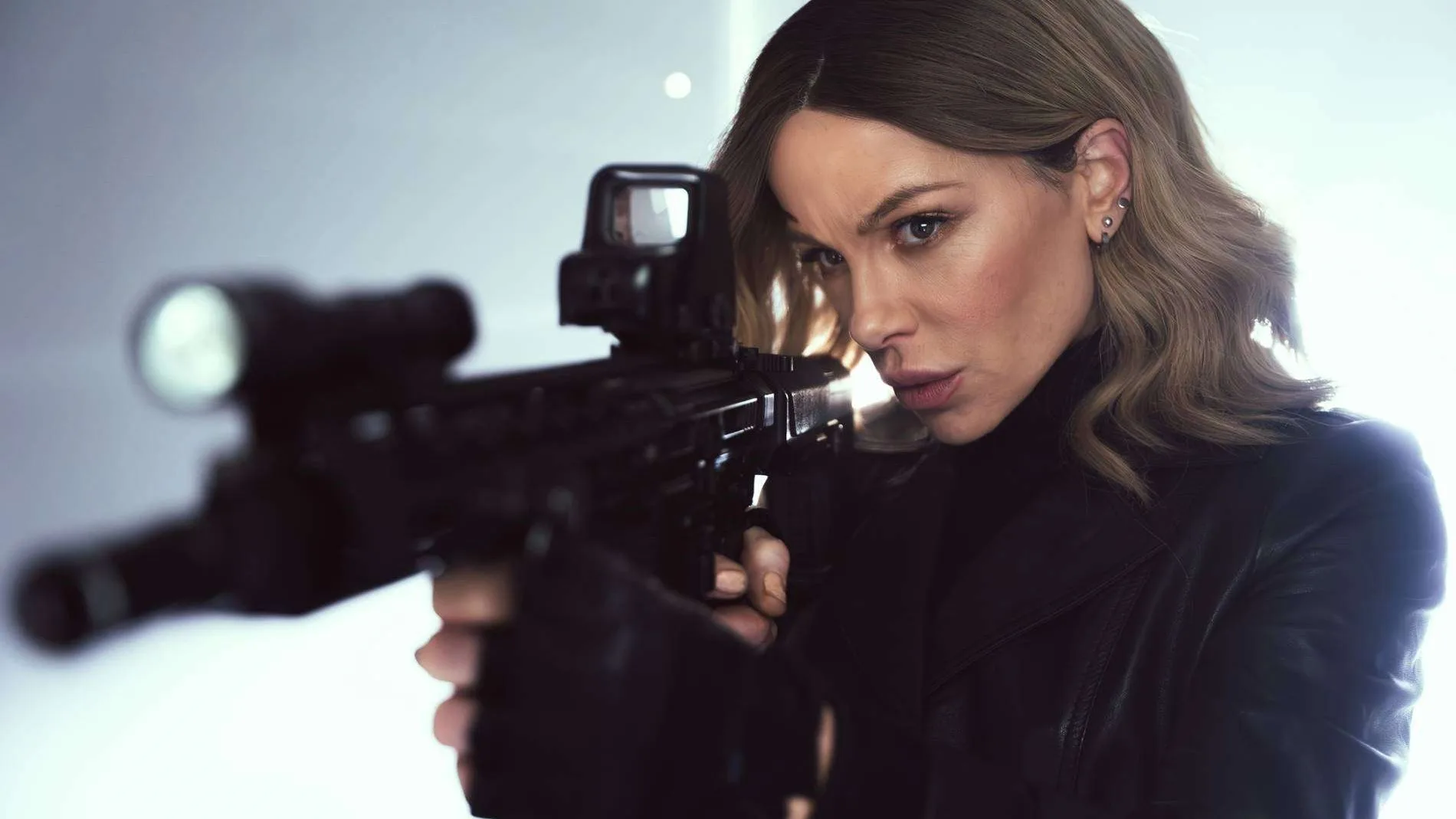
Beckinsale returns to a familiar archetype: the cool, capable fighter driven by a single imperative. She brings necessary gravitas and a physical literacy to Ada. Her most affecting moments occur when the hardened mask cracks and the primal anxiety of a mother fighting for her child becomes visible. That vulnerability anchors the film’s emotional hope.
Rasmus Hardiker’s Edward introduces notable dramatic friction. His role is to be the irresponsible catalyst for the plot. The script gestures at childhood trauma and PTSD as the wellspring of his recklessness. The film, however, struggles to reconcile the buffoonish aspects of his behavior with the claim of psychological consequence. Edward slides between being a necessary plot irritant and being a figure of genuine suffering; the tonal uncertainty suggests the script sensed thematic weight but lacked the room or patience to examine it fully.
The movie also underuses some potent talent. Charles Dance and Alice Krige are cast as unexamined villains who supply menace without a chance to display fuller range. They function as mechanical parts in the genre’s engine. That pattern of employing veteran actors in quick-service action roles raises questions about talent utilization across the current media landscape. On an interpersonal level the relationships are thinly constructed.
The past romantic history between Ada and Roman and the fractured loyalty between Ada and Edward are offered as background facts. The action’s pace prevents those anchors from accumulating sufficient moral or emotional heft to make the characters’ sacrifices feel earned. The performers do diligent work; the skeletal construction of their bonds remains an obstacle.
Tonal Ambivalence and The Failed Political Stage
The film presses on a clear thematic impulse: maternal defense, the collapse of a precarious peace when the most sacred bond is threatened. Ada’s eight years of civilian anonymity prove fragile and temporary. That primal defense motive carries real emotional force.
The aesthetic ambition of the filmmakers is uncertain. They layer a dark, serious theme with a light, quippy humor drawn from British crime playbooks. The film opens with a comedic slant that uses slang and caricature for levity. As the hostage scenario deepens the tone abruptly shifts to earnest drama. The two modes collide without finding a coherent synthesis, and the result is dramatic confusion. Viewers may be unsure how to register key moments because the humorous and the dire sit at odds, never settling into a unified effect.
The riot setting, again, fails to function as a political stage. The chaos in East London, with its implied social disorder, never operates as a meaningful backdrop; it stays a logistical convenience for the heist. Wildcat is a competent action picture. It runs smoothly and supplies ephemeral entertainment fit for casual viewing. It meets genre expectations adequately, and that steady professionalism prevents the film from securing a lasting intellectual or emotional impression. The picture functions as a well-made item of serviceable action cinema that, regrettably, feels disposable.
Wildcat is an action thriller directed by James Nunn, known for his work on the One Shot franchise. The movie, which was previously known as Lioness, stars Kate Beckinsale as Ada, a former black-ops operative forced out of retirement to execute a dangerous heist in London and rescue her kidnapped daughter. The film was acquired for a theatrical and digital release by Aura Entertainment and is scheduled to be released in the United States on November 25, 2025.
Full Credits
Title: Wildcat
Distributor: Aura Entertainment
Release date: November 25, 2025
Director: James Nunn
Writers: Dominic Burns
Producers and Executive Producers: Dominic Burns, Mark Lane, Crawford Anderson-Dillon, James Harris, Christian Mercuri
Cast: Kate Beckinsale, Lewis Tan, Rasmus Hardiker, Alice Krige, Charles Dance, Bailey Patrick, Tom Bennett, Matt Willis
Director of Photography (Cinematographer): Maja Zamojda
The Review
Wildcat
The action sequences in James Nunn's film are staged with technical excellence, providing immediate, high-octane entertainment. Kate Beckinsale delivers the necessary maternal desperation, anchoring the urgency of the plot. However, the narrative is handicapped by structural clutter and a crippling inability to sustain emotional depth for its characters. The ambitious tonal fusion of serious drama and quip-heavy crime comedy results in ambivalence. This is a slick, competently made action vehicle that satisfies the genre's minimum requirement, yet offers little substance to warrant lasting consideration.
PROS
- Kinetically strong action sequences, staged with professional precision.
- Director James Nunn's proficient handling of technical execution.
- Lewis Tan's highly authentic and strong physical performance.
- Kate Beckinsale's grounding presence and affective maternal vulnerability.
CONS
- Muddled narrative structure employing unnecessary time jumps.
- Lack of character and relationship development due to relentless pacing.
- Tonal inconsistency between dark drama and slapstick British crime humor.
- Underutilization of talented supporting actors like Charles Dance and Alice Krige.
- Reliance on a stunt double for the lead actor's complex fight choreography.