















The shot rests on a lined face, every pore and bruise of stubble held in pitiless focus, the folds at the eyes deepening into a study of tenderness and severity. That dual register marks Drew Friedman. Kevin Dougherty’s documentary, Drew Friedman: Vermeer of the Borscht Belt, maps the artist’s life, influence, and style with steady attention to his place in American illustration and cartooning.
Friedman’s art occupies a precise register. He builds painstaking portraits of figures often labeled obsolete or marginal, the “Old Jewish Comedians” and other overlooked showbiz personalities with eloquent faces. His hand is unmistakable, a calibrated balance of exacting realism and deliberate grotesque.
The title signals the productive paradox at work, casting a chronicler of niche, nearly forgotten subjects in the light of a Dutch master. The film traces a career defined by devotion to people the culture tends to discard and shows how that devotion shaped his stature.
Portrait of the Obsessive
Friedman drew obsessively from childhood, a drive nourished by a family tied to publishing, with memories that include meeting Groucho Marx at a young age. The film situates him near the alternative comics scene with appearances by Robert Crumb, yet it marks a different personal history. The portrait that emerges is steady and assured, grounded in support that gave him confidence.
The camera studies process. We watch a method that shifts over time. A style treasured by clients becomes difficult under commercial deadlines, which forces adjustments in technique. His subjects remain constant: showbusiness relics, rugged faces, and figures from another era.
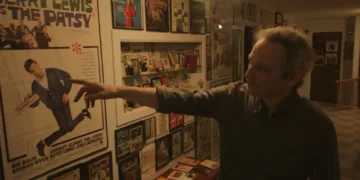
This constancy fuels his reputation and threads through assignments for The New Yorker, Mad Magazine, and High Times. A large share of the running time unfolds inside his personal archive, the “Jewseum,” where shelves and drawers frame an open view of influences and sources that animate the drawings.
Voices of Veneration
An array of comedians, actors, and artists describes Friedman’s stature. The late Gilbert Gottfried, Marc Maron, Patton Oswalt, Richard Kind, Mike Judge, and Robert Crumb appear, joined by screenwriters Scott Alexander and Larry Karaszewski. Their comments link the drawings to a long continuum of comedy and pop culture that his work catalogs with meticulous care. Mike Judge offers the neat epigram: “There are artists, and then there is Drew Friedman.”
These voices chart a fervent fandom around his work. The film reads as a valentine to that form of devotion, the feeling of “being a fan” made visible. Gottfried’s presence carries special charge, a frequent subject whose unmistakable force sets the tone. There is clear pleasure in watching writers known for chronicling Hollywood’s second row praise an artist who paints with care the performers usually left at the edges.
A Question of Cohesion
At about an hour, the film plays like a brief biography. The length narrows the field, and the result often feels like a deluxe featurette or an excellent DVD extra rather than a wide survey. Structural and technical choices heighten that impression.
Momentum falters. Cuts arrive mid sentence and mid interview, breaking rhythm and thought. Some image composites hide parts of interview subjects. Edits that pause or rewind for comedy blunt the seriousness of the material. Several passages show Friedman paging through books without the commentary the moment seems to request. Access to the studio gives welcome proximity, yet the film trades away narrative depth. The documentary also sidesteps expected friction points and leaves unaddressed the well known Joe Franklin lawsuit, even with a wealth of participants and material at hand.
Drew Friedman: Vermeer of the Borscht Belt is a documentary that traces the evolution of artist Drew Friedman, chronicling his career from underground comics to his notable work on the cover of The New Yorker. Friedman is celebrated for his unique, highly detailed portraits of forgotten Hollywood stars, old Jewish comedians, and figures from pop culture’s margins, captured with a blend of hyper-realism and caricature. The film, directed by Kevin Dougherty, features interviews with many of Friedman’s contemporaries and fans from the world of comedy and art. The documentary was widely available on digital platforms starting in September 2025 and can be streamed or rented through major platforms such as Apple TV and Amazon Video, and is available for free streaming on Hoopla.
Credits
Title: Drew Friedman: Vermeer of the Borscht Belt
Distributor: Shout! Studios
Release date: April 1, 2024 (Earliest US release date found), September 23, 2025 (Digital and On Demand release)
Running time: 56 minutes
Director: Kevin Dougherty
Writers: Kevin Dougherty
Producers and Executive Producers: Jordan Bochanis, Giancarlo Cairella, Walter Dickinson, William Dikel, Kevin Dougherty
Cast: Drew Friedman, Gilbert Gottfried, Richard Kind, Mike Judge, Marc Maron, Leonard Maltin, Robert Crumb, Patton Oswalt, Scott Alexander, Larry Karaszewski, Merrill Markoe, Eddie Gorodetsky, Bruce Jay Friedman, Owen Kline, Kaz, Kliph Nesteroff
Editors: Kevin Dougherty
The Review
Drew Friedman: Vermeer of the Borscht Belt
This documentary offers invaluable, intimate access to the genius of cartoonist Drew Friedman and features an inspired cast of cultural commentators. It succeeds as a loving tribute to fandom and a master artist's unique aesthetic. The film is undermined, however, by severe structural flaws, including erratic editing and a pacing that constantly disrupts narrative momentum. It is a necessary watch for dedicated admirers, though its brevity and lack of focus prevent it from becoming the definitive document this artist deserves.
PROS
- Intimate, unguarded access to Drew Friedman and his artistic process.
- The inclusion of high-profile, insightful cultural commentators.
- Celebrates a unique subject: the art of affectionate, detailed caricature.
CONS
- Erratic, disjointed editing that frequently disrupts the conversational flow.
- Short running time, making the film feel like an incomplete account.
- Lacks a clear, coherent narrative arc.
- Misses opportunities to discuss pivotal career events.