































María Silvia Esteve’s documentary Mailin studies memory and institutional inertia with a clinical patience that feels almost forensic. The film follows Mailin Gobbo, who lives with the shadow of fifteen years of sexual abuse by Father Carlos Eduardo José, a priest who maintained an image of holiness inside her Argentinian community. Esteve spends eight years building the trust needed for this level of proximity and shapes a portrait of survival that feels both fragile and unyielding.
Mailin’s present struggle unfolds along two axes: she attempts to recover memories buried by trauma while also pursuing legal accountability inside a system that shields the aggressor. That system includes the Catholic Church and a state apparatus quick to invoke the “statute-barred” technicality to discard cases, including hers and those of many other victims. Mailin records a determined process of healing that runs alongside an ongoing confrontation with failure, as she searches for strength for herself and for her daughter.
The Architecture of Fragmented Truth
The film adopts a structural duality that moves far away from straightforward expository non-fiction. One strand tracks Mailin’s dealings with courts and Church authorities in Rome and Argentina, a procedural march toward punitive justice. The other strand leans into a poetic, experimental register. Mailin recounts her story to her young daughter, Ona, through a dark bedtime tale about a girl and an evil beast, carefully shaped for a child’s ear.

This fable operates as a sustained, haunting counterpoint to the institutional scenes. Esteve layers these narratives to treat memory as a shifting construction rather than a fixed archive. Images fracture and distort, echoing the psychological fragmentation that trauma leaves behind; remembering appears as a frantic attempt to reach an “unreachable” past.
The film poses a philosophical question in very concrete terms: how does a person reassemble a coherent self after core identity has been shattered. The family unit, especially Mailin’s mother, Mónica, and her sister, Michelle, wrestle with their own silence and guilt, asking themselves how they failed to perceive the horror unfolding inside their home.
Around them stands an institutional landscape marked by corruption, where justice bends toward legalistic technicalities and retreats behind procedures. Some monsters speak through scripture and statute at the same time, and the film leaves that idea hanging with a bleak clarity.
Expressionism in the Archive
Esteve’s visual method avoids simple testimonial recording and draws from the vocabulary of expressionistic psychological thriller. The camera works on Mailin’s interior life through careful manipulation of images. Childhood home videos slow down, reverse, and replay; this technical dissection of the past pulls out small, previously hidden signs of discomfort. The sequence resembles a film noir investigation of evidence, with the witness and the evidence bound together in one body.
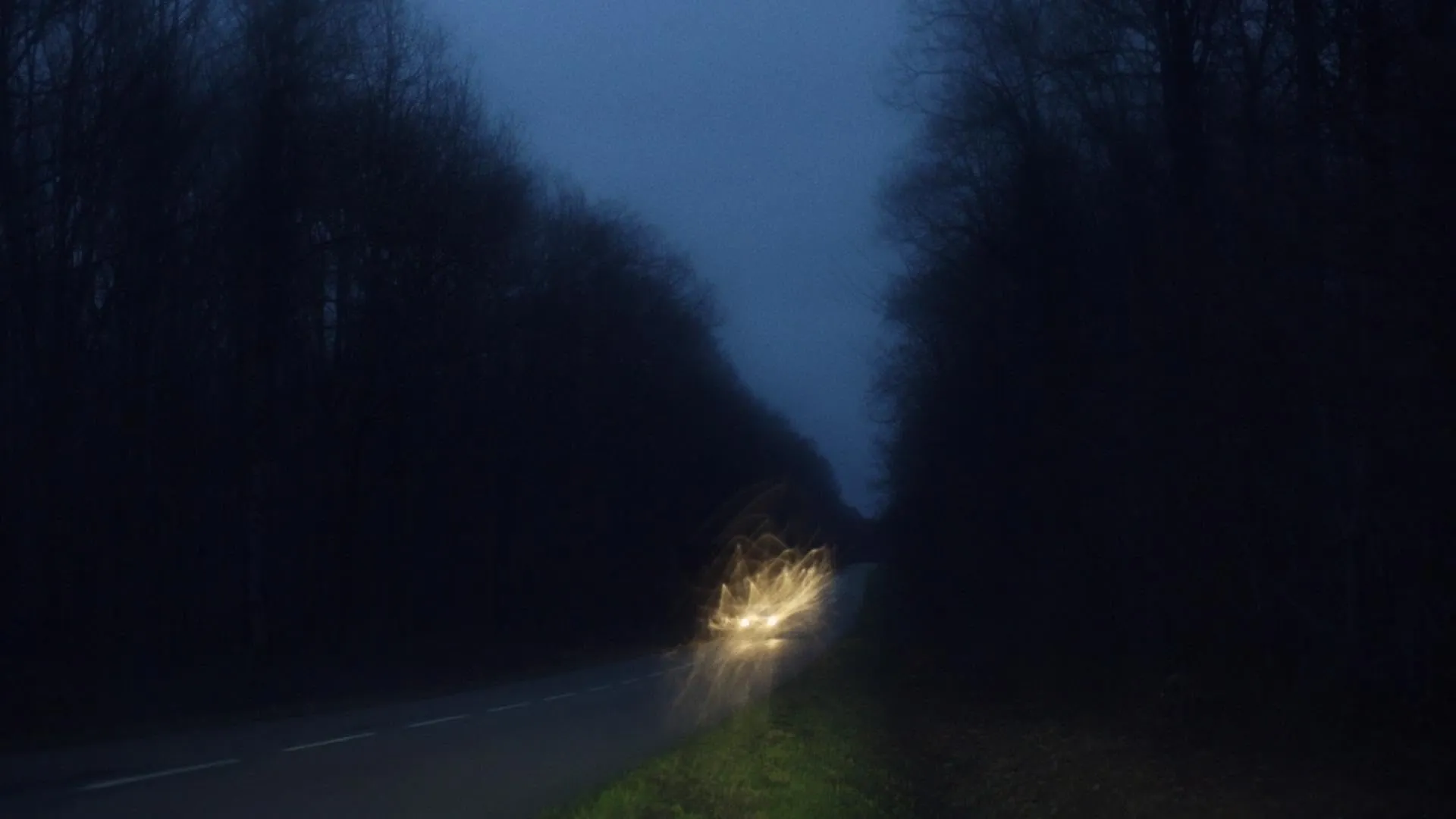
Abstract and jarring visuals, such as the screen seeming to rupture or the sky appearing to tear apart, operate as external signs of a damaged inner landscape. A swimming pool, which might suggest leisure in another context, recurs as a site of concentrated, buried unease.
In scenes of direct confrontation, the camera locks into sustained close-ups of Mailin’s face, recording quiet endurance without relief. Over these images, the soundtrack carries the harrowing audio of her courtroom cross-examinations. The friction between still, watchful images and hostile institutional language creates a powerful form of subjective representation and turns bureaucratic injustice into visceral sensation.
Sound and rhythm guide the viewer’s reactions with calculated precision. The repetition of certain visual motifs and the stark alternation between private spaces and institutional environments shape tension and fatigue in the body of the spectator. When Mailin meets the lens with a steady gaze, often paired with those courtroom audio fragments, she addresses more than court officials or the filmmaker. The stare lands on the audience and functions as an accusation.
The Calculus of Will and Retribution
Mailin’s willpower anchors the film’s existential charge. Her motivation grows from a sharp ethical turn: she wants to break a chain of generational trauma for her daughter. She seeks “her own motherhood” by confronting a past that also hovered over her mother and grandmother.

The film locates its central moral argument in this effort. Mailin faces institutions built from protection and denial, yet her pursuit retains an almost voracious energy. The camera records both her bravery and her pronounced vulnerability, crystalized in a moment where she releases a “primal scream of rage.” That outcry exposes the physical and emotional cost of resisting entrenched authority.
Her personal search for retribution expands into a shared struggle with startling speed. Mailin carries the weight of accountability for thirty-five other women whose cases the legal system dismissed. Her voice becomes a “vivid, vital testimony” that cuts through a long-established silence. The film’s greatest achievement lies in its record of her attempt to “rewrite a story,” a complex act of public reckoning and personal empowerment that tries to force justice into existence through unbending will.
Mailin is an Argentinian, French, and Romanian co-production that premiered in November 2025 at the International Documentary Film Festival Amsterdam (IDFA). The documentary follows Mailin Gobbo as she attempts to recover fragmented memories of childhood sexual abuse inflicted by a Catholic priest and fights for legal justice against institutional protection. While the film has secured world sales through The Party Film Sales, its general theatrical release schedule is slated for 2025. As of today, November 23, 2025, specific streaming or digital platforms for watching the film have not yet been announced; viewers should anticipate it appearing on arthouse streamers or through specialized distributors soon.
Full Credits
- Title: Mailin
- Distributor: The Party Film Sales (World Sales), HANA Films, Ikki Films, deFilm
- Release date: November 2025 (IDFA Premiere)
- Running time: 89 minutes
- Director: María Silvia Esteve
- Writers: María Silvia Esteve
- Producers and Executive Producers: María Silvia Esteve, Alejandra López, Cristina Hanes, Radu Stancu
- Cast: Mailin Gobbo, Michelle Gobbo, Mónica Villafañe, Ona, Augusto Pablo Gobbo
- Director of Photography (Cinematographer): María Silvia Esteve, Andrea Cabrera, Victor R Caivano
- Editors: María Silvia Esteve
- Composer: María Silvia Esteve, Ieronim Pogorilovschi, Codrin Lazar
The Review
Mailin
Mailin is a technically brilliant and emotionally devastating study of resilience. Esteve reframes the testimonial documentary as a psychological excavation, using expressionistic visuals and fractured chronology to mirror the reality of trauma. The film’s greatest strength is its technical proficiency in blending the legal procedural with the dark, personal fairy tale. It stands as a powerful indictment of institutional failures and an essential, if harrowing, account of one woman's refusal to concede her truth. It is cinema as an act of will.
PROS
- Innovative narrative structure that effectively blends legal non-fiction with poetic metaphor.
- Exceptional technical craft; sophisticated use of cinematography, lighting, and sound to convey psychological states.
- Profound, sensitive handling of trauma and the fragmentation of memory.
- Mailin Gobbo’s powerful presence anchors the entire experience.
- A necessary, urgent document on institutional accountability and systemic corruption.
CONS
- The subject matter is relentlessly intense and emotionally challenging.
- The abstract, expressionistic segments may be difficult for some viewers to process.







