

























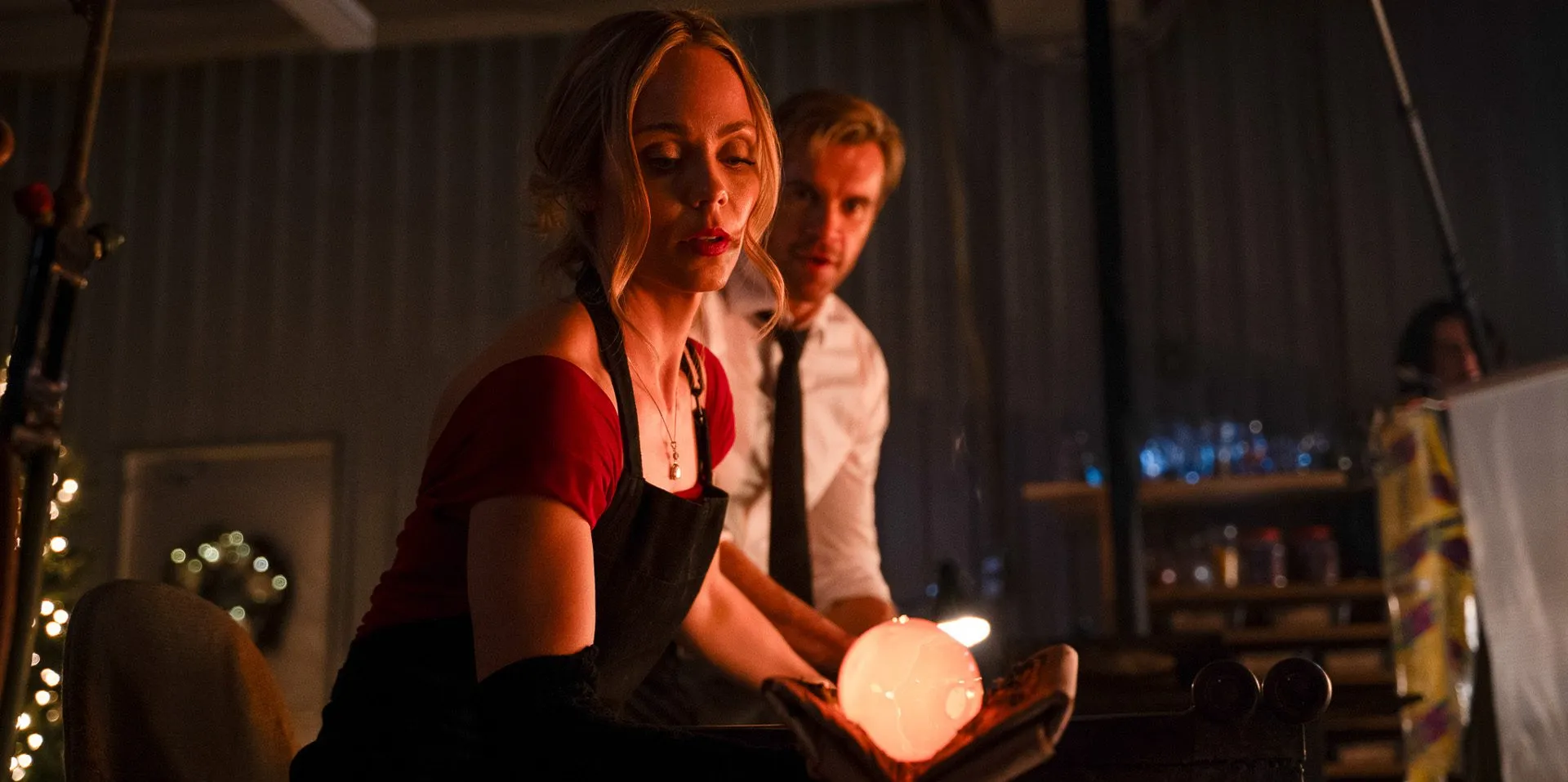

Melt My Heart This Christmas presents itself as a holiday romantic comedy-drama, yet it behaves more like a quietly odd study of professional validation and the harsh math of small-scale craft. The annual Fern Grove Christmas Fair functions as a seasonal marketplace where sentimentality meets spreadsheets.
Holly James (Laura Vandervoort), a focused glassblower, lives inside a very contemporary fear: the belief that skill only counts once the crowd approves it. She is refused a stall at the fair. The key plot device arrives when she accepts a temporary job as assistant to Bianca Bonhomme (Jennifer Wigmore), a glass artist installed as the fair’s main attraction.
The arrangement is strictly economic and quietly subversive. Holly supplies labor in public and art in secret, slipping her own pieces into circulation under the alias Verre Glass. At the same time, Jack Dubois (Stephen Huszar), the conscientious fair organizer, stares down inherited financial collapse; his family name sits on the line, tied entirely to a single season’s profit margin. The film relies on a fragile combination of hidden authorship and inherited ritual.
The Tyranny of Taste and the Glass Ceiling
The most striking creative choice lies in the emphasis on glassblowing, a discipline built around heat, timing, and the controlled reshaping of matter into something both fragile and durable. The work inside the kiln appears only briefly, yet the finished pieces, bright and polished, become Holly’s calling card and the film’s visual anchor. This attention to a niche craft gives the story a precise professional texture that stands apart from the usual cookie-cutter festive jobs.
Bianca initially appears as the designated obstacle, a demanding, diva-style employer whose sharpness is meant to keep the plot moving (her early scenes play like a less amusing echo of the cinematic fashion tyrant type). That surface soon receives a more vulnerable explanation. Bianca’s crisis functions as a small-scale fable about the artist bending to market judgment. After a reviewer dismissed her earlier work as “loud,” she abandoned her bold signature style for “safe, clear pieces,” which now sink at the cash register. She turns into an emblem of self-censorship in the arts, trapped by one external opinion.
This pairing, the emerging talent who still trusts her instincts in the workshop and the veteran who now doubts her own taste, drives the film far more strongly than any flirtation. Their connection moves from servitude and competitive tension to the possibility of partnership built around honesty in the studio. The theme that arises, artistic integrity pressed against commercial fear, has surprising weight for a Christmas movie.
Also Read






The Heroic Deficit
The planned romantic arc between Holly and Jack Dubois, the man running the fair, feels like an afterthought. The early sparring, framed as snappy irritation intended to echo an “enemies to lovers” template, produces almost no spark. The relationship remains flat and indistinct.
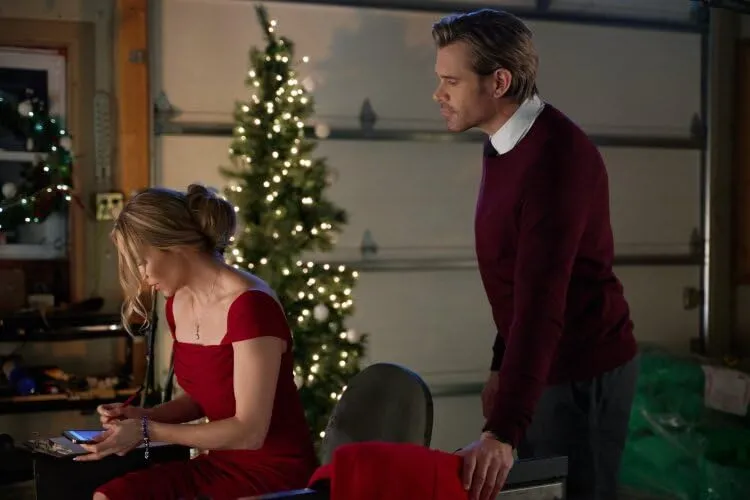
Jack operates as the least defined presence in the film’s structure. The more absorbing professional drama between Holly and Bianca pushes him to the edge of the frame. He exists primarily through his financial worries about the fair. At times he cannot clear the basic bar for a genre lead; he occasionally fails to stand up for Holly and sometimes even joins in the criticism of her position.
For a character designed to rescue the fair and secure the romance, he carries the exasperating air of a man who keeps missing the point. His role in the final stretch is practical, not emotional. He manages the crisis of the Fern Grove Christmas Fair and the threatened sale of the property, a worn-out storyline that appears here mainly to inflate the stakes of his personal narrative.
The Commitment to Chroma
From a technical perspective, the film offers pleasant imagery. The Christmas market setting provides a postcard-ready environment that suits the expectations of the genre, even as it leans into a staged, “Hallmark-y” gloss. The glass pieces bring a genuinely striking element that adds a tactile spark to the production.
The actors lift the material beyond its basic script. Laura Vandervoort gives Holly a brisk, energetic presence that keeps the audience aligned with her ambitions. Jennifer Wigmore stands out in particular. Her performance as Bianca supplies humor, gravity, and a sense of bruised pride to a role that might have stayed at the level of cartoon villainy. She plays the cracks in Bianca’s certainty and lets the insecurity show through.
The film maintains a cozy, mildly absorbing mood. The narrative structure feels familiar, yet the attention to the work lives of its artists lends a distinctive professional angle. The central impression is clear. The film operates effectively as a career-focused piece about ambition and mentorship inside a Christmas fair. It falls short as a romantic comedy, since the love story never quite stirs any real emotion. The result is a split personality: a satisfying portrait of creative persistence wrapped in a romance that feels perfunctory.
Melt My Heart This Christmas is a holiday romantic comedy that premiered on the Hallmark Channel on Sunday, November 23, 2025, as part of its annual Countdown to Christmas programming event. The film centers on Holly James, a talented glassblower who is determined to get her work into a prestigious Christmas fair. She takes a job assisting her artistic idol, a diva who has lost her creative spark, while falling for the charming, uptight fair organizer, Jack Dubois, who is desperately trying to save his family’s legacy. The movie can be watched on the Hallmark Channel and is available for streaming the next day on Hallmark+.
Full Credits
Title: Melt My Heart This Christmas
Distributor: Hallmark Channel
Release Date: Sunday, November 23, 2025
Rating: TV-G
Running Time: Approximately 84 minutes
Director: Amy Force
Writers: Ansley Gordon
Producers and Executive Producers: Lex Emanuel, Sebastian Battro (Producers)
Cast: Laura Vandervoort, Stephen Huszar, Jennifer Wigmore, Madeline Leon, Darrin Baker, John Koensgen
Director of Photography (Cinematographer): Russ Howard III
Composer: Russ Howard III
The Review
Melt My Heart This Christmas
The film is best understood as a professional drama thinly disguised as a romance. While it delivers an engaging, well-acted narrative about artistic validation and the pain of creative defeat, the relationship between Holly and Jack lacks the necessary fervor to melt any viewer's heart. Its compelling focus on glassblowing and the excellent character arc given to the "villain" Bianca warrants attention. However, viewers seeking an incandescent love story will find the central pairing disappointingly tepid. The film offers a solid, if predictable, holiday comfort watch.
PROS
- The specific exploration of glassblowing provides a fresh, visually interesting backdrop.
- The rivalry and eventual alliance between Holly and Bianca is the most compelling and dramatically rich storyline.
- Her portrayal of Bianca, moving from diva to self-aware artist, is nuanced and adds unexpected depth.
- The film maintains a quaint, visually appealing holiday market setting.
CONS
- Holly and Jack lack genuine chemistry, making the romantic pairing unconvincing.
- Jack is a less interesting character than the two female leads, fading into the background.
- The fair's financial distress and the grandfather's ultimatum are formulaic elements.