





























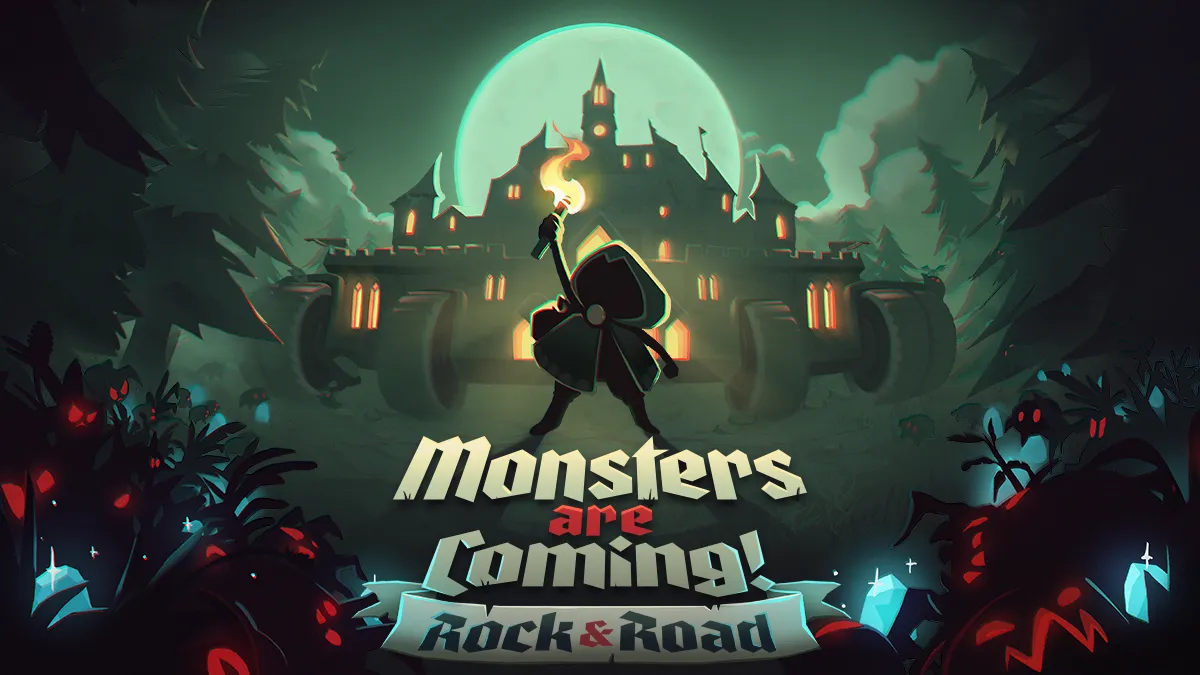

Monsters are Coming! Rock & Road lays out its premise quickly. Shadowy forces have swept across the world, and humanity clings to a distant hope called The Ark. The last survivors have fixed their settlement onto a gigantic mobile platform and sent it rolling toward that sanctuary. The game builds its identity from a mix of horde survival bullet-heaven action, tower defense construction, and roguelite structure.
Each run focuses on one task: keep the colossal, wheeled Town Hall intact as it moves along a fixed route. The player pilots a small, expendable Hero whose tasks cover gathering resources, clearing the way forward, and helping in combat whenever the City’s defenses start to strain. Players who enjoy indie bullet-heaven and tower defense roguelites will recognize the pattern of agile movement feeding into slow, methodical growth of a city build.
Dual Management: Hero and City
The loop demands attention to two layers at once. On the field, the Hero echoes bullet-heaven shooters, attacking automatically while weaving through clusters of enemies. The hero scoops up XP gems dropped by fallen foes; those gems do not strengthen the hero directly, and they instead drive the City’s main upgrade ladder.
The same character handles material gathering by ramming into destructible scenery to collect Wood, Stone, and Gold. These resources only count once they reach the Town Hall, which turns each banking run into a decision about risk and distance. Depositing resources fuels obstacle removal and progression along the road. The hero can afford to fall in battle; death carries a small grid penalty for the City and is followed by an instant respawn. The structure places the City, not the avatar, in the position of central piece and failure point, which matches the caravan’s role as humanity’s last shelter.
City Defense and Progression ties that focus together. The mobile settlement functions as both the central objective and the loss condition for each attempt. Once its HP hits zero, the run stops. Leveling up depends on the XP that the hero has delivered, and each level offers a choice between defensive or supportive structures.
Towers, ballistae, and generators act as the main sources of firepower, firing at regular intervals without direct input. Resource decisions shape how long that defense holds. Wood boosts the City’s rate of fire, Stone repairs damage on demand, and Gold sits in reserve for expensive purchases or for healing at Safe Zones that appear along the route.
Architectural Adaptability and Synergy
Rock & Road’s strategic weight sits in the City Building layer. The Town Hall carries a central grid that accepts modular constructions. Adjacency is not mandatory for every plan, yet thoughtful positioning carries real value. The mobile fortress must fire in all directions because enemies attack from every side, even as the caravan moves forward.
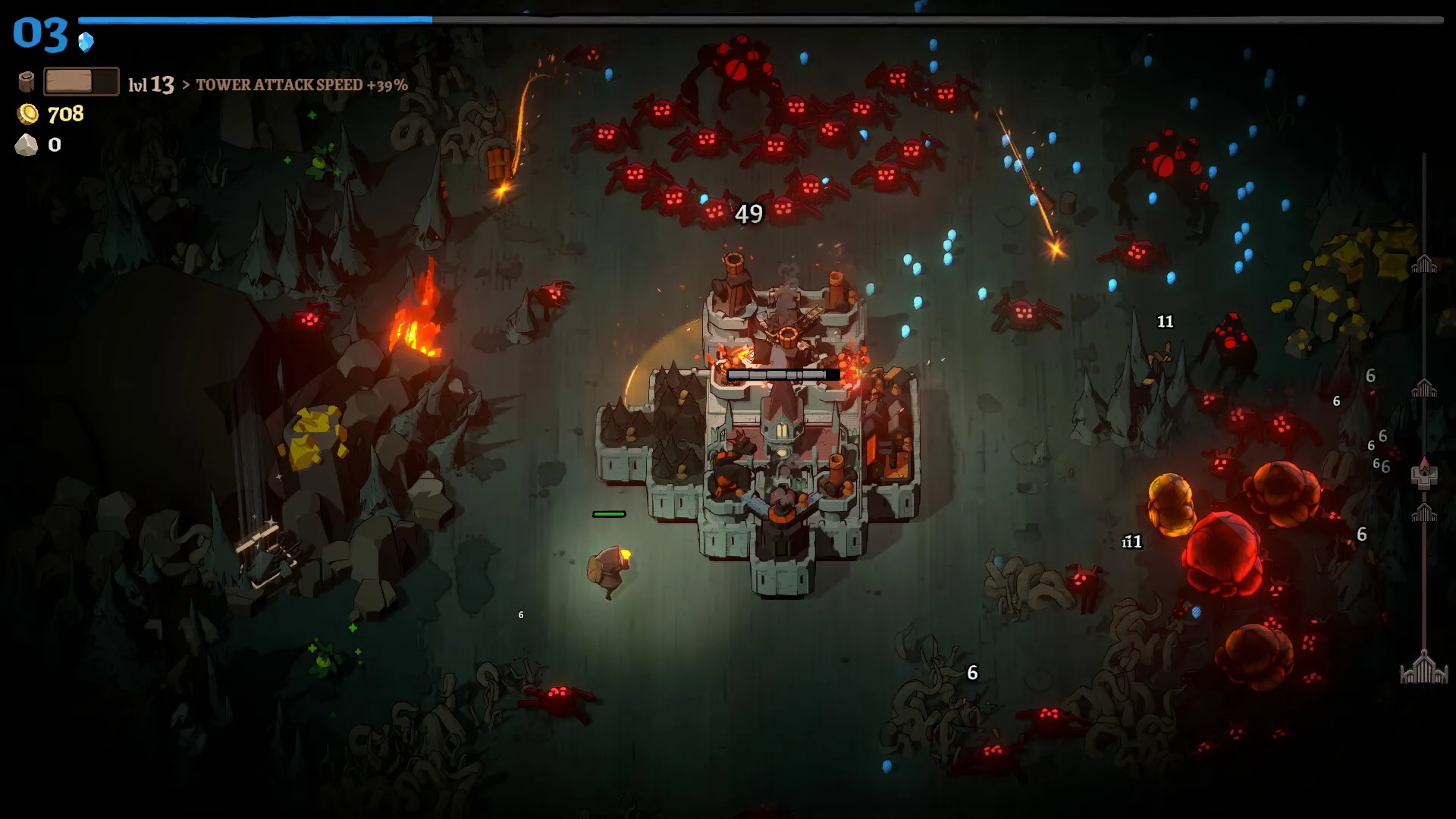
Players mix short-range turrets on the edges of the layout with long-range options such as mortars and ballistae closer to the core. Size versus Mobility becomes a constant trade-off. A broad, heavily armed layout increases damage output, while the extra bulk makes it easier for the Town Hall to scrape against scenery and stall. That friction pressures the hero to carve a clear route quickly.
Synergies and Buffs introduce the most nuanced layer of interaction. Placement translates directly into power. Certain buildings grant Adjacency Bonuses that raise the damage of surrounding towers. Chain Bonuses appear when players link multiple stat farms, turning a few tiles into a stacking field of buffs. Elemental and Minion Synergies deepen that puzzle.
One example pairs an ice weapon that freezes enemies with a fire tower that hits those slowed targets for far higher impact. City Type multiplies that complexity from the very start of a run. Mirror City doubles every building placement, opening up wide patterns, while City of Ashes rewires the XP economy so that resource harvesting becomes the key source, replacing monster kills. Each City Type pushes the player toward a different plan for path clearing, offense, and support.
The Loop: Progression and Adaptation
Rock & Road favors brisk sessions that stay under the thirty-minute mark. Each run moves through discrete waves of enemies that lead into Safe Zone Checkpoints. At these pauses, players adjust the hero’s weapon, spend Gold in a shop to upgrade the City, and take part in short resource collection minigames.

The roguelite spine rests on the Randomization of building choices granted at level-up. Early strategies never feel locked, because future levels may only offer structures that lean heavily into fire and ice effects or focus on minions and gold generation.
Each successful push along the road ends with an End-of-Run Challenge against a colossal, Kaiju-style boss. One boss requires quick demolition of nearby scenery to break its invulnerability, so the hero must switch from direct combat to gathering work on short notice. Between runs, Permanent Progression systems hold attention.
Points awarded for distance traveled convert into lasting percentage buffs for both hero and City attributes. Players also Unlock extra City Types and weapons, which expand the pool of possibilities that the Randomization can draw from. Reaching The Ark grants that specific City Immortality and turns it into a mark of success, encouraging repeated attempts until all ten starting cities have made the trip.
Content Depth and the Difficulty Curve
Rock & Road ships with four Difficulty Levels. Normal mode provides an approachable entry point, while the jump to Hard marks a sharp rise in challenge. That spike highlights an underlying design expectation around Persistent Upgrades. To stay effective at the higher settings, players need to spend time farming those accumulated bonuses. The requirement for steady grinding can feel tiring for fans of roguelites that lean more heavily on pure skill growth than on statistical stacking.

The campaign runs across four Environments or Roads: Elder Wood, Ice, Sand, and Ashes. Each road brings a distinct look, from terrain color to atmospheric details. Monster design does not shift as much between these tracks, which softens the impact of those visual changes.
Replay Value stays strong elsewhere. The game encourages repeat sessions through the task of finishing runs with all ten Town Halls, meeting the specific conditions that Unlock every building, and climbing into the upper tiers of difficulty.
Visual Identity and Soundtrack
Monsters are Coming! Rock & Road adopts an Art Style that sets cute, finely drawn overworld elements against a crowd of shadowy, red-eyed creatures. Visual spectacle rises during late-run defenses, when the City spits out layer after layer of effects such as ice beams, fire bursts, and whirring saws, turning each wave into a dense display of destruction.

City and Tower Design reinforces the sense of long-term construction, since structures shift and expand visually as they rank up. The Soundtrack supports the action with strong musical backing. Music tracks stay tied to the four road themes, so repeated play on a single environment can cause those tunes to blur together through repetition.
The Review
Monsters are Coming! Rock & Road
The game successfully merges auto-shooter action with deep, moving tower defense strategy. The constant need to manage the hero, resources, and city placement creates a highly compelling loop. Unlocking new city types and mastering complex building synergies provides significant depth and ensures runs feel distinct. While the progression requires some mandatory grinding for higher difficulties, and the visual variety of enemies is limited, the core mechanical achievement is exceptional. This title offers immense replayability and strategic satisfaction.
PROS
- Successful and dynamic combination of bullet-heaven action and strategic tower defense.
- Complex building placement, adjacency bonuses, and elemental/minion synergies allow for highly optimized builds.
- Multiple unlockable Town Halls fundamentally change the starting strategy and core mechanics of each run.
- Robust meta-game upgrades ensure every run contributes to long-term power.
- Bitesized runs (under 30 minutes) are highly addictive and easily digestible.
- Charming art style and intense visual spectacle during late-game defense.
CONS
- Significant and potentially jarring leap in challenge between Normal and Hard difficulties.
- Mandatory need to farm permanent upgrades to successfully handle higher difficulty tiers can feel wearisome.
- Limited variety in monster visuals across the four different environment types.
- Soundtrack is tied to specific levels, leading to repetitive music during multiple runs on the same road.