












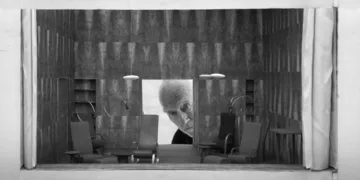














Safe House (2025), directed by Jaimie Marshall, delivers a sleek, efficient action thriller with a clear sense of tempo. At ninety minutes, the movie commits to momentum from its first frames, opening on a major terrorist strike in downtown Los Angeles that targets a Vice Presidential convoy. The jolt of that sequence announces a straightforward promise: high-velocity storytelling that prioritizes propulsion and clarity.
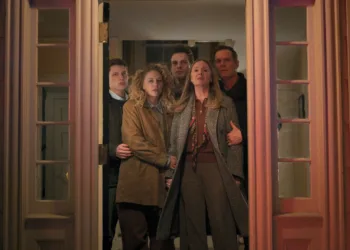
The shock of the attack tightens into a contained scenario that gathers six federal agents from different arms of the government, including the Department of Defense, Homeland Security, and Langley, inside a fortified safe house. Agent Choi carries a cryptic device known as “the Soccer Ball,” and the supposed sanctuary turns into a pressure cooker once a superior reports that a detonator signal has been traced to the building. Everyone becomes a suspect.
The setup frames a dual challenge. The agents must hold off waves of mercenaries while working out which colleague has betrayed them. Isolation becomes both a tactical obstacle and a psychological trigger, compressing the film into a study of suspicion.
The Paranoia of the Locked Room
Six armed professionals boxed into one location creates a sturdy engine for tension. Confinement has powered great courtroom stories and many stage pieces for a reason. Limited space accelerates collision. The format fits this project, which treats the safe house like a chessboard where every square carries risk.
As the minutes tick by, trust erodes and nerves fray. Each agent guards a career built on secrets, so every exchange carries a second layer. The result feels like a watchful game, one where the audience scans posture and cadence for tells. Character types sharpen the friction. Agent Sorello plays the hair-trigger instigator, ready to turn argument into confrontation.
Agent Halton arrives with a grizzled authority that hints at knowledge beyond the official line. Marshall and screenwriter Leon Langford keep the question of guilt alive through red herrings and double bluffs, then spring a final reveal that lands with impact, even if the timing feels rushed. I kept thinking about how compact thrillers reflect the attention economy we live in. Shorter features meet a cultural appetite for lean narratives, and this film embraces that appetite without apology.
Kinetic Action and Technical Execution
Marshall’s background in second unit work on large productions shows in the control of movement and geography. A modest budget becomes an asset once the story collapses into the safe house, and the pace benefits from constant action that still reads cleanly. The Los Angeles assault sets a big-canvas tone, then the film wisely miniaturizes that scale, trading wide destruction for room-to-room urgency.

Inside the building, the action shifts gears with regularity. Bone-cracking fights, snap gun battles, and breaches through windows and ceilings keep the setting alive. The physicality has bite and speed. The hand-to-hand work stands out, and the emphasis on actors performing their own stunts gives the danger a tactile edge. I am a sucker for well-cut punch rhythms, probably a holdover from late-night VHS marathons of compact Hong Kong brawlers, and the timing here scratches that itch.
The images look clean and purposeful, a credit to cinematographer Michael Merriman. Digital effects occasionally reveal the scale of the production, yet they hold the line for momentum. The smartest technical choice lies in how set pieces integrate with space. The film treats hallways, stairwells, and offices like instruments, and it keeps playing new notes.
Ensemble Energy and Character Hurdles
The cast injects energy into material that favors function over deep shading. Lewis Tan’s work as Agent Choi leads with athletic confidence. He commands the physical center of the movie and reads as a capable action lead. Holt McCallany gives Agent Halton weight the second he appears, and that gravity steadies several exchanges.
Hannah John-Kamen’s Agent Owens lands with focus, though the writing gives her fewer layers than the performance suggests. Lucien Laviscount plays Anderson, the safe house operator whose routine collapses, and he sells the shock of that reversal.
The script keeps the agents sketched in quick strokes. Personality traits drive behavior more than history or contradiction. Attempts to add feeling through brief conversations about the pasts of Owens and Anderson ring familiar and lack specificity. Agent Sorello often functions as comic relief, and the levity undercuts the menace in a few key moments.
The film still satisfies as a disciplined genre piece, yet the character work caps the ceiling. There is a version of this story that lets the locked room format turn biography into strategy. This one prefers acceleration, and it stays true to that choice.
Safe House fits neatly into a run of compact, single-location thrillers that speak to production pragmatism and audience habits. Independent and mainstream projects keep borrowing from each other in this lane. You can feel a studio polish in the clarity of action beats, and you can feel indie discipline in the focus on space, bodies, and timing. That mix gives the movie its snap. The craft decisions align with a cultural moment that rewards immediacy, and the film’s design leans into that reality with confidence.
Safe House centers on a group of federal agents who find themselves locked in a high-security safe house after a terrorist attack, with the added threat that one of them is an internal mole. The movie had a limited theatrical release in the United States on October 31, 2025, distributed by Vertical Entertainment. As of the current date, it may be available in select theaters, on digital platforms, or on-demand, though specific streaming availability should be checked via current listings. The film has a running time of 90 minutes.
Credits
Title: Safe House
Distributor: Vertical Entertainment
Release date: October 31, 2025
Running time: 90 minutes
Director: Jamie Marshall
Writers: Leon Langford
Producers and Executive Producers: Nicolas Chartier, Tim Sullivan, Lucas Jarach, Brian Pitt, Jonathan Deckter, Timothy C. Sullivan
Cast: Lucien Laviscount, Hannah John-Kamen, Ethan Embry, Lewis Tan, Holt McCallany, Adam Levy, Michael Bradway, Brett Cullen
Director of Photography (Cinematographer): Michael Merriman
Editors: Tommy Aagaard, Evan Schrodek
Composer: Sam Ewing
The Review
Safe House
Safe House is a textbook example of a proficient genre film. Director Jaimie Marshall delivers a taut, kinetic thriller that maximizes its single-location premise and short runtime. The action sequences are well-executed and brutal, providing immediate, visceral excitement. However, the film struggles to develop its talented ensemble cast beyond basic archetypes. While the "locked room" tension is compelling, the thin character writing and occasional reliance on cliché prevent it from becoming a memorable standout. It is an entertaining watch, but ultimately feels like a capable sketch of a greater movie.
PROS
- Relentless pacing and efficient 90-minute runtime.
- Effective "locked room" whodunnit premise that builds paranoia.
- Intense and well-choreographed physical action sequences.
- Strong, capable performances from the ensemble cast, particularly Lewis Tan and Holt McCallany.
- Director Jaimie Marshall's skilled approach to maximizing a modest budget.
CONS
- Thin character writing that relies on rough sketches rather than depth.
- Clichéd and forced emotional dialogue in certain relationship scenes.
- The final traitor reveal is somewhat predictable and rushed.
- Uneven quality in the visual effects.
- Certain characters, like Agent Sorello, lean too far toward cartoonish relief.