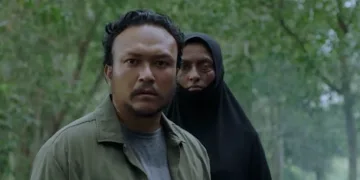




























The groan of an aging engine hangs over a remote mountain road while a man strains to wrestle it back to life. The image fixes the gaze and opens the door to Indera. Director Woo Ming Jin, celebrated for Stone Turtle, turns to a period horror drama with a cooler pulse and a sharper edge than much contemporary Southeast Asian horror.
The story follows Joe, a debt-burdened single father, and Sofia, his mute daughter whose silence shapes every frame she enters. Their hardship pushes Joe toward a handyman job deep in the mountains under a Javanese woman who supervises several children. The year is 1985, and the landscape carries the charge of the Memali Incident, a climate of curfew and suspicion that seeps into daily life. History thickens the air around the characters and shades the supernatural unease with political anxiety.
The Weight of the Past
Dread gathers through patience. The film turns on two veiled questions: the 1970s car crash that took Joe’s wife and the hidden nature of the mountain community. Woo Ming Jin spaces out the answers with steady control, inviting the audience to sift through fragments of private memory and local lore. The 1985 setting tied to the Memali Incident sharpens this search.
Curfew rules and wary policing echo through the plot, linking public unrest to the personal terrors stalking these lives. The film draws on Javanese traditions and Malaysian experience, giving the fear a cultural footing that feels specific and lived-in. Its argument revolves around crime and punishment, with the phrase “sins of the parents torment their children” serving as a moral key.
Joe’s knotted remorse and Sofia’s silence read as scars of unresolved damage, and their bond holds the film’s philosophical chill. The strands tighten toward the end, where a brutal act lands with force and a final image shocks with clarity. The thread involving the children occasionally follows familiar genre paths, yet it supports the film’s dark, unified design.
Light and Longing
Saifuddin Musa’s images carry a wintry temperature that steadies the mood. The camera treats the mountain mansion and a malicious well like presences that watch from the edge of the frame. A striking choice places most of the terror under daylight.

By withholding the cover of night, the film sustains unease across open, sunlit spaces and avoids easy jolts from darkness or shadow. Woo Ming Jin directs with restraint, favoring tone and suspense over cheap startles, and the result offers a thoughtful genre piece for viewers who want classical frights paired with intellectual bite.
Editing by Wong Kai Yun and Yap Xhian Way supports the film’s measured cadence. Momentum holds, with a few pauses that hint at a leaner cut which could tighten the nerves without thinning the ideas. Craft choices align to make the fear feel earned and lingering.
Portraits of Anguish
Performance gives the film its weight. Shaheizy Sam shapes Joe as a man pulled between duty and buried guilt, his quiet exterior interrupted by surges of pain. The flashbacks that expose the source of that pain mark a peak in his work.
Samara Kenzo plays Sofia with clarity, speaking through gesture and gaze to carry the burden of her condition. Azira Shafinaz, as Joe’s wife, leaves a mark in pivotal moments that sketch the couple’s shared past. The casting secures the stakes and steadies the final stretch, where character and theme lock together with conviction.
Indera is a Malaysian horror film released in 2024 and directed by Woo Ming Jin. The story follows a debt-ridden man named Joe and his non-verbal daughter, Sophia, who move to a remote village after a tragic accident. Joe takes a job as a handyman for a mysterious Javanese woman who promises to help Sophia, but the two soon begin experiencing terrifying visions. Set against the real-life 1985 Memali Incident, the film blends folk horror with historical and political tension. It had its international premiere at film festivals in July 2024 and was released theatrically in Malaysia on August 7, 2025. You may be able to watch it at film festivals or through its distributor, which is often GSC Movies in Malaysia.
Credits
Title: Indera
Distributor: GSC Movies, Lomo Pictures
Release date: July 2024 (International Premiere), August 7, 2025 (Malaysia)
Rating: 13
Running time: 1 hour 45 minutes
Director: Woo Ming Jin
Writers: Woo Ming Jin, Deo Mahameru, Muzzamer Rahman
Producers and Executive Producers: Woo Ming Jin, Aron Koh, Kervis Soo, Chew Ban Heng, Stewart Low, Samantha Chong, Calvin Lim, Kathy Yang, Edmond Kuek, Ken Tey, Frank Lim, Peter Wong Kok Wai
Cast: Shaheizy Sam, Azira Shafinaz, Samara Kenzo, Ruminah Sidek, Adlin Aman Ramlie, Mia Deen, Duerra Mitilda, Shahfi Rafiq, Mubarak Majid
Director of Photography (Cinematographer): Saifuddin Musa
Editors: Wong Kai Yun, Yap Xhian Way
Composer: Chapavich Temnitikul
The Review
Indera
Indera provides a thoughtful, mood-driven approach to the horror genre. Woo Ming Jin successfully merges deep personal trauma with the volatile setting of 1985 Malaysia. The film's technical execution and committed performances create a sustained sense of dread, favoring patient suspense over momentary scares. It stands as a sophisticated exploration of inherited guilt and historical pain, making it a valuable addition to contemporary Asian cinema.
PROS
- Priority on atmosphere and sustained suspense.
- Effective merger of personal trauma with historical context.
- Chilly, distinctive cinematography.
- Strong, convincing lead performance by Shaheizy Sam.
- Impressive, shocking climax and thematic convergence.
CONS
- Slight delay in pacing; could benefit from trimming.
- The arc involving the children is occasionally conventional.
- The focus on historical atmosphere may divide some viewers.