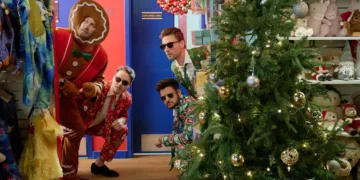























“I don’t like how that bird talked to my brother,” Taylor announces from inside a police station, wearing a Christmas costume that makes the scene feel even stranger. The line lands near the end of one of Three Wisest Men’s comic detours and captures the film’s mix of absurdity and family anxiety. Luke (Andrew Walker), Taylor (Tyler Hynes), and Stephan (Paul Campbell) once again gather under the Brenners’ childhood roof, a place they have never left behind.
As the third, and possibly final, chapter in this series, the story heightens the Brenner brothers’ stalemate with adulthood. A burst pipe, impending twins, and a cross-country job offer pile up into a domestic storm that drives the siblings back to the one fixed point in their lives, the home of their mother Barbara (Margaret Colin).
The reunion collides with Barbara’s announcement that she plans to sell the house, which pushes the brothers into an all-consuming attempt to stage the legendary Best Christmas Ever (BCE). The movie spins frantic set pieces together with tender exchanges, creating a holiday film that feels lively and emotionally grounded.
Fraternal Flaws and Maternal Anchor
Much of the film’s pleasure lies in watching three handsome men stumble through their own shortcomings. The “wisest” label reads as a running joke. Luke, a fire chief and soon-to-be father of three, wrestles with questions of competence, his uncertainty surfacing in anxious attempts to parent his young son Thomas.

Stephan’s route to the altar meets resistance from his fiancé Susie’s disapproving father Bob, whose skepticism about Stephan intensifies after an incident involving Bob’s escaped cockatiel. Taylor still lives at home and must measure a promising job in San Francisco against the comfort of lifelong family routines. That opportunity carries the added complication of his ex-girlfriend Fiona, who is involved in the new venture and turns the potential move into a knot of professional and romantic stakes.
Inside this swirl stands Margaret Colin’s Barbara. She functions as the primary emotional anchor, her performance giving the chaos weight and texture. She hands out firm truths with clear affection, and that combination of sharpness and warmth keeps the film from slipping into pure cartoon. The connection among Colin, Walker, Hynes, and Campbell feels lived-in. Their scenes together suggest years of shared holidays and old arguments, and their charm grows from an ongoing, good-natured failure to step fully into adulthood.
The Grammar of Holiday Mayhem
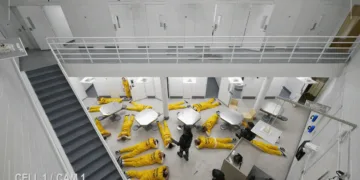
Three Wisest Men builds its comedy on unrestrained holiday chaos. The film leans into big, brazen situations that echo classic family Christmas blowups while holding tight to a gentle mood. A frantic scramble for a must-have toy, the chain of mistakes that lands the brothers in a jail cell, and the escalating fiascos around the runaway bird all arrive with careful timing and clear design for laughter. The noise of these set pieces feels purposeful, because the brothers commit completely to the BCE mission and treat their checklist like a duty.
The script, credited to Paul Campbell and Kimberley Sustad, understands why audiences show up for this series. The writing lands oversized jokes and then lets the characters sit quietly with their worries. It pays attention to relationships, crafting exchanges that feel warm and specific.
One scene in which Barbara speaks about the memory of the brothers’ absent father gives the movie a moment of steady feeling that lingers beneath the slapstick. Returning director Terry Ingram keeps the pace brisk and the tone consistent with earlier films, and the sense of cast and crew enjoyment carries through the finished work.
Facing Change, Finding Home
The planned sale of the Brenners’ house shapes the movie’s emotional framework. That decision forces Luke, Taylor, and Stephan to face how much they rely on a building that has sheltered their reluctance to grow up. Each brother stands at the edge of a choice that demands genuine responsibility.
Stephan moves toward marriage, Luke toward a larger family, Taylor toward a life that requires independence and a different city. The potential loss of the house functions as a trigger, pushing them away from their familiar misfit status and into lives that require courage instead of retreat.
The film presents holiday spirit and family connection as forces that extend beyond this home. Their bond has enough strength to stretch beyond that address, and the worth of Christmas appears in the time they choose to dedicate to one another.
Audience attachment to Three Wisest Men grows from this portrait of likable people who try and fail in public to be the ideal partner, parent, or son and who keep trying anyway. As a possible final chapter, the movie serves as an affectionate closing mark on the Brenner story, leaving room for viewers to imagine future chaotic holidays for this family.
Three Wisest Men premiered on November 15, 2025, as part of the Hallmark Channel’s annual “Countdown to Christmas” programming event. This movie is the third installment in the popular Brenner brothers series. As a Hallmark original film, it typically airs on the Hallmark Channel and becomes available for streaming on the Hallmark Movies Now subscription platform the following day.
Credits
Title: Three Wisest Men
Distributor: Hallmark Channel
Release date: November 15, 2025
Rating: TV-G
Running time: 1 hour 24 minutes (84 minutes)
Director: Terry Ingram
Writers: Paul Campbell, Kimberley Sustad, Russell Hainline
Producers and Executive Producers: Shawn Williamson, Paul Campbell, Kimberley Sustad, Andrew Walker, Kevin Leslie, Samantha Di Francesco, Jamie Goehring, Trevor Belcourt
Cast: Andrew Walker, Tyler Hynes, Paul Campbell, Margaret Colin, Miles Marthaller, Nicole Major, Fiona Vroom, Erin Karpluk, Matt Hamilton, Lochlyn Munro, Kimberley Sustad, Ali Liebert, Christopher Shyer
Director of Photography (Cinematographer): Ryan McMaster
Editors: Andrew May
Composer: Jeff Toyne
The Review
Three Wisest Men
The film succeeds by leaning into the chaotic energy of its returning cast while deepening the emotional reality of the Brenner family. The script skillfully balances broad situational comedy—featuring runaway birds and a jail stint—with genuine stakes, fueled by Barbara’s anchoring performance. This is a hilarious, high-stakes conclusion that honors the series' established mix of vulnerability and humor, proving that adulting is an ongoing, messy process, especially during the holidays.
PROS
- The core quartet of Andrew Walker, Tyler Hynes, Paul Campbell, and Margaret Colin displays palpable, natural family chemistry.
- Margaret Colin's performance as Barbara provides essential emotional depth, grounding the film's wilder comedic moments with warmth and realism.
- The writing effectively blends rapid-fire situational comedy with moments of genuine, realistic relational honesty.
- The film offers a satisfying conclusion to the brothers' journey, tackling themes of maturation and the evolving meaning of "home."
CONS
- Some plot points rely heavily on extreme, almost slapstick scenarios (e.g., the specific antics of the bird, the jail scene) that might feel overly contrived.
- The "chaotic family holiday that teaches the real meaning of Christmas" structure is standard holiday fare.
- The pace is consistently high, which, while fun, might feel overwhelming during prolonged periods of conflict.