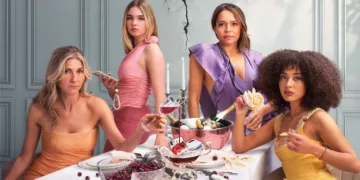























The contemporary thriller Wild Cherry drops viewers into Richford Lake, an insulated, hyper-wealthy enclave in leafy Surrey, where British upper-class manners collide with a distinctly Americanised sense of excess. Across six episodes, the series adopts a glossy, soap-inflected visual style that recalls the architecture of prestige dramas such as Big Little Lies.
It mixes the high-stakes secrets of well-off parents with the risky, always-online existence of their teenage daughters. From the outset, the show insists on its darker intentions, opening with a flash-forward of four women scrubbing blood from their hands, a stylised omen of violence that hangs over everything that follows.
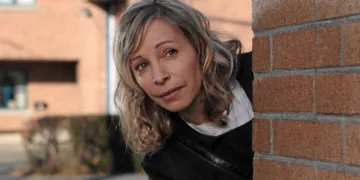
The story follows two intertwined mother-daughter pairs. Juliet (Eve Best) is an “old money” parenting expert, author of How To Parent Your Teens – PS, They Can Be Your Best Friends, and she lives with her influencer-obsessed daughter, Allegra (Amelia May). Juliet’s closest friend, Lorna (Carmen Ejogo), is a self-made business powerhouse raising her daughter Grace (Imogen Faires). Tension erupts once the girls’ elite private school hears rumours of a deleted “lewd video,” which forces both women to confront their daughters’ biggest secret: a provocative rating app known as “The Catalogue”.
The Digital Divide and the Privilege of Denial
Wild Cherry aligns itself with a growing television interest in “eat-the-rich” storytelling, using the extravagant wealth of Richford Lake as a vehicle for social criticism. The show’s fixation on designer interiors, high-end clothing, and spotless mansions highlights how far these families have drifted from ordinary life. Privilege appears as armour.
Juliet, the “old money” author, calls on her family’s resources to silence the school scandal, and the plot shows how financial power helps her sidestep accountability. Within this gated world, social issues remain background noise until they threaten social standing.
That distance from reality shapes the way these mothers raise their children. Juliet’s advertised “BFF” approach to parenting emerges as an act of denial once her daughter’s toxic behaviour comes into focus. Both Juliet and Lorna, regardless of class origin, struggle to grasp the full truth of their daughters’ lives. The show sketches a sharp generational divide: the mothers carry their own concealed “skeletons” and find it difficult to bring those histories into honest conversation with their daughters’ choices.
“The Catalogue” functions as the drama’s central engine, a digital-age reworking of the high school “Burn Book.” This fictional app invites teenagers to upload and rate provocative images. The device captures the corrosive side of contemporary social media, where peer approval and public validation become addictive. What begins as performance for the camera quickly slides into material that others can use for leverage and harassment, with potentially severe fallout for the girls who participate, including the missing friend, Iris.
Casting Choices and Cultural Commentary
The series gains considerable force from its leads. Eve Best’s Juliet embodies an image-conscious strand of inherited wealth, a woman whose professional persona shows clear signs of strain. Carmen Ejogo’s Lorna plays the successful outsider chasing full acceptance in a community that quietly reminds her of its unwritten rules.

The teenage characters inject an uneasy charge into each episode. Amelia May makes Allegra believably spoiled and calculating, a teenager shaped by constant exposure to public feedback. The tight, co-dependent relationship between Allegra and Grace (Imogen Faires) captures the intensity of contemporary teenage girl friendships, with loyalty and rivalry existing side by side.
Nicôle Lecky, who serves as showrunner and writer, also steps in front of the camera as Gigi, an American lifestyle coach and recent arrival in Richford Lake. Gigi’s position allows Lecky to place an outsider’s eye inside this closed community, and her voiceover turns into a running commentary on a world she is eager to enter.
Through Gigi, the drama foregrounds questions of class and race, especially the subtle forms of exclusion she meets as the wealthy “new wife.” Lecky’s sharp dialogue keeps a careful balance between mystery and heightened soap, relying on irony to expose the contradictions of a strain of “white feminism” tied to this particular social tier.
Production and Streaming Age Aesthetics
Wild Cherry leans into high production values and a polished, high-gloss surface. The emphasis on luxurious costuming and interior design feels deliberate; the images themselves critique the culture they depict, stressing the materialism that defines Richford Lake. Repeated shots of beige, camel, and silky fabrics underline how carefully the characters curate their wardrobes, even as that surface poise feels precarious.
The six-part structure follows a mystery template, and the rhythm of the episodes uses the opening flash-forward and the later disappearance of Iris to sustain momentum. Thriller beats sit alongside social drama, so the series keeps a sense of urgency and avoids slipping into pure observation.
Another striking quality lies in the show’s Americanised tone, shaped by its glossy style and the presence of an American narrator. This creative choice aligns Wild Cherry with a wider shift in British television toward adopting high-budget, high-concept visual language associated with global streaming services while still telling a specifically British story. The mystery framework remains familiar, yet the series delivers engaging escapist entertainment that doubles as a pointed examination of privilege, packaged in the form of a domestic thriller.
Wild Cherry premiered on Saturday, November 15, 2025, on BBC One in the UK, with all six episodes immediately available to stream on BBC iPlayer. The series is a provocative thriller set in the ultra-wealthy, fictional gated community of Richford Lake. It explores the fracturing friendship between two mothers, Juliet (Eve Best) and Lorna (Carmen Ejogo), after their teenage daughters are implicated in a shocking scandal involving a secret social media app at their elite private school, shining a light on mother-daughter relationships, privilege, and the dark side of digital life.
Credits
Title: Wild Cherry
Distributor: BBC One, BBC iPlayer
Release date: Saturday, November 15, 2025
Rating: TV-MA
Running time: 6 episodes (Approx. 60 minutes each)
Director: Toby MacDonald
Writers: Nicôle Lecky
Producers and Executive Producers: Ado Yoshizaki Cassuto (Producer), Nicôle Lecky, Elizabeth Kilgarriff, Craig Holleworth, Lisa Walters (Executive Producers)
Cast: Eve Best, Carmen Ejogo, Amelia May, Imogen Faires, Nicôle Lecky, Sophie Winkleman, Daniel Lapaine, Hayat Kamille, Isabelle Allen, James Murray, Jason York, Katarina Čas, Nathaniel Martello-White, Sonita Henry, Tara Webb, Will Bagnall, Hugh Quarshie, Catriona Chandler
The Review
Wild Cherry
Wild Cherry successfully uses its glossy thriller framework to explore the dark consequences of extreme wealth and digital scrutiny. The series is highly entertaining, leveraging strong performances, particularly from Eve Best and Carmen Ejogo, to anchor its soapy drama. While it offers a sharp critique of parental denial and social media toxicity, its focus remains on delivering escapist, high-stakes mystery. It's a compelling piece of television that capitalizes on current trends, confirming its status as bingeable, modern critique.
PROS
- Excellent anchoring by Eve Best and Carmen Ejogo.
- High-gloss visuals and fashion that enhance the "eat-the-rich" theme.
- Engages effectively with issues of social media toxicity and parental hypocrisy.
- The flash-forward structure and central mystery keep the pacing tight and addictive.
- Applies the big-budget, prestige thriller format to a unique Surrey setting.
CONS
- Follows familiar genre formulas (wealthy people with secrets) without wholly reinventing the wheel.
- The serious social commentary is sometimes overshadowed by the high-stakes soap opera elements.
- The blend of deep critique and high-camp glamour may feel uneven for some viewers.