































As I Began to Dream is a puzzle-adventure platformer from Indonesian developer Strayflux that opens in a quiet, heavy register. The story introduces Lily, a young girl whose family outing collapses into catastrophe. A simple walk with her parents turns horrifying when a sinister, dark force engulfs them, leaving Lily suddenly isolated and unmoored. Her attempt to move forward and understand what happened begins with the help of her stuffed turtle, which inexplicably starts to talk. This fantastical companion frames the premise clearly: the game follows a child trying to make sense of overwhelming grief.
Lily’s immediate goal is to find her parents, but the emotional center lies in her attempt to accept a new reality. The game leans on a hand-drawn watercolor style that gives each scene a soft, dreamlike quality, which fits its bittersweet, melancholic subject. In the vein of emotional platformers like Gris or Celeste, As I Began to Dream uses familiar platforming and puzzle structures to explore the crushing weight of loss. The experience is brief, yet it lingers because of the clarity with which it treats this emotional burden.
Symbolism, Grief, and Visual Language
Loss sits at the core of As I Began to Dream, and the game treats it through a child’s reliance on fantasy and memory. The narrative frame gives shape to this emotional process. Each environment Lily visits functions as a symbolic expression of grief, mapping loosely onto the classic DABDA model of Denial, Anger, Bargaining, Depression, and Acceptance. This approach recalls games like Psychonauts, where the world design serves as a psychological map of a character’s inner life.
The shifting worlds track Lily’s changing state of mind. Early on, she explores a zone built around a mythical civilization, defined by pyramid structures and a playful sense of wonder. That setting evokes early responses like Denial or Bargaining. Later, Lily moves into a corporate-adjacent space, where her psychic abilities temporarily disappear. This muted, dull-colored city feels heavy and oppressive and signals stages closer to Depression or Anger. These contrasts are direct yet avoid easy reduction; the presentation keeps Lily’s emotional path readable without draining it of complexity.
The hand-drawn, occasionally childlike art style reinforces this idea of memory frozen in time. The game treats the moment of recall as fixed and unchangeable, even when it includes dark entities and a talking turtle. Lily’s perception of her trauma is presented as real and valid, with the visual language giving those memories sharp edges. The watercolor look does not diminish the pain; the hurt comes through with force.
Sound design carries the same sensitivity. The soundtrack often pairs melancholy melodies with more adventurous rhythms. Gentle ambience colors the cavern sequences, while the seaside area feels curious and exploratory. The industrial zone opens with a bombastic musical surge that suggests the effort and strain involved in working through trauma. The absence of voice acting keeps the emotional load on the imagery and the score, letting the music and soundscape communicate directly.
The Psychic Puzzle Mechanic
As a 2D puzzle-platformer, As I Began to Dream builds its moment-to-moment play around straightforward traversal. The player guides Lily from one point to another, collecting keys in the form of yellow gems and clearing environmental obstacles. The standout mechanic is her psychic ability. She can activate this power only while standing on specific blue markers. From that fixed position, she can rotate or swap square chunks of the environment, effectively rearranging pieces of the level.

This structure allows Lily to create walkable paths or reposition objects and enemies. Puzzle setups usually involve only two or three tiles, which keeps every problem contained and readable. That tight scope gives the design a clean feel, especially in comparison to puzzle-platformers that rely heavily on repetitive crate-shoving or sprawling layouts. A key strength lies in how quickly a solution can be carried out.
Because Lily remains in place while manipulating the environment, there is no gap between solving a puzzle in your head and implementing it on screen. That instant feedback is satisfying and rewards patient thinking, and some of the more complex arrangements can be mentally plotted even when the player steps away from the keyboard or controller.
Standard hazards fill out these spaces. Pits, spikes, and shadowy creatures threaten Lily, and the tile system folds these threats into the problem-solving process. Certain shadow creatures carry keys attached to their backs, pushing players to reposition tiles in ways that expose, move, or defeat them. For players who want extra challenge, the game hides bonus orbs in some levels. Collecting these optional orbs presumably unlocks extra content or alternate endings, giving puzzle enthusiasts something more to chase.
Execution Flaws and Technical Resistance
Conceptually, the puzzle structure holds together well, but the execution undercuts that strength in several ways. The game expects careful, logical play, yet technical shortcomings often create difficulty that feels unfair rather than thoughtful.
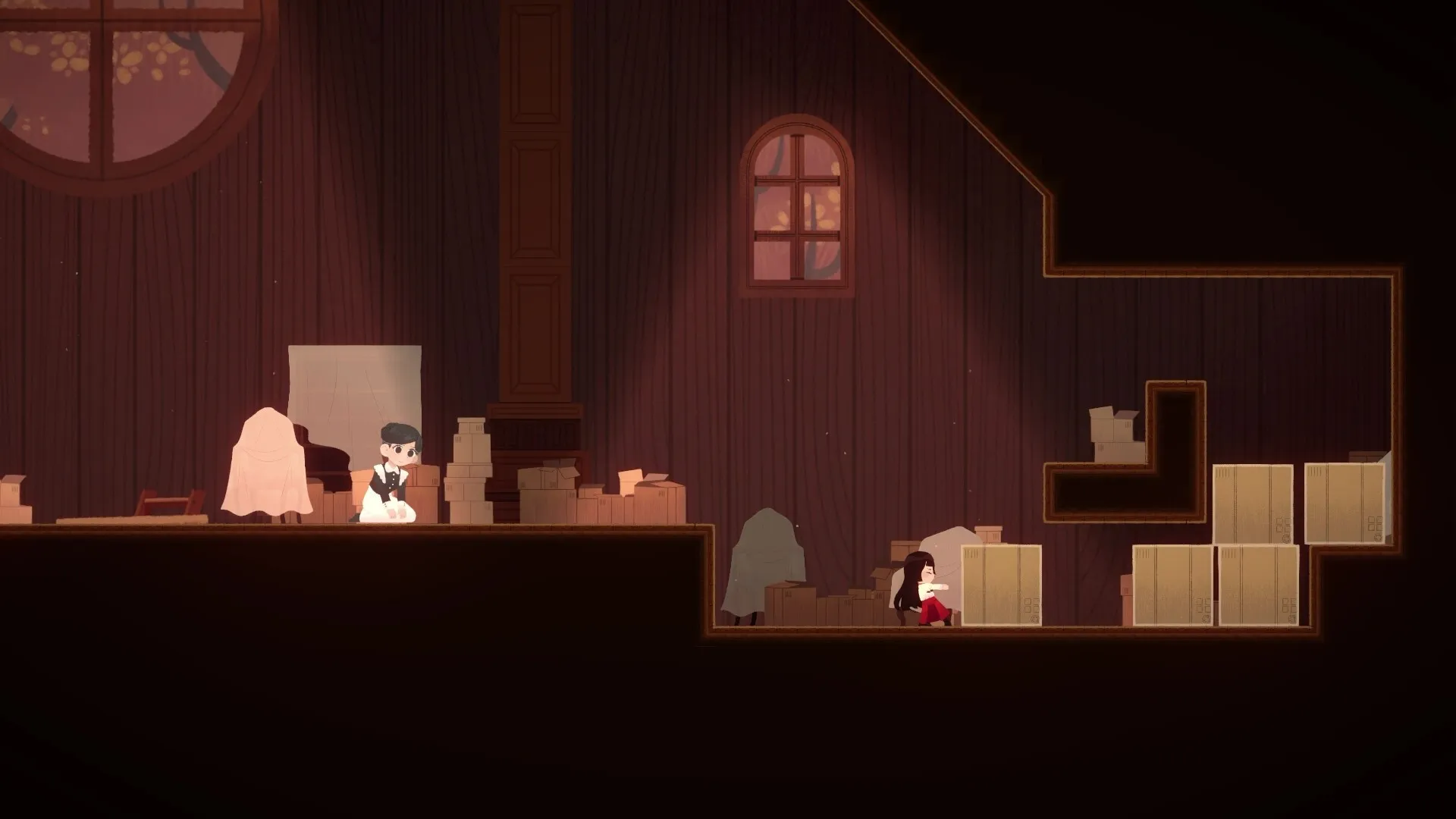
One major frustration stems from how rigid the solutions appear to be. A single mistake in a multi-step room can require a full reset of that space. Momentum collapses when a slight misstep sends the player back to the beginning of a complex sequence. This approach creates the sense of a single correct path through a room, and that rigidity feels harsher than in many physics-based platformers that allow partial recovery from errors.
The physics system also introduces problems. Lily occasionally needs to carry a glowing key orb. While holding it, she cannot jump, so she must throw it across gaps or up to ledges. The loose, unpredictable feel of the physics can cause the orb to stall unexpectedly or, in worse cases, clip into level geometry and become permanently stuck. These moments do not feel rare.
The grab mechanic for objects such as boxes used in platforming shares this instability; Lily can stop pushing or pulling a box even on flat terrain with no obvious cause. Situations like these interrupt the flow of play because the challenge shifts away from puzzle logic and toward wrestling with the underlying systems.
Even with these issues, Lily remains a striking lead character. Her bittersweet search for closure gives the game its emotional strength and keeps the experience memorable. Through her, As I Began to Dream speaks to the shared need to keep moving after a devastating loss and to find a path through that grief, no matter how fragile it feels.
The Review
As I Began to Dream
As I Began to Dream delivers a powerful, moving narrative on grief, beautifully supported by its symbolic art and poignant soundtrack. The core psychic puzzle mechanic is intellectually satisfying and immediately rewarding. However, inconsistent physics and frustrating technical glitches with object interaction frequently disrupt the flow, transforming solid mental challenges into mechanical struggles. It is a memorable, emotionally resonant experience hampered by technical execution flaws.
PROS
- Poignant, symbolic narrative structure
- Beautiful hand-drawn, watercolor visuals
- Satisfying, instant psychic puzzle mechanic
- Evocative, complementary soundtrack
CONS
- Inconsistent object physics
- Frustrating requirement for total room resets
- Clunky grab and movement mechanics
- Sometimes linear puzzle solutions